



By Jeremy B. Mazur
El Paso’s growing role in regional economic growth and international trade is a good Texas-Mexico border story. Its success, however, hinges on finding water in the desert.
Interestingly, this story starts with geopolitical instability abroad. China’s economic crisis, turbulence in the Middle East and the war in Ukraine have prompted many industries to bring their operations closer to or within the United States.
This phenomenon, known as “nearshoring,” offers the dividends of jobs, capital investment and economic growth for El Paso and its sister city Juárez across the Rio Grande in Mexico.
But several key ingredients are needed for making nearshoring work. Roberto Coronado, a Dallas Federal Reserve senior vice president and Texas 2036 board member, lists these ingredients as: available and affordable electricity, a qualified workforce and the availability of water.
Unsurprisingly, water is a big deal in El Paso. The city’s crown of dark brown mountains testify to its residence in the Southwestern desert.
Throughout 2024, the El Paso region has bounced between extreme and moderate drought conditions, according to the U.S. Drought Monitor. The last time the region was essentially drought-free was more that one year ago in early July 2023.
These seemingly perpetual drought conditions have affected the region’s most obvious available water source — the Rio Grande. As of today, the Elephant Butte reservoir, which stores surface water for the thirsty region, hovers at just 6.1% full.
But in a fascinating twist, local water leaders aim to sever their reliance on the Rio Grande.
With an eye toward securing reliable water supplies to support the region’s economy, El Paso Water has embarked on a path toward remarkable innovation and water supply portfolio diversification.
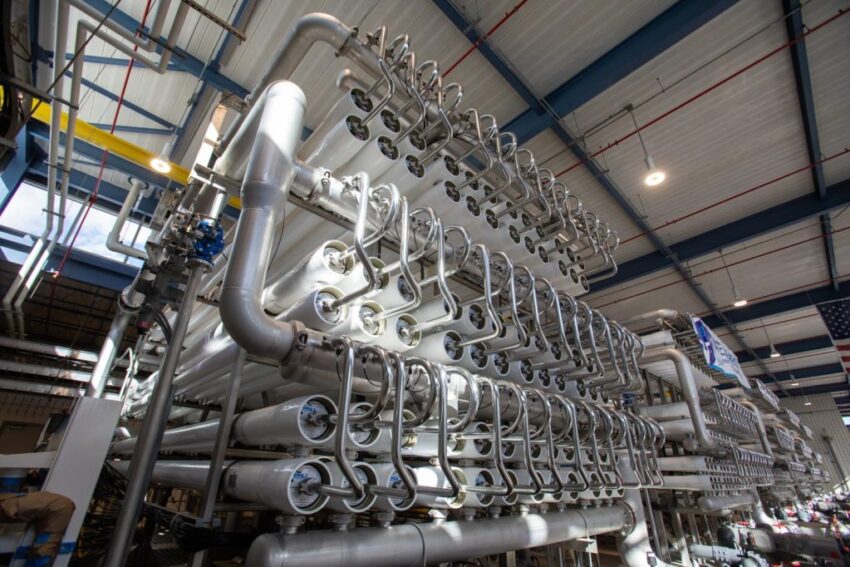
On the innovation side, El Paso is home to the world’s largest inland desalination facility — the Kay Bailey Hutchison Desalination Plant — capable of removing salt from 27.5 million gallons of brackish groundwater per day. The utility also operates a groundwater recharge project that stores treated wastewater within a local aquifer, and it recently broke ground on another similar project.
Beyond desalination and aquifer recharge, El Paso Water has expanded its water supply portfolio through the purchase of groundwater rights and the implementation of an aggressive water conservation program. According to the utility’s recent water conservation plan, per capita water use has declined to 128 gallons per day.
This water supply portfolio diversification with a strong eye to drought resilience has supported the city’s growth and development. In fact, a recent summit about El Paso’s role in nearshoring and international trade would have been pointless if the region’s current and future water supplies were in doubt. Water infrastructure and economic development go hand in hand.
Still, other water challenges, like the mounted cowboys in Marty Robbins’ eponymous ballad, lie ahead. These include the need for developing a qualified water workforce and continued investment in water infrastructure. In the meantime, there are good lessons to be learned from the story in El Paso.
Jeremy B. Mazur is director for infrastructure and natural resources policy at Texas 2036, a nonprofit, nonpartisan state policy organization working to secure Texas’ continued prosperity.
The post Opinion: To capitalize on economic opportunities, El Paso is tackling long-standing water challenges appeared first on El Paso Matters.
Read: Read More