




Never miss an episode. Subscribe to the El Paso Matters Podcast on YouTube, Apple Podcasts or Spotify.
This episode was recorded Oct. 20, 2026.
Read the transcript
Mendoza-Moyers: Today: We’re talking data centers, and we’ll also pull the curtain back a little bit on our own journalism process.
El Paso Matters recently published an article in collaboration with the investigative outlet ProPublica exploring the climate impacts of the Meta and Oracle data center projects under construction in our region. We also took a look at the even bigger data center planned on Fort Bliss, which we have very little information about.
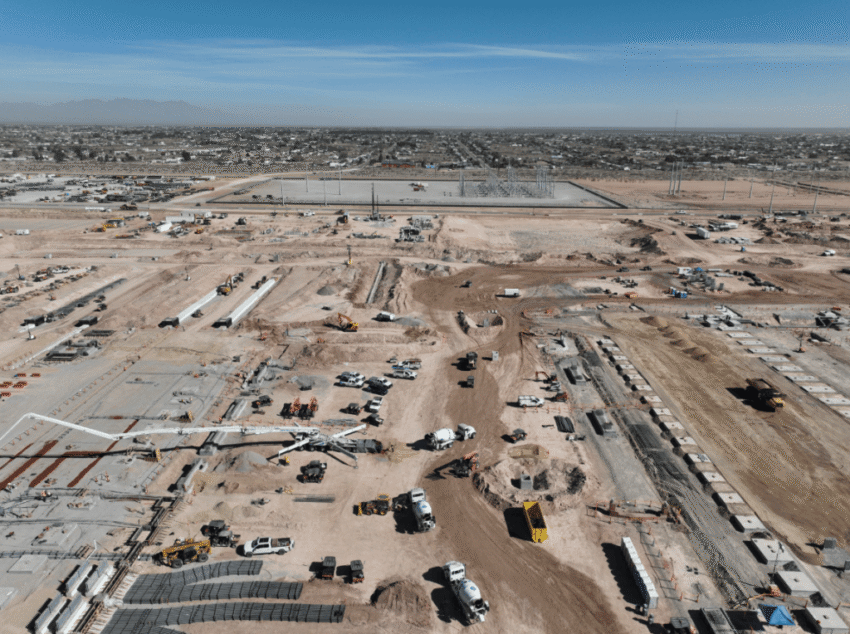
Plus, I’ll talk about my recent tour of Project Jupiter, which was the biggest construction site I’ve ever seen. And it put into context the scale of this global AI race taking place in our backyard.
Oracle also recently announced plans for a bill credit worth tens of millions of dollars, annually, for all El Paso Electric customers in New Mexico. Will that actually become a reality, though?
I’m Diego Mendoza-Moyers, a reporter with El Paso Matters. In a minute, I’ll be joined by Pablo Villa, our assistant editor, to do another data center update.
Before I speak with Pablo, this El Paso Matters podcast episode is brought to you by our podcast title sponsor, Tawney, Acosta and Chaparro, truck crash and injury attorneys. Their team of local, seasoned trial attorneys are ready to help if you’ve been injured in a crash.
Also, you can subscribe to the El Paso Matters podcast on YouTube, or read our free reporting at elpasomatters.org. And many thanks to El Paso Community College Valle Verde Campus for the use of their studio podcast space.
Now, on to the show.
Pablo, thanks for joining me, as always.
Pablo Villa: Diego, always a pleasure to be here, and I’m glad you let me fill in the host seat again. It’s always fun to be on this side of things.
So, Diego, same time, next week. Seems like we just talked about data centers not too long ago.
Diego: About a month ago, yeah.
Pablo: We’re about to get into it again.
Diego: I’m waiting for when people don’t care anymore. But, man, when we publish these podcasts or stories (about data centers), they get a lot of interest. So, we’re trying to give the people what they want.
Pablo: Absolutely, absolutely. And you’ve certainly done a good job of that.
And, so, what we’re here to talk about is a new investigation that’s raised another significant question: what are these good projects going to mean for the region’s efforts to combat climate change, right? And you engaged in a really significant reporting project with ProPublica and the Texas Tribune that found that power plants proposed for two of the region’s largest data centers, Project Jupiter and Meta, they could emit as much greenhouse gas annually as roughly 2 million cars. It’s a pretty significant number.

And those potential emissions weren’t accounted for in these really ambitious climate plans developed by both El Paso and southern New Mexico. And it was at a cost of several million dollars on those. So, I wanted to get with you and talk to you about that. You worked on this investigation for a significant amount of time.
So, I want to discuss what your reporting uncovered, how it came together, what it means for this region? So, can you kind of walk us through how this collaboration came together and what each newsroom brought to the project and what it took to report a story with so many moving parts?
Diego: Yeah, I mean, I guess I’ll just say, like, we’ve been covering data centers for the last year or so. Obviously, lots of interest nationally. And, so, ProPublica, which to me is, like, the gold standard of investigative journalism, right up there with the New York Times or these really elite media outlets. They wanted to do a collaboration with us to produce an investigation of some sort about data centers.
And, so, these talks probably started, I don’t know, sometime in the last year. And we didn’t really have any particular bent. It’s, like, “Hey, let’s just explore this and figure out what’s our biggest question?”
And, so, as I have been thinking about data centers, I think the first thing that people think about is the water. And I’ve kind of – most of my concerns around the water usage have been addressed.
But the big underlying question for me was the air quality impacts. Because one thing we know about data centers, they’re really massive. They need incredible amounts of electricity. Like, more electricity than we use in all of El Paso and Las Cruces. Like, just for one facility, will use a city’s worth of electricity. And, so, that requires a power plant. Typically, gas-fired power plant. These data centers aren’t really relying on big solar fields.
So, I’m just seeing multiple gigawatts of new power plants being built. That’s probably going to cause a lot of pollution. Let’s explore the implications. And, so, that was kind of the start of our reporting quest, if you will, with ProPublica, was just, like, “Hey, what’s the impact to our air here?” Right?
And, so, as you go through the reporting, like, there’s this key distinction where, are we talking about greenhouse gases, right? Like CO2, that contributes to climate change. It goes up in the atmosphere, mixes up there, causes global warming. That’s one kind of emission. And the data centers here are going to produce many millions of tons of greenhouse gases and these climate change-causing compounds here in El Paso in the coming years.
The other air pollution you think of is local air pollution. Like nitrogen oxides, ozone, carbon monoxide, particulate matter, right, dust. So, that’s a separate kind of air pollution other than greenhouse gases, right? And, so, we just wanted to explore, like, what is the true air quality impact?
And I talked about this a little bit last time that we did our podcast. There was – my initial concern was the air pollution. How is that going to affect our health and so forth, like, in the here and now, right? Climate change is a little bit longer term. And what I found was that the emissions being sought by Meta and Project Jupiter in Santa Teresa, like the air pollution, that wasn’t really the story. It wasn’t so big that it’s going to totally deteriorate our air quality.
I think if you live in – and I wrote about this – if you live in Chaparral or some of these communities neighboring the data center, immediately adjacent, you’ll probably have a little bit worse air quality. But by and large, the real impact from an air perspective is the greenhouse gases. Because these facilities, I think, Project Jupiter will roughly emit like 8 million tons, up to 8 million tons, roughly, per year of CO2. El Paso Electric wouldn’t share with me the figures of how much its power plant that it’s building for Meta is going to emit.
So, part of the reporting process here – and I hope listeners can appreciate the multidisciplinary aspect of this, man – I was in there looking at EPA methodology, trying to estimate myself with the information available, “What is going to be the greenhouse gas emissions of this Meta power plant?” So, we – that was part when you asked, like, what did the different newsrooms bring?
Like, ProPublica, they’ve got all this expertise, these data reporters, like, the elite journalists, right? I’m just a guy in El Paso. They have some of the top people in the country. So, we kind of had some debate over how should we try to estimate this? And that’s one detail in the story, right? So, that’s why it took months of reporting.
And I don’t know that we uncovered some grand truth that was hidden to the public.
I think we just crystallized, like, man, we have record heat in our region. These local governments, the state of New Mexico, the city of El Paso, we just adopted climate action plans in the last year that we spent a lot of money putting together to say, like, “Hey, here’s how much greenhouse gases we’re producing now, every car and power plant in the region. Here’s how we plan to get to at least close to (net) zero by 2050 so that we’re not contributing to climate change.”
Well, those plans didn’t factor in these massive new power plants, incredibly huge, being built right in our region, spewing more greenhouse gases than we produce as a region.
So, that was the central finding, right? Or sort of central reporting claim was, like, “Man, doesn’t seem great.” You know what I mean? I don’t need to spell that out for people.
We have record heat, drought, and so forth, and the substances that drive climate change are going to increase here. So, that was one of the central claims. But when you’re working with an organization like ProPublica, you’ve got to be very rigorous, interview after interview with as many academics, air quality experts as we could find. And it turns out, like, reporting is not always a sexy process, right? Like, it’s not always like you’re in a parking garage getting some envelope of some secret, damning evidence of something interesting.
It was really, like, looking through regulatory filings, calling up academics and air quality researchers and experts and just trying to ask them, like, “Hey, can you help me understand this?” And, so, it was a good – I think it was a good finding. Not to overstate it. Like, we could always do more, and I don’t think I’m going to win a Pulitzer or anything like that. But it was just our attempt to answer that one question around the air quality.
Of course, there are other questions around water, utility rate impacts, other things. Tax benefits and things like that. But the air quality impact, we really tried to hone in on that. And my central finding is, like, I don’t think we’re going to have massively worsened air quality, but we’re going to have a lot more greenhouse gases in our region.
Pablo: OK, and I know you’re being modest, but I don’t have to be, right? I do think this was a really significant effort that is the first one to really contextualize what all this means. You alluded to so many things that are happening in separate silos, right? I think you and ProPublica and the Texas Tribune are the first agencies that brought all this information together and really presented it in a way that readers can easily, well, they can digest it, hopefully easily, but it is very complicated stuff. And you all did a great job in putting that together. So, certainly appreciate that. I hope our readers do as well.
And you alluded to this already, but one of the most striking findings is just the sheer scale of the potential emissions that are going to come from these data centers. Your reporting found that power plants proposed for Project Jupiter and Meta produce up to 10 million tons of greenhouse gases, annually. Can you help us put that number into perspective and explain what it tells us about the environmental footprint of these projects?
SEE ALSO: Oracle says Project Jupiter remains on track despite power supply concerns
Diego: Yeah, so several thoughts on this. I mean, number one, like these are, this figure we’re referring to, and it kind of changes. Like, I think Oracle’s kind of amended their application. So, now I think the total between Project Jupiter and Meta is around 8 million tons of CO2 annually. But what does that mean?
So, our region produces – I think the baseline that we’re operating off of, right, where the city of El Paso said, “OK, what are we producing as far as greenhouse gases so that there’s a baseline level so we can look back and evaluate this in 20 years and say, look, we’re producing less than we were in 2019.” Well, as a region, I think the number that the city came up with was we produced, like, 7.6 million tons of CO2, annually. Again, whatever, right? But that’s less than these two data centers combined.
The other thing that we have to remember is at Fort Bliss, the Carlyle Group, this private equity firm, is talking about building a data center on Fort Bliss that exceeds both Project Jupiter and Meta in size. But it’s just been so secretive and vague about the project that we don’t know what it’s going to produce from a greenhouse gas perspective. The Army has told me, “Yeah, we’re probably going to use natural gas power plants.” A lot of natural gas generation over there in Fort Bliss.
We’ve heard recently Congresswoman (Veronica) Escobar say the Fort Bliss project might shrink a little bit or change. But until I get any level of confirmation, I’m kind of operating off of what I’ve reported that it’s going to be this massive power plant.
So, when I say we’re talking about millions of tons of CO2 from Meta and Project Jupiter, that doesn’t even factor in Fort Bliss. So, that could be millions more.
To be fair, one thing I have to mention that’s a little bit hard to parse is that both Oracle and Meta have said, “Hey, everybody, don’t worry. We’re going to build solar farms somewhere else so that we will sort of, like, as much as we’re going to be using fossil fuels, we’re going to be generating renewable energy, right?”
And it’s kind of an accounting claim and it gets pretty convoluted as far as, like, is that a valid claim? And are you really sort of offsetting your greenhouse gases somewhere else? Won’t even get into it, but just to give the companies credit, they say “We’re going to build a lot of solar.”
We’ll have to see if that actually plays out, right? We have no idea. They’re not nearly as far along as the plans are for these power plants. So, yeah, just to put it into context, I mean, the greenhouse gases are complicated. Because you talk to any climatologist, like, the people who are inclined to raise alarms about greenhouse gases, they’ll tell you, “Well, it just goes up in the atmosphere and mixes in the atmosphere.” And, so, a ton of CO2 emitted in Europe or Africa or wherever in the world has the same warming impact in El Paso as a ton of CO2 emitted here. Because it goes up in the air and contributes to a global problem rather than increase warming in a specific location.
That’s kind of frustrating, right? Like, that’s not the sexiest finding. I don’t think we could conclude, like, “Oh, these data centers are going to increase heat in El Paso, specifically.” But I think we can conclude they’re heavily contributing to this broad problem that we’ve identified. We’ve created plans to try to reverse climate change, and now this big build-out of data centers here and elsewhere are going to make it a lot harder to meet those climate goals. And, so, I’ve got a 10-month-old son. Seems problematic. But we’re just trying to highlight the issue and see if the tech companies can respond in an appropriate way.
Pablo: One thing we’ve raised already is this issue of climate plans, right, developed by both El Paso and southern New Mexico. These were developed at a cost, a pretty significant cost, millions of dollars, only to have these projects sort of emerge around them, right? Can you tell us how that disconnect happened? And, I guess, what did your report reveal about the challenges that governments face when they have these economic development opportunities that sort of run into these environmental commitments?
Diego: Yeah, I mean – and I’m not trying to cast aspersions on anyone who works at the New Mexico Environment Department or in the, I think it’s the Office of Climate and Sustainability at the city. Fernando Berjano has led the development of the climate plan. I think he does a great job. And I just think it was a thing of, like, the climate plan – the city of El Paso developed it in response to voters voting, I think in 2022, I want to say, for allocating $5 million for the development of a climate plan.
And then it kind of took off from there and has involved other efforts. But the bottom line is nobody knew about data centers back then when voters voted for this and the city embarked on the plan to develop a climate plan. Like, they just weren’t there. And, so, it’s kind of this issue where you’ve got to spend several years evaluating what are the emissions in our region? What are we going to do to lower them?
And the plans the city has put forth are totally sensible. Like, let’s cover parking lots with solar panels. Let’s generate more renewable energy on city facilities. Let’s plant more trees and just do things to try to make it a little cooler, and it’s not anything over the top, But there are goals as well to encourage electric vehicles and do these things to lower our emissions. Well, it doesn’t matter what we do if you have a power plant there emitting millions of tons of CO2. It just kind of offsets it.
And I mentioned the cost. I think the city spent maybe $1.7 million on the climate plan. And that’s – it’s not some astronomical amount. But the point is there’s a lot of effort that went into this climate plan for the city. And, in my mind, it’s going to be really hard to achieve the reductions in greenhouse gas emissions laid out in that plan as a result of this power plant, assuming El Paso Electric gets the approval to build a power plant for Meta.
LEARN MORE: El Paso leaders approve city’s first climate action plan. What happens now?
Now, Project Jupiter, the state of New Mexico, created this statewide plan, very aggressive – very progressive, I guess, if you think climate change is important. And, so, there again, they’ve got this plan, they’ve got all these people working, and “Hey, let’s get off fossil fuels, let’s generate more renewable energy.” And I talked with Dave DuBois, the state climatologist in New Mexico, and he just said it straight up to me in an interview. I just called him up on a Friday afternoon, and he was just, like, “Yeah, this Project Jupiter is going to undo” – I think the quote was, “It’s going to undo a lot of the very expensive and very meaningful work a lot of people are doing in New Mexico to curb climate change.”
Again, maybe if these companies build lots of solar, and maybe it plays out in an optimistic way. But I just – it portends a bad trend to me of more greenhouse gases at a time that our world’s experiencing record heat.
Pablo: Yeah. And, so, Project Jupiter seems like it’s just down the road from us, but it’s actually in another state. And so that presents some challenges. I think one interesting example that you have in your story is that New Mexico requires developers to disclose projected greenhouse gas emissions and Texas doesn’t. How have those differences shaped what we know about these projects and what do they tell us about the ability of governments to evaluate their cumulative impacts?
Diego: Yeah, I mean, we’re in an interesting area, right? Like, we’ve got Mexico. Which, just a side note, I mean, I think that there’s been a sort of manufacturing boom in Juárez for computer parts for data centers here and around the country.
We’ve got Mexico, we’ve got Texas, we’ve got New Mexico, but for us it’s all one region, right? But then you realize all of the different jurisdictions and different governments involved and all these things that, man, it makes it really complicated.
So, for example, I mean, the Meta data center is right on the state line in far Northeast El Paso, right there, Texas-New Mexico state line, across the state line from – a couple hundred meters from Chaparral. And, so, they’re going to build a data center, they’re going to build a power plant. Who’s going to bear the brunt of that? It’s going to be the community in Chaparral that’s the closest neighboring residential community. But they have no say over it because they’re in another state, even though they’re right there. They’re going to breathe the air pollution and just experience – they’ve had issues with water and things like that.
So, that’s one example where we’re in this area with all these jurisdictional lines that kind of make these projects not have the best or not be the most optimal, right? Your community can’t even have a say in the power plant that’s being built right next to it because it happens to be in another state.
And it’s kind of similar to Project Jupiter. For Project Jupiter, because New Mexico is maybe a little bit more progressive or whatever you want to call it, environmentally concerned, they make the project, hey, when Project Jupiter is trying to get an air permit, which authorizes a certain level of pollution, they have to say, “This is how much we think we’re going to pollute, and this is how much greenhouse gases we think we’re going to emit.” So, that’s when we got figures of 8 million, 9 million tons of CO2, annually, from Project Jupiter.
For Meta, Meta is regulated by the Texas Environmental Regulator, the TCEQ. They don’t have to say anything about greenhouse gases. Who cares, right? So, then I asked El Paso Electric, “Hey, what’s the greenhouse gas emissions of this power plant you’re building for Meta?” Well, they’re not going to answer that. So, then that’s when I have to embark upon becoming a freaking emissions estimator and try to figure it out myself. And I think we got a pretty solid estimate of about 1.3 million tons of CO2 a year from the Meta power plant.
But that just shows the differences across jurisdictions where New Mexico, you’ve got to report certain things. There are sort of more stringent requirements on renewable energy there. Texas, not so much. “Go ahead and build it.”
And another interesting thing is EP Electric got an air permit for this power plant. They haven’t gotten authority from the PUC – the Public Utility Commission. But they did get authority from the Texas Commission on Environmental Quality last fall. Nobody even knew. Like, “Hey, EP Electric, you want to build a power plant for Meta? Go ahead.” No public notice or hearing or anything. They just got it. And then El Paso Electric came up to me and showed it to me one day and I was, like, “Oh, I didn’t even know you guys got this yet.” Whereas it’s so much different in New Mexico.
New Mexico, there’s going to be a trial-like hearing, right? And it was supposed to take place in September. There were some lawsuits filed. It got delayed. And now I think it’s, I, actually – I think they just appointed a hearing examiner. They’re going to have to set the hearing date. Point is, for Project Jupiter to get an air permit, very similar to what Meta has gotten, Project Jupiter has to go through this whole hearing, present evidence, sort of go against some of the environmental organizations that are going to argue against it. Just a much more intensive process.
Even so, Project Jupiter is probably going to emit more than Meta, right? So there’s these contradictions that, yes, New Mexico is more progressive and maybe more heavy-handed from an environmental perspective. They’re still having a massive power plant and data center being built.
So, anyways, it’s interesting that we’re in this region and you’ve got these different jurisdictions. We’re all clustered together. It feels like one community, but so many different departments and regulators and so forth involved in this.
Pablo: Yeah, very heavy. And, so, on the subject of accountability, policymakers are still grappling with this, going to continue to grapple with this in the years ahead. We’ve even had some elected officials who have taken a step back from their original stances, right, and are calling for more safeguards. I guess, based on your reporting, Diego, I mean, where do we go from here? What are some of the things that have to happen and what are some of the consequential decisions that are still ahead?
Diego: I would say that, for example, the Doña Ana County Board of Commissioners, just the other day, they had Oracle there in their chambers, the county commissioners of Doña Ana, like, they were holding the Oracle’s feet to the fire. Like, “Hey, make sure you build solar, don’t do this, do this.” Like really, really grilling them.
I would say we probably have a little bit less oversight over Meta. You don’t see El Paso City Council or El Paso County Commissioners chastising Meta executives in public meetings.
But I will say, for example, I spoke with Mayra Chavez, research scientist at UTEP who’s, like, one of the leading air quality experts in the region. And she basically said, on the subject of data centers, like, “We’re just going to have to keep an eye on it as researchers.” Like “It’s on us as the academics, as the people that track these things of air quality and to check the air monitor readings and things like that. Like, it’s on us to see what the impacts are and if it becomes – if the air pollution becomes really hazardous” or things like that.
I think as far as the water, you’re going to have El Paso Water producing annual reports of who their top users are. I would think we would have some visibility if Meta enters there. Oracle says they’re going to be producing a dashboard of every data of every operational detail and the water use and air pollution and noise and all these things. We’ll have to see how that plays out, right?
But I do think that the scrutiny on the data centers has been such that there will be quite a bit of oversight. But it’s interesting. I do think maybe New Mexico has a little bit more – like, Oracle’s been more front or sort of public-facing. They’ve had to answer more questions, maybe face a little more scrutiny. But I’m fairly confident that the public blowback has triggered a response from our local governments to like really over, you know, just overlook the, or not overlook, but look over these facilities, right? And same with the state of Texas. You know, the governor’s, you know, said that he’s very upset about data centers. So maybe we’ll see reports come out that verify like they’re not using all the water, they’re not polluting excessively, but we’ll have to see, right? And hopefully, I guess that’s also part on our job to try to keep on top of them, too.
Pablo: That’s all we can do, is just wait and see, right, and continue to report. I could talk about this story all day, but I do want to get away from it for a little while.
I do want to encourage our readers to go check it out at elpasomatters.org. Really, really excellent project that we conducted with ProPublica and Texas Tribune.
But I do have another set of questions for you that I wanted to get to. I do know, apart from your reporting, you actually got to take a tour of the Project Jupiter site very recently. What can you tell us about that? What did you see? What’s it like? Do they have all these jobs? Did you apply for one? What’s going on out there? Tell us about Project Jupiter.

Diego: Yeah, I mean, I’ve got, I think, at Project Jupiter, like 4,400 people working out there right now. So, it’s a pretty big, pretty active job site.
But yeah, we got to do this media tour. It was me with other reporters that went. And we had to put on the hard hats and gloves and all this protective equipment and stuff.
It was interesting, though. I’ll say this: Whatever you think about Project Jupiter, it is a 2-square-mile-plus site of construction. And it’s kind of a feat of human engineering in some ways in that it’s this massive construction site. Every square meter is full of something, whether it’s construction equipment, like, a mess hall for the workers. They’ve got these cooling stations and there’s all these divots and there’s drainage ditches.
It’s just – trying to imagine how you plan a two-square-mile plot of land where every single, like I said, square meter has some sort of function or purpose or is doing something. It was just kind of hard to wrap your head around. It’s so big. There’s so much going on at all times.
We saw tons of workers there. We went inside one of the buildings, the data halls that’ll house these computers that are sort of doing the AI processing. And it wasn’t particularly spectacular. It was a really big building. It was still under construction. It kind of felt just like a really big warehouse, with, like, steel racks going everywhere and stuff.
Kind of what was interesting was this big, massive facility that, I mean, to me, it looked like it was, like, a quarter of a mile long or maybe longer. It was just absolutely massive. And they said that would be the cooling facility. And it kind of just had these tubes going every direction. And it looked like something out of Star Trek or something. Like, I’m not an engineer enough to understand exactly what the components of that were, but it just was incredibly massive. Everything on the Project Jupiter site – it’s many different buildings, but everything was a massive scale. It just was sort of a sight to behold in many ways.
And of course, that’s what Oracle wanted us to take away, right? Like, you go into it recognizing, “Hey, this is a kind of a PR thing. They’re trying to show everybody how great it is.”
But it was interesting. And it’s pretty rare to see a two square mile construction zone with so many things going on, so many components. And a lot of people working, right? Like, say what you want about it. And people can come to their own conclusions about it. Lots of people working.
I think – let me check my notes. I think now they’re up to 630 Doña Ana residents working there out of about 4,400 total, about 1,200 New Mexicans. And of course, look, everybody would like to see that more. I’ve asked Oracle what are the number of people working there who are from El Paso? So, that would be interesting.
But, yeah, it was just a massive site. And you just kind of see why there’s – when they talk about billions and billions of investment going there, you see why. It’s just massive facilities, massive buildings, thousands of people. Just pretty interesting to see, I would say.
Pablo: Yeah, I know you’ll leverage that trip in your future reporting efforts. So, hopefully you’ll continue to give us a look behind that curtain as well.
So, I know another thing you recently learned is there’s this deal that Project Jupiter has with El Paso Electric that involves a bill credit. You want to tell us about that?
Diego: Yeah. So, this is super interesting. And I know we’ve got an out here, so I won’t go on and on. But this is just an example of these data centers are trying to win over the public, clearly, right? The tech companies.
So, Oracle, they announced this plan last week that really caught my attention, where they announced other things, too, but really what got my attention was they’re saying, “Hey, El Paso Electric and El Paso Electric’s New Mexico customers, you guys are about to face a rate increase.”
EPE, they did a rate increase in Texas earlier this year, they’re doing a rate increase in New Mexico that’s even larger, which I think the average bill impact is, like, $40 a month. So, really large impact. To be fair, New Mexico hasn’t had a rate increase in a while. EPE says, “Hey, we’re catching up here.”
But the point is, so, EP Electric is about to impose a very large rate increase. Oracle said, “Hey, why don’t we kick in $55 million annually for three years to, essentially, offset that rate increase on customers?” And the details are very uncertain. Like, does that all go to residential customers? How much of it goes to business customers? Is it an even split? Like, we don’t know those details.
But the point is, it would be very significant, right? I mean, maybe $40 bucks off of the average person’s bill, which is about what the rate increase is.
So, when you talk about direct assistance to people living in an area where data centers are coming, it’s hard for me to imagine a much more direct, tangible benefit than “Hey, knock 40 bucks off your utility bill.” Even if that’s just sort of an increase that you’re about to face. To me, it’s a pretty tangible benefit.
But I was surprised the Doña Ana County Commissioners really pushed back heavily on that proposal by Oracle. And I think for reasons like they said, “Oracle, you should have presented this to us sooner. We should have been in on the conversation. You just kind of worked this deal out with the Peso Electric and presented it.” Like, kind of transparency concerns. Fine.
But I will say, I think there’s this persistent fear of “We cannot have Project Jupiter connect into the electric grid with El Paso Electric.” And some of the county commissioners like Christopher Schaljo-Hernandez were essentially saying, like, in any world, that’s bad if EP Electric and Project Jupiter tie in together. And I don’t think that’s true.
I think the whispers have been for many months that Oracle and EP Electric absolutely want to tie in together and Oracle’s building this massive power plant it’s not going to need to use all the time. Hey, maybe it sends some power onto El Paso Electric’s grid and maybe that’s cheaper than EP Electric having to build a new power plant or something like that, right? We don’t know. Like, there’s many details to be worked out.
But I was surprised the county commissioners were just absolutely opposed to this bill credit for customers and not maybe approaching it with some cautious optimism. Like, “Hey, we don’t really trust you, Oracle, but let’s explore this. Could there be some benefit of you tying in the grid, you give these bill credits to customers, it offsets the rate increase?” Like, that’s – in my mind, that’s pretty tangible.
But, yeah, so we’ll have to see what happens there. Oracle almost walked it back afterward. Which I was like, “Man, you guys must not have had very much conviction about wanting to provide these bill credits.”
But, yeah, so that’s just something for New Mexico customers. Like, man, I wish that was happening for EPE Texas customers, but just something to keep in mind. It could essentially wipe away the rate increase.
And just to contrast that with Meta – I know we’ve got to wrap up here in a minute, Pablo. But, again, Oracle is saying $55 million annually in bill credits for three years. Meta gave $25,000 one time for EP Water customers for bill credits. So, you can say what it is, but Oracle, at least they’re trying to – and people (say) “They’re buying people off,” whatever you want to say, pretty sizable amount of money.
Pablo: Trying to get in good graces, right?
Diego: Exactly.
Pablo: So, I know you’re going to continue to follow that. And by the way, while El Paso Electric is breaking in a new CEO, right? That’s also something you reported on. So, shameless plug for you. I encourage readers to go check out your coverage about El Paso Electric.
One last question for you, Diego. So, we’ve talked a lot about Project Jupiter, but we have one of our own data centers in our own backyard, right, Meta? What’s up with them?
Diego: So, it’s been a little bit, like, I think construction’s been ongoing. It hasn’t been a ton of news, but I think, as it is now, the big hurdle that we’ve been talking about that still exists is will the Public Utility Commission give El Paso Electric permission to build a power plant specifically for Meta, right?
And it’s, I’ve said before, it’s the McCloud power plant. It’s really not a power plant as much as a bunch of small generators stacked together. It costs a ton of money. It’s a really big power plant.
But EP Electric kind of wanted to do this weird thing of like, “Hey, it will only serve Meta for five years, and then after that, it’ll tie into the broader grid and serve all of us.”
And the problem with that is that EP Electric wouldn’t be building this odd power plant with a bunch of small generators stacked together if not for Meta. Meta showed up here, said, “We don’t have time to wait for you to build a solar farm or a traditional power plant. Just put whatever you can in the ground to get power, like, ASAP by 2027.”
So, if Meta hadn’t shown up and said that, EP Electric wouldn’t be building this facility, but then they want to charge us all for it in a few years. So, the PUC, the actual commissioners, are going to have to make a determination on that.
But the judges that are sort of overseeing the case and issue a recommendation to the PUC basically said, “Hey, El Paso Electric, go ahead and build this power plant for Meta as long as Meta pays for every penny of it for the life of the plant.”
So, that’s kind of where we’re at. It’s a little bit of a kind of holding pattern for now. I expect we’ll get a decision by the end of the year. But that’s a big hurdle for Meta, so we’re going to have to see what happens there.
But I’m curious to see if Meta maybe follows Oracle’s suit and starts greasing people up with some larger donations and so forth. We’ll have to see.
Pablo: Diego, thank you very much for all this information you’ve provided. Again, a very significant project you undertook, and we’re glad it’s over. We’re glad it’s now in the public’s hands. Hopefully, they read it and take advantage of the information that you’ve collected, because it did take a lot of work. I know you had a lot of sleepless nights and early mornings.
Diego: A lot of early mornings.
Pablo: Yeah, so thank you for that. I know you’re going to continue to be watching this, and I’m sure we’re going to be back here talking about it again before too long. So appreciate all the info.
Diego: For sure, Pablo. Always good to talk data centers with you. There’s always a lot to talk, so we’ll be back here soon.
Pablo: Yeah, definitely. We’ll do it again in a minute.
Diego: Thanks.
The post Podcast: Data center emissions, a Project Jupiter tour and Oracle’s proposed household electric bill credits appeared first on El Paso Matters.
Read: Read More