



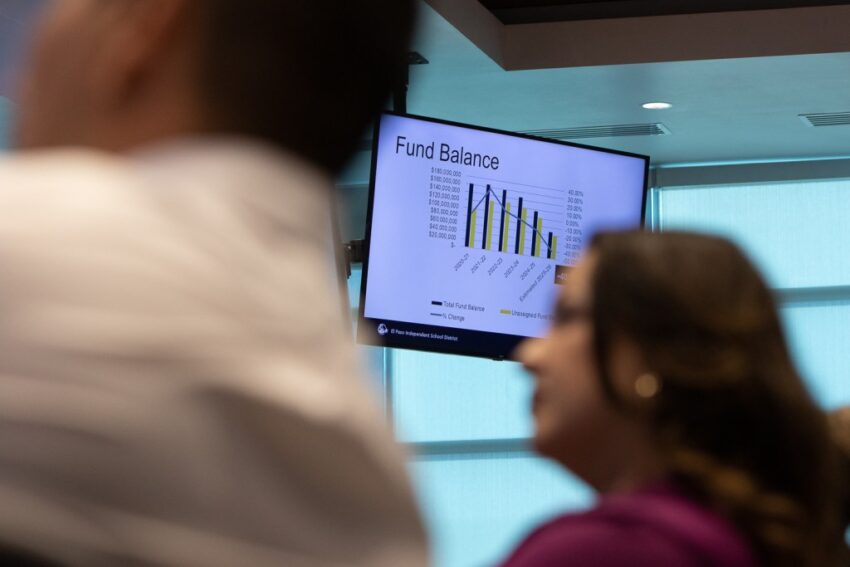

Diego Mendoza-Moyers: Today: EPISD is likely going to put a bond north of $400 million to voters this November. Just weeks after the district declared financial exigency, a form of bankruptcy for public school districts, the elephant in the room now is whether the district can garner enough trust from voters to win support for the ballot item this fall.
Elsewhere in El Paso’s education system, Ysleta Independent School District just approved a budget that virtually wipes out the district’s savings balance and leaves the district with almost no room for financial error. And while the district superintendent has said YISD will avoid the kind of layoffs EPISD recently implemented, the district will likely still see a reduction in force next school year.
Meanwhile, Socorro Independent School District expects a budget surplus for the upcoming year, and the district could exit state conservatorship next month.
In just a moment, I’ll speak with El Paso Matters education reporter Claudia Silva to talk through the conditions at each of El Paso’s three largest school districts – which are all beleaguered to some extent at the moment – and what to expect at each district in the near future.
First, this El Paso Matters Podcast episode is brought to you by our podcast title sponsor Tawney, Acosta and Chaparro, truck crash and injury attorneys. Their team of local, seasoned trial attorneys are ready to help if you’ve been injured in a crash.
And you can read our free reporting or sign up for our newsletter at our website, elpasomatters.org.
On to the rest of the show.
Claudia, good to be with you again.
Claudia Silva: Yeah, thanks for having me.
Diego: It seems like we’ve been talking a lot about education-related stuff, so thanks for taking the time. I know a lot is going on.
So, you wrote this week about EPISD’s plans for a bond election this November. Can you talk through the district’s plan and what it wants to use new funds for?
Claudia: Yeah, well, I just want to say it’s still always a pleasure to inform people about what’s going on with the districts, even though things have been really hectic right now.
But, yeah, let’s talk about EPISD. So, I guess before we start talking about an actual bond, I think the first thing that we should maybe go over is this new long-range master plan that was presented around the same time as this bond proposal.
So, what the long-range master plan is, essentially, is the district’s long-term plan for any renovations and improvements that it needs to make in the coming years. And this plan was actually developed by a series of committees and subcommittees that are made (up) by citizens, residents, parents, there’s some school employees and union members.
So, they all got together and talked about different aspects of the district that they think need improvement. And they put this (to a) vote. And, with all that information that they gathered and a lot of data that the district gathered about the resources in the different areas of the schools and the conditions of the actual campuses, they came up with a long-range master plan that is worth a total of a billion dollars.
In that plan, I think the two largest portions are air conditioning or HVAC, so heating and cooling. And for the long-range master plan, that would cost about $133 million. And the actual really big, big chunk of that is deferred maintenance, which is basically maintenance that’s been put off. So, if there’s been any repairs needed or anything that’s broken that the district just hasn’t had money to fix, that’s where that kind of goes.
And the district calculated that it has about almost $470 million in deferred maintenance needs. So, that’s basically the vast majority of that $1 billion – almost half of that $1 billion long-range master plan.
In the plan is also the inclusion of some smaller things, like installing solar panels in 13 schools, adding green spaces throughout the campuses, new IT infrastructure and cybersecurity. They’ve also been talking about rebuilding Bliss Elementary, which was something that was from the 2016 bond.
So, what was actually presented as far as a bond earlier this week was actually just a draft. So, this isn’t an official proposal. This is just to give an idea of what a bond could look like. So the bond, it was separated into three pieces and it totaled $445 million. So, even though the district identified a billion dollars in needs, they’re only going to go after a portion of that.
READ MORE: EPISD eyes up to $450 million bond election, outlines $1 billion in long-term needs
And, so, it’s broken into three pieces. The first, the largest piece is $409 (million), about $410 million. And that is to address cooling systems, some of the most dire deferred maintenance needs, installing solar panels at four schools and just kind of general improvements throughout the districts. There’s making the playgrounds better, more green spaces, things that will improve the student experience, like adding water fountains and water refill stations. So, just general things like that.
The second would be about $10 million, and it’s an ask to purchase technology devices for teachers and students. That one’s a little bit controversial, because there’s some people that don’t think it’s a good idea to get into debt, essentially. to purchase equipment that’s going to be outdated in a few years. So, that’s its own proposition on its own.
And then the last one is $25 million to renovate athletic stadiums. So, these are just the ones that are used for big games.
That’s essentially what the draft is. We should know sometime in early August, or even within the next few weeks in July, what the official proposal is going to be. The district, I think their goal is to keep the tax rate the same. So, that’s the exact number that they’re going to look for. David Bates, the deputy superintendent, he told me that could be anywhere between $430 (million) to about $450 million.
But one thing I think is important to know when we talk about the tax rate is they are trying to keep the tax rate the same, but that doesn’t necessarily mean taxes won’t increase. Some homeowners may see an increase just because property valuations have been going up.
But another thing to remind people is that there are still a significant amount of people in El Paso that wouldn’t be affected by this. Usually, seniors and disabled veterans, a lot of times their school property taxes are frozen. So, it’s pretty complicated when you look into it. But, bottom line, tax rate is going to stay the same, but a few people’s tax bills for the district could go up.
Diego: All really good information. Appreciate that, Claudia, and kind of breaking down the different buckets, I guess, that they’re seeking funding for.
You’ve done a lot of reporting recently on EPISD declaring financial exigency, basically discovering a budget blow up, right, that apparently had been withheld from the board of trustees by some of the senior administrators at EPISD.
And, so, EPISD, all right, in the middle of a big budget crisis, they just had to lay off 55 employees. A couple of the trustees on the board resigned. So, EPISD’s going through some tough financial times, right? And, even still, there’s still pretty strong support for EPISD’s bond among different community groups that have been advocating for this for a while, particularly around installing new HVAC units.
And, so, I just wonder if you can talk about how some of the community organizing groups are pushing the bond and why?
Claudia: Yeah. Well, one thing to mention is, the last time there was a bond approved by voters, it was in 2016. And that bond, primarily, focused on additions to the high schools and making renovations there. And it also consolidated a few elementary and middle schools and basically combined them into this, pre-K-through-8 campuses.
But that actually left a lot of schools, mainly elementary schools, without a lot of updates. So, I think that that was – one of the main things that people are wanting is they’re seeing that we have still a lot of schools that weren’t touched by the 2016 bond and people want to start seeing improvements there.
SEE ALSO: Delayed EPISD subcontractor payments near resolution as board considers $400K payout
One of the organizations that has been in support of a bond for a couple of years now is the Amanecer People’s Project. So, they launched what they call the Escuelas Frescas campaign in 2024. And, basically, what they did is they went around and they talked to parents and went to different campuses and tried to just get information on what they could.
And they found that there were several dozen elementary schools that just didn’t have adequate air conditioning. A lot of them were running on, I think, what we would call swamp coolers or evaporative air. And a lot of those just aren’t as – they don’t really work as well whenever the temperatures are really high. And another problem is that there’s now requirements where all classrooms have to close their doors. And the way those air-conditioning systems work, if you don’t have doors open or some form of airflow, they’re basically just completely ineffective.
So, that’s kind of what they ended up finding. And, since then, they’ve been pushing and looking for different ways that the district can get different air conditioning.
The other group that has shown support for the bond has been Familias Unidas Por La Educacion. They are a grassroots advocacy group from the Chamizal neighborhood in South Central El Paso. And they have been very vocal against the closures of schools that happened under previous leadership.
And one thing that they’re really supporting is, under the long-range master plan and potentially the bond, and still hasn’t been fully clarified, is they’re talking about reopening some of the closed schools that were closed through the 2016 bond and turn them into pre-K centers.
And I think the purpose of that is really to try to get more people to enroll. And after talking to some people that live in the neighborhood, they actually feel that there’s a lot of people, there are a lot of parents that have young children that could qualify to go to pre-K or kindergarten, and they just haven’t been enrolled for whatever reason. So, they’re hoping that reopening the center will give students access to education, and the district, I think, is hoping to get more enrollment from that.
Diego: Yeah, and maybe breathe some life into the campuses that have been defunct?
Claudia: Essentially, yeah.
Diego: So, EPISD’s Deputy Superintendent, David Bates, who you mentioned, and he recently joined the district, I think late last year, right, with the new superintendent Brian Lusk. So, relatively new to the district. But he had an interesting quote in your story where he was saying, like, “I’ve managed $5.5 billion in funds when I was in Dallas. And, so, here I can manage $400 million, essentially, with no problem,” right? And, so, I thought that was interesting.
I thought it was trying to maybe differentiate the current administration with the prior leadership at EPISD, which had some troubles implementing the 2016 bond. And, so, I just wonder what you made of Bates’ comment there and just the district’s overall push to rebuild trust with the community before the election in November?
Claudia: Yeah. Well, I just want to mention, I really wasn’t around when the 2016 bond was implemented, so, I can’t really speak to what it was like back then. But, from what I’ve heard from people is that there were some issues, there were some delays, and even we’ve reported that there were some delays with payments. So, the bond really didn’t go very smoothly from what I understand.
Now, when we talk about administration, when you kind of compare it to the administration that we had previously under Diana Sayavedra, she resigned last year under pressure from the board after this whole changeup of the makeup and of the board.
But this administration seems – they seem competent to me. But, in hindsight, the last one did as well. And now we see the issues that came from them. But I will say that I do think that this administration has been more transparent, at least with me as a reporter and with different members of the community.
Previously, I did feel like it was more difficult to get interviews and sometimes the answers that we got weren’t the most straightforward. And now this new administration, both David Bates and Dr. Lusk, if we ask to speak to them, that’s usually happened. There’s usually been no problem.
The other thing is, in these past few days, I’ve looked at more documents related to the conditions of EPISD’s facilities, the resources in the area, all these different aspects related to school enrollment, teacher attrition, all of that. I’ve seen more of that in these past few days than I’d seen in this whole time, three years that I’ve been working (covering) EPISD.
And it was a lot of data, maybe a little bit too much to absorb. But, to me, that shows that there is an effort to give that information and be more open with the community. And it is, I think, fair to say these two administrators, they come from a bigger district. They’ve worked with much, much larger sums of money.
But, at the end of the day, it’s really hard to say if all of that I’ve just mentioned is enough to truly convince voters. They just laid off 55 employees. A lot of the public doesn’t fully understand a lot of the changes that were happening. I don’t think that they understand that everything that came out came out because of these changes in administration. And I think it’s just going to be a difficult sell to ask some people for more money when there has been this history in this district of not being able to manage it adequately.
Diego: Yeah. And we’ve spoken about this a couple times, but just how I think the question of whether the district can rebuild trust, like that’s going to matter a lot for students, right? And, if voters do reject this, the people that will suffer are students sitting in hotter classrooms and with worse facilities and things like that.
But of course, at the same time, I’m going to understand and – I get the skepticism of EPISD. They just had this financial disaster sort of show up out of nowhere. Apparently the trustees all had no idea and weren’t very well-informed on what was going on in the district. So, I think that there’s going to be some skepticism from voters.
But, anyways, I appreciate that. And I just thought it was an interesting comment from David Bates to make the point, like, “We’ve dealt with even bigger sums of money. We can handle this. We can deploy it effectively and get these projects done.” So, just was an interesting selling point from him, I guess.
But speaking of the trustees, Claudia, we know – and we’ve done a couple of podcasts recently. We’ve spoken through how Trustees Daniel Call and Valerie Beals stepped down and resigned amid this budget blow up.
And I just wonder, is there any clarity on when their seats will be filled? I think you reported that the trustees are opting to do an appointment process as opposed to an election. And, so, and part of the reason I’m asking this is because the trustees will have to decide on whether to put the bond on the ballot in November. Is that right?
Claudia: Yeah. So, it will be up to the trustees. They’re going to have to do a final vote and it’s going to be in August, early August where they’re going to vote on whether the bond is going to be on the ballot this November.
But, so, essentially, what the board is doing is they’re taking an appointment process to try to fill those two vacancies. I’ve already talked to a few people that say that they are interested in applying or have already applied. So, it seems like there are going to be quite a few people who are interested in taking responsibility for this role.
The last time there was an appointment was Dr. Jack Loveridge. He was an appointed board member. And what they did, essentially, is they took applications from different people that were living in the district who were interested. And they actually decided on three final candidates or three finalists.
What they did is they held a candidates forum. And after that forum – well, at the forum, what they did is they, essentially, were able to talk to the public, answer questions, share information about themselves, who they are. And, after the forum, the board went ahead and voted and decided who would fill those positions of those three finalists.
I think what’s important to know is whoever gets chosen is going to have to run again in May if they want to keep their seat. So, I think that’s just an important thing to keep in mind. This is going to be less than a year that they would technically be on the board.
From what I understand, they should be selecting a finalist in potentially late July, early August. They haven’t set out an official timeline just yet, but we should, I think, probably in the next week get some more information from the district about what the process will look like. I’m not 100% sure if they’ll have to vote on that, but there’s usually a presentation given to the board that outlines the process of what the appointment will be like.
Diego: Do you think the new trustees, whoever they are, will be in their seats in time to vote on the bond question, I guess, or the bond item?
Claudia: I think that’s the goal. They have to move rather quickly since their plan is to vote on the bond on August 11th. But I think it is possible for them to get it done before then.
Diego: Yeah, well, it’ll be interesting to see that process play out.
Shifting off of EPISD – I think we could talk EPISD for a while – but I just want to get your thoughts on a couple of the other school districts in town, Claudia, that obviously serve a big chunk of the population.
So, at Socorro Independent School District, they’re the second-largest district. They’ve had a situation where I think last year they entered conservatorship by the State of Texas for complex reasons that you’re welcome to talk to if you want. But where they are now is they just approved a budget with a budget surplus, right? So, I think they’re trying to rebuild their savings at Socorro.
And, so, it’s looking like, “OK, in the next coming year, we’ll have a surplus. Maybe in the years after, we might have a small surplus as well.” And they might be exiting the state conservatorship next month. So, I just wonder if you can give us an overall look at where Socorro Independent School District is at after they’ve had some troubles recently as well?
Claudia: Yeah, definitely. Well, the first thing I want to note is it’s actually getting closer to, I think, I believe two years where the conservators have been appointed.
Diego: Time’s flying.
Claudia: Yeah, definitely. So, they were actually – or maybe close, maybe even more. OK, so actually they were appointed in 2024. So, it’s getting closer to two years that they were appointed. So, they’ve definitely been there for some time.
So, when we talk about Socorro ISD, they’re basically coming out on the other end of their financial crisis. So, if we go back a couple of years, Socorro ISD was dealing with overspending and budgets that were higher than they were bringing in in revenue, which ended up digging into their savings.
So, what ended up happening is, as their savings started to dwindle down, they didn’t really have the money on hand to always cover their expenses. To kind of understand how it works is the state and the property taxes will come in in a scheduled time frame. So, the districts need to have this money on hand so they can pay their bills, pay payroll and make sure that everyone gets their paychecks on time.
So, when this was happening, the district was having to take out loans. What they ended up having to do is make a series of budget cuts and they laid off employees last year. That allowed them to have a balanced budget. And this year as well they’re having another balanced budget.
So, now their plan going forward is to try to rebuild their savings. So, they’re trying to get some – try to generate more revenue, so that they have more of that money on hand so they don’t have to rely on loans in the future in case something happens.
They did not have to declare financial exigency when they did layoffs, which was different than EPISD. I think what happened with EPISD is it was very sudden and they had already planned to approve all of these contracts, so they had to break them in order to lay people off. Socorro ISD had been planning ahead of time a little bit more. So, what they did is rather than breaking contracts is they set them for non-renewal. So basically said, “Hey, you work for us. We are not going to renew your contract next year.” And that basically always happens in the summer in between school years.
Now, when it comes to the conservators, they came on board for a couple of different reasons. I think the primary one was related to some graduation issues that had happened in previous years. And when they went in there, they realized there were a lot of problems with the district’s financial tracking. So, they tried to kind of try to get everything back into shape.
The only issue now is that the TEA, or the Texas Education Agency, discovered that there was some data related to special education that was, I guess, not correct or wasn’t up to date. So, they did delay the conservatorship a little bit, and they’re going to, from my understanding – that should get corrected relatively quickly. And the conservators are expected to leave next month.
But, the other thing, going back to bringing in more revenue. So, Socorro ISD, just like all the other districts in El Paso, have been dealing with declining enrollment. So, it’s been really difficult for them to bring in more money.
So, what their plan is, and it’s something that they attempted last year, is to call for a voter approved tax rate election, or some people call it a VATRE or a VATRE. And basically this allows the district to raise the tax rate so they can bring in more money. That failed last year, but it looks like they’re planning to repeat that again this year and hoping that they can rebuild their savings.
Diego: Yeah, pretty interesting. I thought the way you described it, them coming out of the end of their financial crisis, and it seems like EPISD is kind of entering it or is in the throes of it. So, that’s an interesting contrast.
Claudia: Definitely, yeah.
Diego: I guess a positive thing that maybe the conservators will be leaving and Socorro will sort of – the board will have more direct oversight over the district, right?
Claudia: Yeah, I mean, if things go as planned, things should be a lot more smooth. There shouldn’t be really any major budget cuts. They should be able to just handle their declining enrollment the normal way a district would, which would be through retirements and attrition and just slowly reducing their budget and workforce over time. And, theoretically, that shouldn’t have a huge impact on students.
Diego: Yeah. So, going to the third-largest school district that’s also got quite a bit of issues is Ysleta Independent School District. And YISD just approved a budget recently with a really small fund balance, right? Essentially, carrying no savings. So ,if something goes wrong, they’re not going to have a pot of cash, essentially, to tap, right?
LEARN MORE: Ysleta ISD nearly depletes savings under adopted budget, avoids layoffs for now
But they did pass the budget. And, so, minimal room for error. And I just wonder if you can kind of talk through the financial situation at Ysleta? And I’ll just add, I think the YISD superintendent told you that “We’re not planning layoffs like EPISD is.” But, really, YISD is kind of just going to let some contracts expire and still have a reduction in force, even if it’s not layoffs, right?
Claudia: Yeah. Well, I guess, to kind of go over YISD’s financial situation a little bit, they’re in a very similar situation that Socorro was a couple of years ago, where there was overspending or having budgets that went into their savings.
I think something that was really interesting is the CFO or the chief financial officer, for several years she had recommended the district approve balanced budgets. But the board ended up going beyond that and dipping into their savings. Sometimes they wanted to give employees raises. There were times that they wanted to address, maybe different issues in the district that needed to be addressed.
But, overall, they did not go with the administration’s recommendations and continued to dip into their savings. And these last few years, there have been a lot of financial issues within the state as far as districts not getting the funding that they were promised because (of) recalculations of certain tax exemptions, very limited increases to state funding. Declining enrollment, we can’t forget about that, which is the biggest contributing factor.
So, these last few years, the CFO has said, plainly, that she has not been able to recommend a balanced budget, that their expenses just outweigh their revenue. And, with most districts, we know that the largest portion of their expenses is employee salaries, primarily teachers. So, at this point, the district is expecting to dwindle its savings really close to almost nothing, at least for a school district of its size, after the end of the following school year. So, that’s the end of the ’26-’27 school year.
What the Ysleta superintendent said is that they will probably have to let go of employees in between that time. And I think we can call them layoffs, because these employees that, generally, most of the time, unless they want to retire or quit, they usually have been promised that they would have a job the following year. So, these employees may, essentially, get laid off simply because the district does not have the money to cover all its payroll expenses.
What they plan to do is similar to what Socorro did as far as trying to plan ahead and trying to not renew contracts. That way, they don’t have to declare financial exigency. And I think this also gives employees a little bit more time to plan. He did say that he hopes to, if there are going to be any reductions in force or layoffs, he hopes to notify the infected employees by January.
So, I think one thing is he’s seen the layoffs that have happened recently and he wants to be a little more tactful and go about them a little more carefully. Something that we’ve seen happen both at EPISD and Socorro is where employees were laid off and then eventually, they were able to find these people different jobs. And I think he wants to avoid that. I don’t know how easy that’s going to be.
But I think just the fact that we have all these school districts in these financial problems kind of goes to show that this is not just one school or an outlying issue. There are several school districts across the state who are dealing with financial problems.
Actually, when we’re done with this interview, I’m going to be visiting San Elizario ISD because they’ve recently planned to close two campuses of their own. So, there are budget issues all throughout the state. And just some campuses, like the ones we see here in El Paso, because of the declining enrollment and other budget problems, are just faring a lot worse.
Diego: Yeah. And I think you’ve done some reporting to identify maybe some of the missteps or failures locally that happened by, whether it’s the trustees. I think you reported on an audit report that said EPISD maybe should have known about some of the budget issues sooner, things like that.
But I think the bigger point is these are outside factors that even if, locally, the districts had done certain things differently, maybe they could have staved off the problem. But the problems are bigger and more structural, whether it’s, like, state policies or just kind of the not promising population trends in El Paso, right?
So, I think it’s been interesting to try to suss out, like, what are these broader trends from outside of El Paso versus what are some local missteps? And I think it’s fair to say it’s probably the bigger factor affecting school districts, do you think?
Claudia: Yeah, I mean, I think that they play a big role. I think we’ve said it before, is the overall situation with declining enrollment and just lack of increases in funding have just put its districts in this really tight spot. And if anything goes wrong, it just ends in catastrophe a lot of the times.
Diego: Yeah, well, I guess not a very positive image. But I guess one thing that’s slightly encouraging as we see EPISD and YISD going through challenging times is maybe seeing some improvements at SISD, right? And maybe that can give us some hope for the future of the other two biggest school districts in El Paso?
Claudia: Yeah, I mean, there’s hope that down the line they’re going to be able to get out of this. But, I hate to be doom and gloom, but just right now there isn’t a whole lot of hope for the overall education system in the state. I do think that the districts will be able to improve and get their financial budgets fixed in the system that currently exists.
But I think we need to start talking about this system and how it’s just not really adequate and not working for the citizens of the state.
Diego: Yeah. We’ll go ahead and leave it there, Claudia. I think we’ll probably be talking more in the future, whether it’s about the bond or some of the other situations at the school district. So, always appreciate you lending your time and expertise with us.
Claudia: Yeah, it’s my pleasure.
Diego: All right, we’ll talk soon. Thanks.
Claudia: Thanks.
The post Podcast: El Paso’s 3 biggest school districts are facing financial crises, some worse than others. Here’s what to know. appeared first on El Paso Matters.
Read: Read More