




A beaver… in the desert? The story of how a visitor made an El Paso wetlands park home.
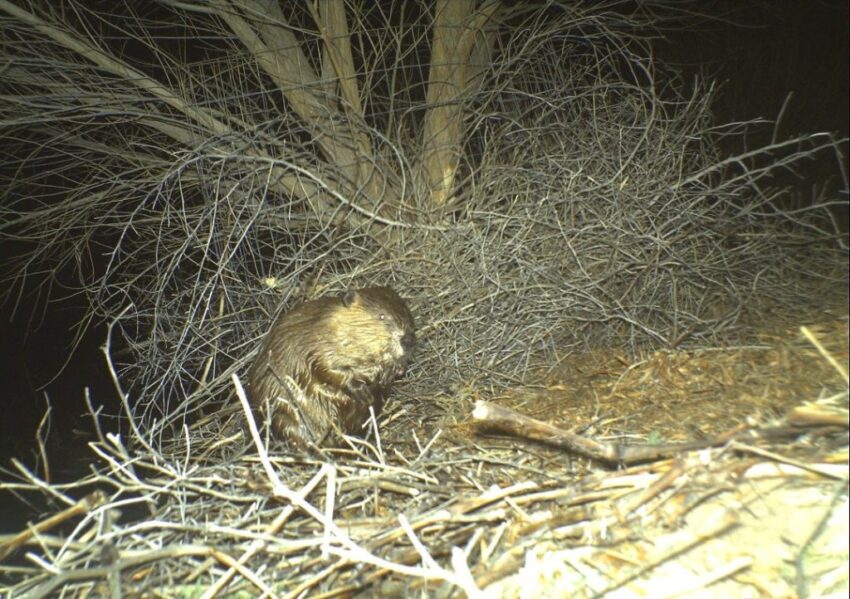
Diego Mendoza-Moyers: In early 2019, a trail camera captured something rarely seen in our dry border region: a beaver sitting at the base of a tree in the Rio Bosque Wetlands Park in El Paso’s Lower Valley.
It wasn’t the first time the park’s managers had seen signs of a beaver at the park — which is a kind of sanctuary for wildlife in El Paso’s urban landscape. But it’s the first time a beaver has made the park its home by building dams, gnawing trees and adapting to the park’s ecosystem.
It’s a sign that, against all odds, some water-dependent wildlife can still make El Paso home, even after we’ve tamed the Rio Grande and turned it more into a water delivery system rather than a wild, naturally-flowing river that used to support abundant flora and fauna.
In just a moment, El Paso Matters reporter Priscilla Totiyapungprasert will join the podcast to share her experience reporting on El Paso’s celebrity beaver and its impact on the landscape at Rio Bosque.
First: This El Paso Matters Podcast episode is brought to you by our podcast title sponsor, Tawney, Acosta and Chaparro, truck crash and injury attorneys. Their team of local, seasoned trial attorneys are ready to help if you’ve been injured in a crash.
And you can sign up for El Paso Matters’ free newsletter and read our reporting at our website, elpasomatters.org.
On to the show.
Priscilla, I’m excited for this one. Tell us about this beaver that you found in El Paso’s Lower Valley and how it ended up making the Rio Bosque Wetlands Park here home?

Priscilla Totiyapungprasert: So, this beaver – I should back up a little bit. I’m not from El Paso, and so I didn’t know that beavers are native to this area. And there was a time when there were a lot of beavers actually here.
And a couple years ago, I was doing a tour of the Rio Bosque for a different reporting assignment. And John Sproul, the manager at the time, mentioned, “Oh, and we have a resident beaver.” And he dropped it very casually and then kind of went on. But I said, “Wait, hold on, back up. Like, there’s a beaver here? I need to know more.”
I had a lot of questions. Like, “What is it doing here? You know, why? I mean, what is it?” And then he explained like, “Yes, we’ve had this beaver. It’s been here since 2019. It’s building dams.” And I was, like, “Wow. That’s pretty cool for someone like me.” Like, I’ve never seen a beaver and definitely would not have thought of beavers being native to the desert. I was, like, “That’s cool.”
Diego: Yeah, we think of beavers more in like, Oregon or something – really heavily wooded, forested areas?
Priscilla: Yeah, these kind of cold places up north where they have these huge dams. And that’s kind of where I learned that there’s actually subspecies of beavers. Not to get a little bit nerdy with you, but there are different subspecies of beavers. And this one is the Rio Grande beaver, also called the Mexican beaver. There’s another desert beaver called the Sonoran beaver. You can find that in Arizona.
And, so, this one is a little bit different from the northern counterparts. This one doesn’t build the big dams that you think of, like the ones in the middle of the river. Or no, not dams, the big dens in the middle of the river. It actually makes its dens on the side of the riverbank in the mud. And it might be because it keeps cool in the summertime. So, I was, like, “Wow, desert beaver – I learn something new every day.”
Diego: Yeah. Well, so just talk about your experience touring Rio Bosque and kind of seeing the signs of this beaver?
And for those who don’t know, Rio Bosque is sort of, like, this wetlands park trying to recreate a little bit of the ecosystem that existed along the Rio Grande prior to the channelization of the river, right, and kind of turning it from a naturally flowing river into something that’s kind of a managed flow? But, so, Rio Bosque is this kind of a – I called it a sanctuary at the top for wildlife, birds and so forth.
But I wonder just what was it like touring it for the story? And it seems like the beavers made quite an impact on the park’s landscape?
READ MORE: El Paso has a celebrity beaver and it lives at Rio Bosque Wetlands Park
Priscilla: Yes, so the first time I took a tour of the Rio Bosque a couple years ago, there was water, quite a bit of water. Because the river is very controlled now, the Rio Bosque Park only gets water from the wastewater treatment plant next door a couple times a year. And, so, this time, when I went back in March, it was a lot drier. That’s because it hasn’t gotten its next flow of water yet. That’ll come maybe in, like, May or June.
So, when the water level is down, you can actually see the dams. There’s six dams right now. And if you walk along the old river channel and you just look down at the dry riverbed, you’ll see these big, it looks like woody piles. There’s a bunch of cattails growing over it, kind of like twigs, branches, dried mud, rocks. And you’re like, “Whoa, that’s a beaver dam.”
And then because the water level is low, you can actually see the dens, too. So, as you’re walking along, you’ll see these holes like, in the riverbanks, and that’s the beaver’s dens.
And when you – I mean, if you were to look inside the hole, I mean, maybe you won’t see it, but there’s actually a little chamber. So, the entrance of the den would be underwater normally. And that’s how the beaver hides from predators, like bobcats or wolves. And then inside the den, there’s a little dry chamber, kind of like a beaver living room, you know? Just dries off, hangs out, chills, snacks on some twigs.
Diego: It sounds like he’s been hard at work. I mean, six dams, and they’re pretty large, right?
Priscilla: Yeah. At least I think they’re noticeable. This beaver is very industrious, as what we think of beavers. They are very hard-working animals. They’re nocturnal. It comes out at night and just works on this dam. And it can build a dam – like, I think it started off with one dam, and then it built like five in a row one summer.
Diego: Wow.
Priscilla: So, yes, it’s a very hardworking beaver.

Diego: Yeah. And I think you had a quote in there that a beaver can down a tree or chop through a tree overnight, right? Like they can really go through the wildlife, or the plants, I mean, kind of in their area.
Priscilla: Yeah, I mean, the trees that grow native to the Rio Bosque, they’re softer. So, they’re easier to chew and have a lot of nutrients inside the bark for it.
Diego: And, so, what did you learn about the beaver’s impact on the park broadly? And you had a quote in your piece about beavers kind of being a keystone species that sort of, like, they impact the environment in such a way that they kind of keep everything going for other animals, right? And kind of just have a big impact beyond just their own hunting and gathering or whatever. But I just wonder kind of the broader impact of the beaver at a park like Rio Bosque?
Priscilla: Yeah, so, beavers, I mean – one wildlife biologist, Ben Padilla, over at the University of Texas at El Paso, he studies mammals there. And he told me it’s a bit like a chicken or egg situation. Like, what came first? The beaver changed the landscape or the beaver disappeared and then the landscape affected the beaver population? They kind of work together.
And, so, because we have changed our landscape here so much in El Paso, not just with the channelization of the river, but with development, agriculture, increased militarization of the border, like, we have not made it a very habitable place for a beaver here.
And, so, for a beaver to even just stick around this long, that’s kind of amazing because it’s not that this is the only beaver in town. I want to make that very clear. People have seen beavers. I haven’t personally, but people have seen beavers like in the irrigation ditches or the canals, maybe more so in southern New Mexico swimming around.
But this beaver has stuck around for quite a few years now and built a home. And I think that’s what makes it different from just other beavers that we’ve seen swimming around while people are fishing or whatever.
Diego: You said that the beaver had to sort of – like, it took some tenacity to get to the Rio Bosque, right? To kind of navigate El Paso’s urban landscape and arrive at the park at all was kind of a big task for the beaver?
Priscilla: Yeah. Like, before this beaver, it’d been quite a few years since the previous beaver. And the previous ones just came and left. And this one, we don’t know for sure because the beaver’s not tagged or anything, but wildlife biologists think that maybe it came from New Mexico, maybe Las Cruces area, somewhere further up north in the river. And then came down and somehow made its way to the Bosque. And then the likelihood of another beaver showing up there, it’s not impossible, but it’s probably highly unlikely.
Diego: Yeah, and that was my next question was, I guess what the park’s managers and biologists have told you about this beaver’s life, right? Like, it’s got this cool home, but you don’t think it’s likely that it’ll have a mate at some point to share the home with? Is that fair to say?
Priscilla: It’s highly unlikely. So, this beaver is maybe 9 years old now. That’s what we guessed because beavers disperse to form their colonies at 2. And this one’s been at the park for seven years, so it’s probably about 9 years old. And then beavers in the wild only live for like 10 to 12 years. They could live more, but just 10 to 12 years.
And then it took so long for this one beaver to show up. There was, like, a big gap period of no beaver showing up to the bosque. So, what’s the likelihood? I don’t know. I’ve been told that once the border wall went up, it’s possible that might impede some of the beaver movement.
Diego: That’s kind of sad.
Priscilla: Yeah, I mean, it’d be cool if it could have a mate, if it could start a family and start a colony. But, for now, we can enjoy that just knowing that we at least have one beaver at the park.
Diego: Yeah, and I’ll follow up with another question. But first, I just want you to explain the beaver deceiver. Like, can you just kind of walk us through what this is and why it’s in place? And I’ll just say it spoke to me, like, the great effort the park’s managers of Rio Bosque have undertaken to accommodate the beaver there at the park. So, just talk through the beaver deceiver.
Priscilla: Yeah, so earlier we talked about how the beaver is very industrious, very hardworking. That also comes to repairing its dams. And for the park manager and the volunteers that take care of the park, when the park receives water, they want to get (it) to wetland cells and to flow to different parts of the park. That can’t happen if there are dams blocking the water.
So, when the beaver built its first dam, people working at the park would take out parts of it. And then they would let the water go through. However, that sound of running water triggers the beaver. So, at night, it would come out like, “Oh, I have a break in my dam. Like, I need to go take care of this.” And it would patch up the hole.
Diego: Time to go to work.
Priscilla: Right. And then the next day, people at the park would be like, “Oh, OK, so it undid our work.” And, for the beaver, it undid that beaver’s work. For the people working at the park, they’re like, “It undid our work.” So, they would have to go and make more holes.
So, that is probably not the most efficient way to work with the beaver, to continuously alarm it. So, they installed what’s called a beaver deceiver.
It’s like a pipe, and it runs through the dam. And there’s like a cage that goes around it. And essentially it just lets water go through, but quietly. So, there’s not that running water sound that will alarm the beaver.
Diego: So, I guess, what did it tell you about like the degree to which they’re willing to do things to accommodate the beaver, right? I mean, that seems like a pretty big step. It was kind of a big underground pipe that’s kind of like running through the park?
Priscilla: Yeah, because in other parts where beavers show up in urban and suburban environments, people are annoyed about beavers damming up their water and basically, they kind of treat beavers like a nuisance sometimes in other places.
And here at the park, they want to take care to work with the beaver. If the beaver wants to stay, they’re not going to kick the beaver out. They’re going to let it stay and they’re going to figure out a way to kind of adapt and still maintain the park while not disturbing the beaver.

Diego: Yeah, which is kind of cool.
I guess, was there anything that you really learned about beavers that surprised you in this story? You said at the top you weren’t super familiar with beavers. I’m not either, right? I don’t really know much about the architecture of beaver dams or all that kind of stuff. So, it’s been interesting to learn from your reporting.
I just wonder if there’s anything that surprised you or that you found particularly interesting about beavers that you learned through the story?
Priscilla: Well, it’s that the dams aren’t just for the beavers.
I found out toward the end of our tour that actually other animals and other wildlife, they use the beaver dams, actually. There’s been footage of other animals crossing the river channel using the dam as a bridge, like a wolf, bobcat, raccoons. They’ll cross using it as a bridge.
There’s also birds. Like, ducks will come because the water gets pooled up behind the dam. And, so, they’ll come and they’ll hang out over there. Birds will go and perch there. Animals will stop there and take a good drink of water. So, it’s not just for the beaver, this dam. It actually affects a lot of wildlife there.

Diego: Wow, that’s really interesting. And just also kind of like I was saying, it’s almost like you can see a little glimpse of maybe the ecosystems that used to exist here, 100, 200 years ago? Before we really kind of developed a river and, like I said, kind of turned it into a system more for water delivery than something to support an ecosystem. But it’s interesting to think a few hundred years ago, maybe there were beaver dams and animals making use of them and things like that.
Priscilla: Yeah, and the purpose of these dams are to keep water around. And that’s a pretty big deal, living here in a desert, to be able to have pools of water and water collected in places.
Diego: Yeah. So, I mean, just based on your conversations, could we ever see a beaver population sustained in our borderland region, like in any sort of large scale? Or is this just kind of like a lone sojourner, kind of a one-off guy who just kind of happened to make his way there against all odds, like I said, and he’ll just kind of be a resident there for a while? Or is there any hope that we could see maybe more beavers in the future here in El Paso?

Priscilla: Well, like I said, there have been beavers spotted up and down the river. So, it’s not the only beaver in town. But the likelihood of having the colonies again, that’s probably unlikely just because of the way the river is set up.
We don’t have these floodplains. The river used to move around and would create these floodplains where trees can grow and that’s beaver habitat. So, we don’t have a system in place for these beaver habitats to naturally flourish to attract beavers to stick around. That’s our issue. We would have to make a lot of changes, but we want the water for ourselves, for our use as human uses.
So, it’s very unlikely that will happen. But there are restoration projects that are happening in other places. Arizona’s one of them.
And I think that, something that really stuck with me is that Ben Padilla from UTEP, he talked about beavers existing in urban and suburban environments. And I said, “Cool, why is that important? Like, why should we have even beavers in these environments living with us?” And he said, “It’s important to have wildlife, like, in our human communities because it creates a sense of wonder to be able to even know that a beaver could exist as our neighbor.” And that’s something I really think about a lot of times, like creating that sense of wonder that, “Hey, these are animals that used to be all over here.” And it’s nice that there’s still some around.
Diego: And it certainly sparked a little wonder in me kind of thinking about just the things that Beaver’s doing to adapt and make this park its home and really make an impact there. It’s interesting.
Just the last question here, Priscilla. You seem to have a penchant for reporting on our celebrity wildlife or wildlife celebrities, I should say. You’ve reported on Bob the Goat and the sheep that have been reintroduced here and now the beaver. Just wonder what it is about wildlife that you find so interesting?
Priscilla: The desert, people think — who are not from the desert or don’t visit the desert – they think of this like, barren wasteland full of just rocks and dirt and can’t really sustain a lot of wildlife, and that’s totally wrong.
I moved here from a different desert, the Sonoran Desert area, but this desert, the Chihuahuan Desert, is the most biodiverse desert in the Western Hemisphere. It can sustain a lot of life. And, so, I really want to drill that home. I want people to know that, like, this is your home. Appreciate that we can have so much life here. And I think that, if we don’t spend time going outdoors, even just opening our eyes and looking around, maybe we miss out on that.
Diego: I think sometimes it takes outsiders coming to El Paso to point out the things that we locals don’t always appreciate.
So, anyways, certainly your story did that for me and kind of realizing like, man, I wouldn’t even have guessed that this kind of interesting, unique water-dependent animal could even make a home here. So, just really interesting story, Priscilla. And I’m going to be looking forward to you finding some other unique, interesting animal that lives in the area that you can profile.
Priscilla: I also want to shout out all the different organizations that work with conservation here, because I find these stories just because I like, go outdoors, and I take these tours, and there’s like birding groups and there’s Friends of the Rio Bosque, for example. And they’re the ones that tell me all this cool information. So shout out to them because I wouldn’t find these stories if it weren’t for them.
Diego: Sure. Well, thanks for your reporting on this, Priscilla. We’ll leave it there for now, but looking forward to your wildlife reporting in the future.
Priscilla: Thanks.
The post Podcast: The story of how a beaver made an El Paso wetlands park home appeared first on El Paso Matters.
Read: Read More