



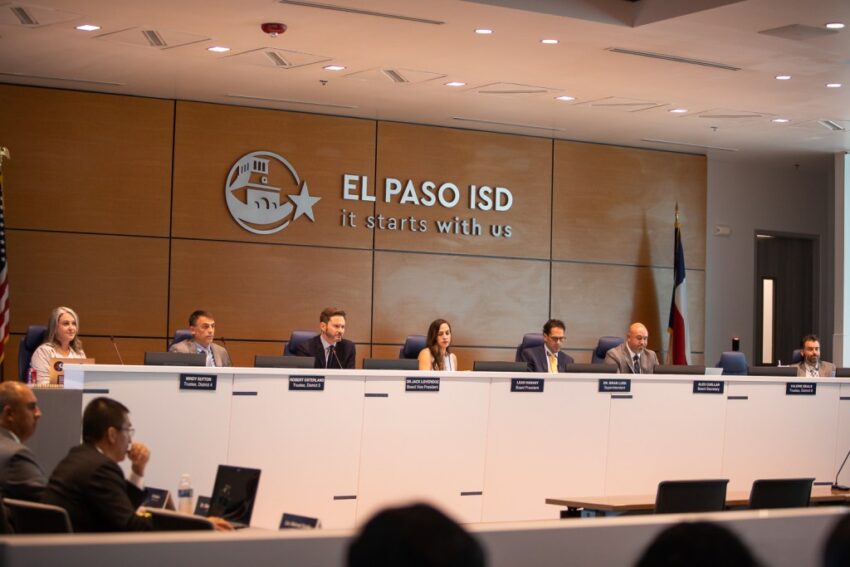

Two trustees resign amid financial turmoil at El Paso’s biggest school district. What comes next?
Diego Mendoza-Moyers: Today: How leaders of El Paso’s largest school district are trying to put the district’s broken finances back together after a budget blowup last month.
The elected trustees overseeing El Paso Independent School District last week voted to enter “financial exigency” – a kind of bankruptcy for public school districts. What that will mean in practice, though, is layoffs for some EPISD employees.
Two trustees resigned from their roles after the vote last week.
As the district picks up the pieces, a question looms: Who’s responsible for the financial mismanagement? Some say the district’s former chief financial officer and interim superintendent withheld bad news and covered up the financial blow up. Others say a lack of state funding was already challenging the district and removed any room for error.
The district’s new superintendent, Brian Lusk, has said the district will reorganize its business and finance department to rebuild public trust – a move that could prove important as the district prepares to put a bond election to voters later this year to raise funds for school repairs.
But the budget blowup was the result of multiple years of oversight, according to EPISD’s financial consultant.
For me, as a graduate of EPISD schools and a resident and taxpayer in the district, questions have come to mind: Why didn’t EPISD have internal controls in place that would have prevented this hidden budget crisis? How did the trustees that voters put into office allow this – a budget blow up that’s going to mean some El Pasoans lose their livelihoods – to happen under their watch? And what will the district do to, once again, regain trust from El Pasoans?
In a moment, I’ll talk with El Paso Matters CEO Bob Moore and education reporter Claudia Silva about the situation at EPISD and what we should expect to see from the district going forward.
First: This El Paso Matters Podcast episode is brought to you by our podcast title sponsor Tawney, Acosta and Chaparro, truck crash and injury attorneys. Their team of local, seasoned trial attorneys are ready to help if you’ve been injured in a crash.
And you can read our free reporting or sign up for our newsletter at elpasomatters.org.
Onto to our conversation.
Claudia, Bob, appreciate you both joining me.
Bob Moore: Thanks for having us.
Diego: Can you guys just bring us up to speed on what’s happened with EPISD’s finances over the last month and just kind of this whole situation that’s playing out there?
Bob: I’ll let Claudia take the first stab at that. That’s an extensive answer.
Claudia: Yeah, well, I’ll try to make it short. But I think a lot of this information started to come to light for the district early last month, and then publicly a little bit more towards the middle end of the month.
But, essentially, if you want a kind of a quick overview, the district learned that they were going to have a deficit that was larger than they initially expected in early May. And a few days after they discovered this, the CFO, Martha Aguirre, resigned. Notably, she used to be the interim superintendent after the previous one, Diana Sayavedra, resigned under pressure from a newly elected board. And before Brian Lusk took over as superintendent earlier this year.
So, after some auditors and an independent company came in to take a look at everything, they discovered that the deficit was much larger than they initially expected. So, last year, they had adopted a budget with a $6 million deficit that ended up going up to $52 million, and we were going to be expecting a $42 million deficit for the following year.
So, in the end, the district needs to cut costs and begin making plans to eliminate 400 positions. Now, since then, the board did vote to declare financial exigency and also said that they were going to lay off about 90 employees. Isn’t that right, Bob?
Bob: That’s the current number. But it’s squishy still.
Claudia: Okay. And, so, that’s kind of where we are today.
Bob: The one thing I want to point out to you on the deficits, because people who follow the national government here talk about the deficits. And, when Congress deficit spends, it means they borrow money. That’s not the same situation here. School districts cannot borrow money – or at least long-term money – to fund day-to-day operations.
So, when Claudia says deficit, it means they’re taking it out of their savings account. And a year ago, when Claudia was covering school board budget meetings, EPISD was bragging that they had the largest fund balance, meaning reserves of any of the major school districts in the county. They’re not saying that anymore. And so just this year alone probably eroded 40% or more of their savings.
Diego: Appreciate that kind of summary on where we’re at. Can you guys just talk more about what financial exigency means for EPISD? Like, what are the implications of that? And then also, you mentioned around 90 layoffs, Bob. I think before they were talking maybe 400 or even more. And, so, what does financial exigency mean and what was behind that reduction in the number of expected layoffs?
6 THINGS TO KNOW: How EPISD is handling a financial crisis
Bob: So, I think Claudia and I have kind of gotten a law degree in school finance law the last few weeks. But, basically, financial exigency says “We can’t pay our bills under normal course of operations. We’re in bad shape. So we have to have some emergency powers that we normally wouldn’t have.” And the most significant of those is the power for the superintendent as the chief executive of the district to break contracts that normally they couldn’t break.
And, most importantly, those involve employment contracts with teachers, with administrators, with everybody who works in the district. And that’s a great power to have. I mean, great in the sense of immense.
And the important context of this, I think Claudia’s research showed that prior to EPISD, only 18 of the 1,200 school districts in Texas had filed for financial exigency in the last decade. This is a very rare and very dramatic step. We’ve compared it to bankruptcy in the private sector, which is not a one-to-one explanation, but much like bankruptcy, it empowers the organization in financial difficulties to break contracts.
And, so, that’s what the board voted on in one vote this past week, and then they made a second vote to approve one of two options that they had on a reduction in force. The numbers, as you indicated, were much lower for both of those options than the previous numbers. That’s because they’ve had vacant positions that haven’t been filled. They’ve had people announcing they’re going to retire so they don’t have to force people out. But it’s still kind of a moving number. And 92 is sort of where we left it on Thursday night.
But the big number for people to remember is probably 600 or more. That’s the number of decrease in employees that EPISD is going to have this coming school year versus where they began the last school year, which is 8% to 9% of the total payroll of the district. We have never seen cuts like this at any public entity in El Paso that I’m aware of. And, obviously, as you can see through the gray hairs, I’ve been doing this for a little while. It is a massive, massive step, and it’s not an exaggeration to call it unprecedented for El Paso.

Claudia: One thing that I did want to note related to financial exigency is that we have heard before that the situation, or at least the tough financial situation, is not completely unique to EPISD. What is unique is how extreme it is. And that something needs to be done and that they needed to declare this in order to correct the issue.
But there are plenty of other districts in Texas right now who are facing tough financial situations. And one of the things I think is that there’s been limited funding increases over several years. I think there was the funding increase that happened last year and then prior to that there hadn’t been any increases since 2019.
So, Texas is also pretty close to the bottom when it comes to per-student funding when you compare it to other states. So, because Texas schools haven’t gotten a lot of funding increases, if there are any mistakes, it just leaves little to no room for error.
And I think that’s one of the things that happened here at EPISD, is that there was some additional funding that they were expected to get. I know there was a “hold harmless” promise when the state legislature gave homestead exemptions and basically increased tax breaks for homeowners.
They promised that they were going to have to give the districts a certain amount of money that ended up not coming through after the comptroller made some recalculations.
Bob: One of the challenges in explaining this situation is that school finance law in Texas is so complex and there are so many moving parts.
But I think Claudia is touching on something very important here and that is that the state has made a number of policy decisions over the years that have been meant to withhold or redirect funding that had gone to public schools. And lots of room to debate whether those were good ideas or bad ideas. But that’s the reason you see so many school districts who had to adopt a deficit budget last year, who are facing extreme deficits this year.
The uniqueness with EPISD and the reason they’re declaring financial exigency and the others are not is EPISD has some horrific self-inflicted wounds here.
And we’ll talk more about that too and what exactly happened. So, it made the situation worse.
So, there’s a lot of moving parts to all of this.

The other big thing that we can’t get away from – and this is also a reason other districts are struggling – is this issue of declining enrollment. And we’ve talked about this repeatedly over these podcasts, and then El Paso Matters has reported on it.
One unique thing that’s now in play is that, for the first time outside the pandemic year, Texas saw an overall decline in student enrollment this year. Statewide, there are about 75,000 fewer students in public schools, which means traditional school districts and charter schools, which has everybody freaked out.
For context, I want to point out that El Paso County accounts for about 3% of all the kids enrolled in public schools in Texas. El Paso County accounts for 6% of the enrollment decline in Texas.
And we’ve also been at it a lot longer than the rest of the state. So, even though we’ve been shedding students for a number of years, we’re still shedding them at a much faster rate than the state. And because funding tends to follow enrollment and attendance, that is the big issue that’s underlying all of this too.
Diego: I appreciate your guys’ explanation of the role of the state policies, right? And just the acknowledgement that El Paso is not the only city with public school districts that are enduring some financial challenges.
But you referred to some of the internal situations at EPISD that have also contributed to their challenges, Bob. I wonder if – can you guys just talk through this debate about the school closures, right? And this idea that, “Hey, enrollment’s declining in El Paso. We’ve got to close some schools. That’s going to be the big financial savior, right? Is closing down some of these operations, realizing savings, and then we kind of make the district leaner and more efficient,” right?
But, at the same time, the district did close some schools last year, and the district didn’t realize the savings it expected. So, I just wonder if you can talk about this dynamic of some people saying, “Hey, look, declining enrollment, close schools, that’ll save everything.” But then the district’s experience hasn’t reflected that. And that’s kind of been a debate, I think, about how EPISD got in this financial position, right? So, can you guys just talk about that debate and what’s played out there?

Bob: Claudia lived through this last year, so I’ll let her kind of outline what happened.
Claudia: Yeah. So, I think one important thing to really mention when you talk about school closures is, when you are dealing with declining enrollment, that is the primary way to address it, is by closing schools. And actually, over the week, I went to an Education Writers Association conference, and there was a big discussion because this is happening nationally. Enrollment is declining, and really, there are just too many schools in this country for the number of children, and this is affecting our community.
So, when you talk about school closures, though, just closing a school doesn’t necessarily save a whole lot of money. A lot of the big savings that you see right away are going to be in utilities and maybe reduce some of the cost of maintenance. But those employees and their salaries don’t suddenly disappear just because you close a school.
So, usually this is a long-term strategy that a district will take. They close a school and over time, as people retire, then they slowly start reducing the number of overall positions. And I really think that that’s what EPISD’s plan was when they wanted to close schools. They promised all the teachers that they were still going to have a job. All those teachers got redistributed to campuses across the district. And, so, essentially, their payroll costs didn’t change whatsoever.
Bob: It actually did. It went up.
Claudia: They weren’t supposed to change – their payroll costs weren’t supposed to change. But, in actuality, what ended up happening is the district ended up hiring more employees and that actually did cause their payroll costs to go up. So, it sounds like to me that they didn’t actually follow through with what their initial plan was supposed to be, which was to reduce the number of employees.
When you look at the employees – so, I went ahead and I looked at the state data, and something to remember with state data is that it counts full-time equivalency.
Bob: It’s the total workforce divided by 40 hours, which, a long time bean counter, I can relate to. So, just when Claudia mentions the FTE numbers, the actual number of human beings involved in this is more than that number. So that’s important to remember.
Claudia: Right. This is the first year that they’ve actually started counting actual employee numbers. But, when we look at the FTE numbers, those went from 7,100 to 7,200 from the previous school year to this one. So, that does show that they knew that they were going to be paying more in payroll even though the plan was to pay less.
Bob: And it’s also important to note that in the budget plan for last year, the school district was planning on a 2.1% decline in enrollment. So, kind of a questionable decision to begin with. When your enrollment is going down by 2.1%, why are you holding payroll steady?
But what happened – and this is one of the errors we can talk about, and error may not be the right word – the actual result of enrollment was that enrollment declined by 4%. The district never adjusted to that and instead wound up adding employees. So, you wind up spending more money, having more employees and far fewer students, and hence you have a massive financial problem.
Diego: And that was also one of the big debates on the board last year, right, was sort of all about the school closures, is this the right path for the district and so forth. So, it’s just interesting that that’s now kind of resurfaced and it turns out it wasn’t the financial savior that I think the board thought.
Bob: It was oversold. And Claudia has been the one kind of consistent voice in all of this, that it really was a long-term savings plan. It was not an immediate panacea. But I think it kind of got spun up as like, “This will help us avoid other hard choices.” But it didn’t happen. And I think it’s an example of going forward that we have to keep in mind that the implementation and consequences of school closures is far more complex than a lot of people assume.

Diego: Yeah. Who resigned from EPISD’s board last week and why?
Claudia: Two trustees resigned from EPISD’s board last week. One of them was Daniel Call. He was, at that point, the longest-running board member. He represented the Coronado feeder pattern. He was elected in 2019 and he and the other trustee who left, Valerie Beals, would have been up for reelection in May of next year. Valerie Beals, she was elected in 2023, and she represents the Franklin feeder pattern.
Bob: And I think it’s important to note that the two of them were part of a four-member majority that favored the school closure plan last year and were very strong supporters of Diana Sayavedra, who was then the superintendent.
In the spring of 2025, there was a school board election where four total seats were up. The two other members of that board majority ran for re-election and were defeated.
So, the result of that was you wound up going from a 4-3 majority that supported the superintendent and her plans to a 5-to-2 majority that were skeptical, to say the least, of the superintendent’s plans. And the relationship between the board and the superintendent deteriorated very rapidly after the election and eventually ended with an agreement by the superintendent to retire.
Diego: Yeah, a big shift in the dynamics of the board there.
I wonder too, I mean, can you talk about why did they resign? Do you think it’s tied directly to the situation EPISD is in? And then when do they resign, how will they be replaced?
Bob: The what I’ll talk about and then Claudia can explain the process we’re about to go through.
So, with Valerie Beals, she said – and I talked to both of the people who resigned – she said that her mother-in-law has stage 4 cancer and she and her family had to move to be closer to her mother-in-law to provide some care. No reason to question that explanation at all. I’m assuming that she was – they’re going through a difficult situation.
It is worth noting she was not at the board meeting, which I would say this was the most important school board meeting in modern El Paso history last Thursday. She wasn’t there. And she didn’t resign until the next day. And actually the resignation didn’t become official until this week. So, that’s why she left.
Daniel Call just said that he needed to spend more time with his family, that he was proud of his board service.
He had made some interesting comments at the board meeting Thursday night. And, frankly, as he was making those comments, I thought to myself, “Wow, he’s going to resign right here.” He was basically saying that he’s made some votes that he now regrets, he wished he’d handle things differently. He’d never specified what those were.

And then he challenged the board members to look in the mirror and take some accountability.
And, at that point, I thought, “Oh, wow, he’s probably going to resign here.” But instead, he decided to use that moment to relitigate the school closures and particularly the decision that was championed by now-board president Leah Hanany to reopen one of the schools that had been closed. And it wasn’t until the next day that I found out that he had resigned. He had told other trustees he was going to resign.
So, I reached out to him and he confirmed to me on Friday that he had indeed resigned. He has not really said “I’m tired or I think the board’s heading in a bad direction” or anything like that. He did say he wishes the district well, but the why of his resignation is probably still not clear. Not to the public. I’m sure he knows why he quit.
Claudia: Yeah. And I think you covered a lot of the things that I was going to initially explain about the two trustees. Beals and Call were the last two remaining members on the board who supported Sayavedra. And, looking back, when the board was voting on the school closures, there was this really fierce divide between anyone who supported the closures and anyone who opposed them. And the push to keep Lamar (Elementary School) open was something that a lot of people have been questioning lately.
But I think we’ve discussed it overall. Keeping that single school open didn’t have a significant impact on the deficit or the issues right now. I think that there’s just been a lot of obvious tension between the two factions. And I think that, at some point, some board members may have gotten a little bit tired of dealing with that tension.
Bob: And I think at Thursday’s meeting, where some of that tension resurfaced when they had to declare financial exigency, because Beals wasn’t there, Call was sort of alone. And he had some points he wanted to raise where he was concerned about not having enough information about the specific impacts of some of these reductions.
And he was actually trying to delay the decision until the next day to allow more information to be gathered, made a motion to that effect, couldn’t even get a second because he had no other support. And he really, without Beals there, he really was isolated. And that was really clear in that meeting.
Diego: Can you guys speak to the process to find a replacement?
Claudia: Yeah. So, from what I can tell, it looks like the district is probably going to appoint a new trustee. Usually, there are two options when a trustee resigns, is either an appointment made by the board, or they hold a special election. The problem with a special election is that it costs the district money. Obviously, since they’re in a financially tight spot, I don’t think that that’s going to be the best option for them.
So, the next best option would be to do an appointment. The last trustee that was appointed to the board was Jack Loveridge. And the process that they went through, I think, was a pretty open and relatively public process. They had different people that applied and they chose three finalists. And those three finalists went through both private and public interviews. The finalists were announced to the public. And then after a period of time, the board voted undecided who they wanted to be that trustee.
So, I assume that they’re going to be taking a similar process. Maybe not identical, but something similar where they’re going to ask for people to apply, if they’re interested and choose some finalists that they will present to the public.
Bob: The difference this time that will be interesting to watch is that all five of the trustees have sort of been aligned on issues. When Loveridge was selected – and, by the way, you got a lot of criticism from some of the more progressive members of the community as not being progressive enough. So it’s one of those kind of interesting moments out there.
But that appointment was made by a board that was a little bit more ideologically divided. Now, you’re going to have five people that – I wouldn’t say they march in ideological lockstep. They’re five very different personalities. All, from my vantage point, seem thoughtful and put some thinking into it. But it’d be interesting to see if ideological diversity plays a role in selecting these candidates at all.
And it’s important to note, as Claudia mentioned, those two positions are up for election next spring. So, these appointments will be for less than a year.
Diego: Yeah, I appreciate all that.
So, I guess I wonder what you guys can talk about it as far as, like, accountability, right? And that’s a word I think a lot of people have been thinking about when it comes to, we’re looking back, how did this happen? What happened? Why weren’t the controls in place to prevent a budget blow up and apparently, systems in place that allowed the former CFO to withhold information allegedly. I don’t know if lie is too strong of a word. But, essentially, the truth wasn’t getting to the board, right?
And, so, I just wonder, what will accountability look like? Is there an investigation underway?
And before you guys answer that, I just want to opine a bit, I guess, that I think the board has been very quick to say, “No, we had nothing to do with this. Look, we weren’t getting the right information. How could we have acted any differently?” Which I think is fair to some extent.
But, on the other hand, I think if you’re just a voter and a taxpayer of EPISD, you go, “How were the controls not in place to prevent this,” right? And I think several of the board members, as you guys have described, haven’t been on the board very long. They were elected, I think, last year. But others have been on the board for a long time, like Daniel Call, the board chair, Leah Hanany. And this has also been a multi-year problem, right, of apparently just kind of a lack of financial oversight and persistence of financial mismanagement.
And, so, as I’m thinking about this as a voter, I go, how did the board allow this to take place, right? And then also, of course, there’s the point of why weren’t there the controls of the EPISD employees themselves?
So, I just wonder, how do you guys think about accountability and how will it look?

Bob: I would suggest dividing that up into two questions, and Claudia can talk about the administrative or staff accountability, and then I can talk about the school board accountability, because I’ve got some things to say about that. And also voter accountability, right? At some point, if you want to hold the school board members accountable, we elect them, right?
So, you want to talk about staff accountability and what Lusk has told us and what people might expect or not expect from any accountability as the district moves forward in its investigations.
Claudia: Yeah, so I think a lot of the information, I don’t know if you agree, has been kind of vague as far as, like, what kind of accountability might come. Obviously, a lot of the biggest accountability when it comes to an issue like this may be someone losing their job. But I think a lot of the blame has been going to Martha Aguirre, who, notably, she resigned.
So, it’s kind of hard to say what kind of accountability there’s going to be there. People have questioned if there may be any kind of criminal charges that could come for this for any employees. And that’s also really been unclear. I haven’t really heard of any actual law that’s been broken.
Bob: And Lusk, the superintendent, has told us that he doesn’t believe there’s any criminal probability, but the investigation is still in progress. So, I think that’s an important caveat.
Claudia: Yeah, so there is still an investigation in progress and they are going to try to be seeing – I think try to pinpoint what errors there were, what communication failure, who might have been responsible for this and how this could have been prevented.
Obviously, though, when it comes to employees, generally, a lot of that stuff ends up being confidential. So, if there is an employee who ends up being found responsible and they end up getting some sort of disciplinary action, whether they’re fired, demoted, put on probation or something, we may never find out.
Something that I also, I guess, wanted to briefly explain before I pass it over to you, Bob to talk, is kind of a little bit about the hierarchy of how this works. The board is, a lot of times, essentially seen as at the top or the one that’s more responsible. But, essentially, they are the boss of the superintendent. And then the superintendent is the boss of all the directors.
And, so, there’s this kind of order of things that need to happen. And the board can’t just go show up to central office or to a campus and start giving orders and say, “Hey, you guys need to do this, and that.” They really need to follow a proper process. There’s actually been board members from different districts who have gotten in some trouble, who have been investigated legally because of things that they did and trying to give directives that were outside of their scope of their power.
So, that’s kind of where they are limited.
I do want to say, and I think that this became very clear to me in hindsight, at the time, maybe these flags weren’t super apparent, but when you look in hindsight, there were a lot of red flags that the board should have been questioning a lot more. And at that point, their job would have been to direct the superintendent to look into this.
Bob: I think the last point Claudia made is really, really important. And it gets back to the board saying that things were taking place that we didn’t know. And while there’s some truth to that, it’s kind of a complex truth too.
And, so, we use the example of the separation agreement with the former superintendent. The board approved an exit package for her, approved a pay raise for Martha Aguirre to be interim superintendent. And then there was never a budget amendment. So, they never designated, like, “Where are we getting this money from? We’re spending this money. Where is it coming from?”
And one of the findings so far in these preliminary investigations is that there were all of these changes that were made to the district’s budget without a budget amendment being approved by the school board, which is kind of standard practice in government. So, there were probably some spending decisions that were made that the board wasn’t aware of. But in this one case, they were aware of it. They made the decision And to say that, “Wow, we didn’t know this was going on” is not 100% true.
So, this issue of who is responsible for what is complicated. But Claudia’s point on the role of the school board is a really, really important one, because it is embedded in law. The school board has two employees. One is the superintendent, the other is the internal auditor. They cannot direct any other employee to take any action. They have to work through the superintendent.
But the board also has a responsibility. It’s like, “Hey, these budget explanations we’re getting, I’m not sure they make sense. Can you ask the CFO to provide more monthly reports on where we are compared to budget for the year?” There are ways that they could have done it. It didn’t happen. Of course, hindsight, it’s easy to say that.

So, then the question becomes, knowing how schools are supposed to be structured, what is the accountability of the school board? They approved the budget with a $6 million deficit. They have board meetings every month, right? Or almost every month, maybe take a month or two off here and there, where they get updates, financial updates from the CFO and other people on the staff. And it’s a bad look if nothing else to wake up one day and say, “Oh, we’re at the end of the school year and we suddenly decided we have a $50 million deficit.”
So, what is the board’s accountability in all of this? And, more importantly, who exercises that accountability?
Claudia and I have asked this question a couple of times to board members with not a whole lot of really solid answers, right? Kind of sidestepping it. And, to be fair, there was stuff that happened that was probably hidden from them.
That became even more clear a little bit at Thursday’s meeting when they declared financial exigency. Mindy Sutton, one of the trustees, made it very clear that the focus of the internal audit investigation is on Martha Aguirre and others that she was meeting with – “others” – and that wasn’t defined. And Sutton was looking – and this was a response to Daniel Call, trying to blame the Lamar situation for the deficit. And she’s basically saying, “You know what they’re looking at. The rest of us don’t.” But that seems to be the direction.
So, some things probably deliberately held from the board.
So, at the end of the day, what are voters to make of it? And this is why, and you mentioned your role as a voter and the questions you have.
Ultimately, the only people that can handle accountability for school board members are the people who vote in elections. And, by extension, the people who don’t vote in elections, too.
So, in less than a year now, we’re going to have elections for three trustees.
Based on recent history, less than 10% of the registered voters are going to participate in these elections. It is hypocritical, to some degree, to say “I want somebody to be held accountable” and then sit it out and not vote.
And I think Claudia is immersed in this. She’s explained to people very in-depth in this conversation of how systems are supposed to work. But I think Claudia and I have talked a little bit about this too, one of the things that strikes us from the public conversation on this is, at root, the public doesn’t know how schools work. And they want things to happen that can’t happen.
Probably the most common reaction we see on social media to the exigency declaration is “the board should cut their pay.” Well, the board’s not paid, right? It’s a volunteer job. And, so people don’t understand how processes work. And I get that. I mean, I’ve been doing this for way too many years and I don’t understand how things work. But at some level, as members of a democracy, we have obligations to understand who has what power, basically, and what they can do. And decide, “OK, this is the kind of person I want with that responsibility.”

And for a long time, maybe through all of our history, the vast majority of El Pasoans choose to sit out school board elections. And there are good reasons for it too. They’re held at a time when no other elections are being held. School board candidates don’t raise a lot of money. And, so, they really can’t educate voters on what’s going on.
Claudia in the last school board election and some of the other members of the El Paso Matters staff spent a lot of effort to tell people about who these candidates are. And even with this really controversial period around school closures and things out there where interest in the schools was highest, we still had fewer than 10% of people turn out.
So, I understand the desire for accountability. I think a lot of times that the desire is like
“We want somebody to blame.” And I get that. But blaming somebody is not accountability. Fixing things is accountability. And, at the end of the day, we’re in a democracy. And we – or at least those of us who live in the El Paso Independent School District – have a say in that. And it’s up to us to decide what the accountability is.
Diego: Appreciate that explanation, Bob. I think sometimes we don’t always connect the decision-making at the districts to the ballot box, right? And the fact that we have very low turnout here and then we have these bad outcomes.
So, just last thing here, speaking of the ballot box, it seems like EPISD is still poised to go to voters and ask for a bond, right? To raise some funds for school repairs and replacing the air conditioning units at schools. Just wonder if you guys can kind of talk about that. Are those plans still set in stone and what are your expectations?
Claudia: Yeah. So, right now it’s really early to know exactly what the plans are going to be for a bond, but there is a bond advisory committee. And the purpose of the committee is to give the district and the board recommendations on a potential bond.
And when we’ve talked to Lusk and we’ve talked to certain board members, it does look like that’s still going to go forward. And I’ve talked about this before, is that there is a significant need on a lot of the campuses. There’s a lot of old, aging campuses, some of them that are reaching close to 100 years old or even older than that. Outdated air conditioning. And I think that that’s really been affecting students. And I think the superintendent has been cognizant of that and the board has been cognizant of that.
And, so, despite all of these issues, I think they still want to move forward with that for the benefit of the students. Now, that being said, I think it’s going to be very difficult for them to gain enough support for this bond. People were already relatively, I think, upset at EPISD when the school closures happened.
Then, when Diana Sayavedra resigned – which was, I think it was somewhat unexpected. I think a lot of people knew that the relationship with her and the new board members who got elected wasn’t the best. But I don’t think people expected her to resign when she did. And I think that did leave a bad taste in some people’s mouth.
Then when we have now the situation of financial exigency, you’ve mentioned this, people are questioning whether EPISD has the ability to manage people’s money.
Now, there are two advocacy organizations, kind of these grassroots groups, that have been very supportive of the bond. The Amanecer People’s Project and Familia Unidas Por la Educacion. Amanecer, they have the Escuelas Frescas campaign, and they’ve been really focused on getting updated air conditioning into schools. And that’s really where their focus has been as far as this bond.

And with Familias Unidas, they’ve been really focusing on barrio schools and schools that they believe have been kind of historically neglected and wanting to improve those schools. So, those are two organizations that may help the district gain some momentum in getting the bond approved. I think it’s notable that, when we looked at that school board election, that really changed the majority. I think they played a major role in getting people to turn out to vote.
Bob: These advocacy groups played a major role.
Claudia: Yes, these advocacy groups, yes. I think they played a major role in getting people out to vote. So, I think just looking at that, if a lot of people are still really passionate about the issues that are affecting children, they may be able to help gain that momentum.

So, if an election does happen in November, that’s going to be a midterm election. And there’s going to be a much higher turnout with those elections. Sometimes the wording on bonds can make voters say, “Hey, I don’t want this.” So, you may get a lot of voters that come in for the midterms, they don’t know anything about EPISD, the issues that are there, the need for this bond money. And they say, “Hey, the district wants more money. Well, I don’t want to pay more taxes.” So they may just vote no just simply because of the ballot language.
So, whatever the district decides to do, they’re going to have to get a lot of information and really try to educate people on what the bond is going to be for, how it’s going to affect taxpayers, and how they’re going to, I guess, right the wrongs of all of these budget issues and essentially regain the trust. Which, at this point, I think they’ve just been saying, “Hey, trust us.” But I think a lot of people are still wondering, “How can we trust you?”
Bob: And trust is the major word here, right? So, Claudia is a very important point about who the electorate’s going to be in November. We just mentioned that, in a typical school board election, which are held in the spring of odd-numbered years, fewer than 10% of people vote. This election, because of this unique moment in our history, like 50% or more of registered voters in El Paso may vote. We may set a record for midterm election voting in El Paso.
But let’s be clear, the reason people are going to be voting in November is to punish Donald Trump or support Donald Trump. And, so, while they’re going down the ballot, they’re going to be thinking about all of those things and affordability and there’s all kinds of stuff coming up.
Then, probably up near the top of the ballot for, and maybe the first issue on the ballot for a lot of people, is going to be this school board bond issue. So, they’re going to look at it and most of the people don’t have this deep knowledge that we’re talking about. They’re going to vote on vibes too. It’s like “EPISD, that’s the one that’s always in trouble, right?” And not just now. Like we’ve got way too much history here with scandal after scandal in EPISD. So they may say, “No, I don’t want to do that.”
On the other hand, the added turnout in this election is going to be made-up in large part by much younger voters than would normally participate in the process. Generally speaking, younger voters are more inclined to support these kinds of bond issues. And, as a matter of fact, it’s important to remember the last time EPISD passed a bond issue was in November of 2016. And what else happened in November of 2016? Donald Trump was on the ballot for the first time. El Paso set at the time a record in turnout for that.
And I remember having a conversation election morning with Juan Cabrera, who was the superintendent, and he was asking me my predictions for the bond vote that night. People are always asking me for my predictions. I am really lousy at political prognosticating, so don’t ever do that. But I told Cabrera that I think the bond was going to pass narrowly, and at the end of the day, he was going to owe Donald Trump a thank you letter because Trump drove young people out mainly to vote against him, and they also turned around and voted for the bond issue.
So, people who are dismissive of the chances of the bond are most likely correct, but some of the points Claudia brings up are really worth considering. And, by the way, one of the numbers that I – or the number that I keep hearing back from people, because the superintendent’s been going around to various groups around town to try to begin rustling up support. He’s never mentioned a number to Claudia and I as much as we push, but the number I keep hearing is $420 million. So, it’ll be interesting to watch if that comes. And for younger folks, 420 has some significance. I don’t know if that’s the reason why they’re settling on that number. I just want to throw that out there.
Diego: Appreciate that breakdown, Bob. And I’ll just say, again, as just kind of a resident and voter who’s not as enmeshed in this stuff as you are, I think the key question is like, will the voters have the trust that, with additional money in hand, will EPISD effectively and efficiently manage it and go ahead and deploy the money in a way that’s going to be effective and not just waste money and actually, like, put HVAC units in schools and they work well and (they’re) good deals and so forth?
Bob: And it’s worth remembering that, in that 2016 bond, the district did not do that. And there’s a lot of people mad about that, that it took way too long for those projects to finish off. There are still subcontractors in town who spent money out of their own pocket to get work done on one project who are still waiting for $400,000 in payment. I don’t think they’re going to be out campaigning for the bond. So, those are the things to keep in mind. They’re all really important points.
RELATED: Years after Don Haskins PK-8 opened, subcontractors claim unpaid work from EPISD project
Diego: Yeah, and those are great points, Bob. But, at the same time, and Claudia and I have discussed this, like, even as I have these questions as a voter, you understand that if voters vote no, the only people who pay, right, are the students who sit in hotter classrooms and have worse facilities and all those kinds of things.
Bob: Yeah, this is not a luxury we’re talking about. Being able to work in a classroom where you’re not sweating is really important to student achievement.
Diego: Yeah, exactly. So, it’s just a really interesting issue with all of this financial blow up going on in EPISD, turmoil on the board, new members. It’s just a lot of moving pieces, man. It’s just a lot to witness. Again, I’m not quite as enmeshed as you guys are, but I just go, “Man, this is a big mess for EPISD to try to clean up in the months ahead.” So it’ll just be really interesting to see how it plays out.
I think we’ll go ahead and leave it there. I don’t want to take up more of your guys’ time, but just appreciate you laying out kind of the politics and the situation, all the complex dynamics at play here. And we’ll just look to you guys to keep us informed for the next few months about all things EPISD.
Bob: I’m going to lay that on Claudia. She’ll take care of you.
Claudia: Yeah, thanks for having us, Diego, and thanks, Bob, for covering me while I was gone.
Bob: Glad to help.
The post Podcast: What’s next for EPISD as it navigates layoffs, board turmoil and aging schools amid budget crisis? appeared first on El Paso Matters.
Read: Read More