




Never miss an episode. Subscribe to the El Paso Matters Podcast on YouTube, Apple Podcasts or Spotify.
This episode was recorded Aug. 13, 2026.
Read the transcript
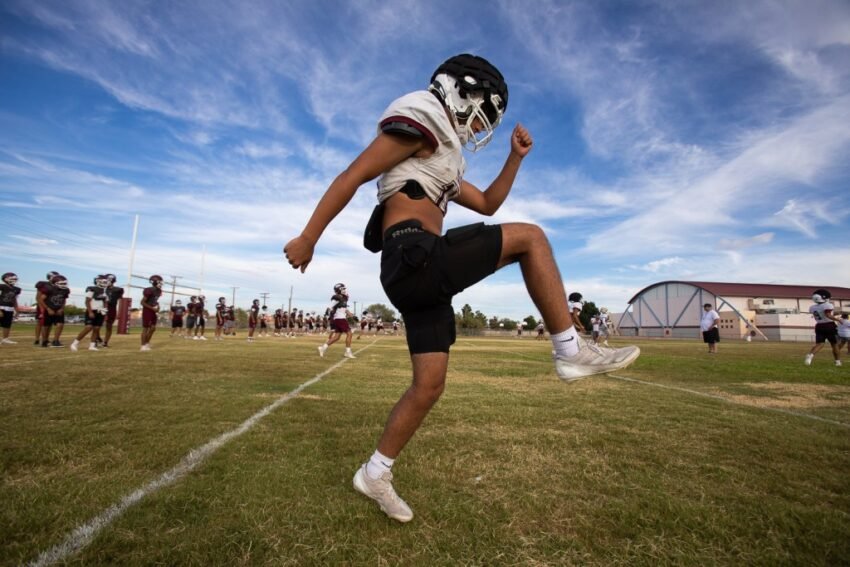
Diego Mendoza-Moyers: Today: Ysleta High School in El Paso’s Lower Valley turns 100 this year, and the school’s football team will look to defend its district championship this season – the school’s first in nearly three decades.
Amid financial challenges and declining enrollment at El Paso’s public school districts, Ysleta Independent School District managed to direct some funds to repair Hutchins Stadium and fix drainage problems beneath the field that almost prevented Ysleta High School’s football team from playing at its home stadium that dates back to 1939.
How did YISD manage to find funding to fix up its flagship school’s football stadium ahead of the start of this upcoming season? And why should schools prioritize athletics at all during tough financial times?
El Paso Matters Assistant Editor Pablo Villa will join me in a moment to talk about his recent reporting on the history of Ysleta High and its long-lived football team, the details of YISD’s financial situation and what athletics mean to high schools and their surrounding communities.
First, this El Paso Matters Podcast episode is brought to you by our podcast title sponsor Tawney, Acosta and Chaparro, truck crash and injury attorneys. Their team of local, seasoned trial attorneys are ready to help if you’ve been injured in a crash.
And you can sign up for our newsletter or read our free reporting at elpasomatters.org, where you can also learn about and register for our 9.15K run that’s coming up on September 19th.
Now, on to the show.
Pablo, football season is upon us. Thanks for taking a few minutes to join me and talk about this.
Just to get into it, Pablo, just give us the overview of your story and what you found and just kind of some of the – why you got into the story, I guess, at this time?
Pablo Villa: Yeah. So, Diego, first of all, thank you for having me. It is our favorite time of year, right? Football season is upon us again.
So, ostensibly, this was really just a story about the start of another high school football season, right? Ysleta, as you mentioned, is coming off its first district championship in 30 years. Its head coach, Joe Martinez, was actually a player on the last Ysleta team to win one – to win a district title, back in 1997.
Now, they’re returning home to a renovated Hutchins Stadium right there on the campus at a pretty remarkable moment in the school’s history. So, what I found in my reporting, though, was an interesting confluence of things. And I think it turned it into something a little bit bigger than football.
So, Ysleta High, as you mentioned, is marking 100 years of accreditation as a high school. And this is a campus that has really deep ties to the Lower Valley. I think, if you look back at history, the footprint that Ysleta managed, at least in terms of its enrollment, it was a really wide swath of El Paso County.
When you consider that Jefferson High School didn’t open until 1949, Bel Air High School opened in 1959. You’ve got to remember that those schools didn’t exist at the time. So, Ysleta pulled in kids from all over the place, right? And a lot of those kids became adults and still live in this community. And generations have continued to go to Ysleta High, right? There’s a really big sense of pride that was instilled at that campus way back then.
And the stadium, Hutchins Stadium, opened 1939, 10 years after the campus that exists now opened. And it’s really become a focal point of the campus. If you go down there, if you’ve been down there to Ysleta to watch a game, you know that Hutchins sits in the middle, right? And the main campus is up in the front, fronting Alameda Avenue. And there’s buildings all that have flanked the stadium over the years, right? So, it’s really just the centerpiece of the campus.
The other layer that’s added to this that you kind of mentioned is that keeping those traditions intact doesn’t happen on its own, right? Ysleta ISD is dealing with declining enrollment, tighter finances, and nearly $72 million in deferred maintenance needs that it identified over the summer.

Diego: Yeah, which we should say every school district in El Paso is kind of dealing with similar challenges of declining enrollment, inadequate state funding and so forth, right?
Pablo: They are. It’s not a unique problem to Ysleta ISD. And, actually, this is a good opportunity for us to give a shout out to our education reporter, Claudia Lorena Silva. I encourage all our readers, or all our listeners, rather, to go read her coverage of school finance. She’s done a really great job of really outlining what every district is dealing with.
But there are recurring themes there, right? But, so, the district spent $1.8 million to replace and remediate the field at Hutchins Stadium. And, for a while, it wasn’t clear that Ysleta was going to be able to play there at all, right? And I think some of that was a little overstated, and we can get into that in a little bit. But there was certainly potential for them to miss at least a portion of this season, which would have really been a bummer for some of the senior kids on that team and probably for the community, right?
So, to me, this became a story about what it takes to preserve something that feels normal, right? A football team plays on Friday night, families fill the stands, alumni show up, all those things. Those things can look effortless, because they’ve happened for generations. But behind them are decisions about money, about facilities, about enrollment and what a school district chooses to preserve. So, that’s really what drew me to this.
Diego: Yeah, it was interesting that it wasn’t, like, a high school football preview of Ysleta’s upcoming season. It was kind of this broad look at the situation we’re in as far as public school districts really throughout Texas and in El Paso dealing with a lot of challenges, a lot of just financial issues and declining enrollment and all these things. And yet, to your point, Ysleta’s managing that, trying to overcome it and preserve, like I called it, its flagship campus and the stadium there and the football program and all that.
I guess, can you talk a little bit more about what was wrong with Hutchins and why did it need this renovation?
Pablo: So, I guess the first thing to mention is that Hutchins actually got a turf field and all the schools in Ysleta ISD got turf fields back in 2016. That was part of another, of a bond package that voters passed back then. And the life of all those fields was about 8 to 10 years, right? So, we’re right at the 10-year mark now. So, it came time to replace all those fields.
And, actually, Ysleta ISD, the board, approved a replacement of all their high school football fields over the summer. And just about all of them, I think, at this point, have their fields ready to go for the season.
Ysleta was actually a different line item in all those budget presentations that took place over the summer. It cost a little more. And the reason for that was that, underneath the turf, there had to be some remediation that was done. The issue is that the Lower Valley – and you might be interested in this or know a little bit more about this considering you’re our environment reporter and know about these unique geographical things that afflict, or rather that are present in our city. The Lower Valley has an abundance of clay underneath the soil, right? And the issue, at least what was described to me, is that clay, due to variances in heat and moisture and all those things – because you’ve got to remember that for about 70 years of its life, that stadium was getting watered, right? There was actual grass that was there.
We’ve had 10 years of no water because we had a turf field there since 2016. And, so, that clay sort of did what it does underground and metastasized and moved around and shifted. It started creating these dips in the field. And it became a safety issue for players, right?
You can imagine you’re running your fly routes or your out routes, you’re doing whatever you do as a football player or a soccer player on that field, and you’re going to run into a dip and blow out an ankle, blow out a knee. So, the district had to remedy that somehow, right? And, so, that’s really the biggest reason that project costs a little bit more.
READ MORE: Ysleta ISD nearly depletes savings under adopted budget, avoids layoffs for now
Diego: Yeah. So, I mean, where did the money come from for this renovation? And we should say that the broader context, and we’ve talked with Claudia and she’s done a lot of reporting on this for the real fine details. But, the point is, Ysleta’s superintendent has talked about a reduction in force and about – I guess that doesn’t necessarily mean layoffs, but fewer employees working there because of the financial challenges the district is dealing with and declining enrollment and so forth.
So, where did the money come from? And I’ll have a follow-up, but just, where’d they get the money to do this renovation?
Pablo: So, it’s a really great question. And I think that there’s very heavily nuanced things that have to do with school finances, right? And again, I would encourage everyone to read Claudia’s coverage because she does a really good job of outlining all of it, right? But, to your question, so the $1.8 million that Ysleta High, that the Ysleta High football field project, so, it was included in a much larger package of deferred maintenance needs that were identified by the district, right?
It was about $72 million And that included everything from roofs, air-conditioning units, buses, all manner of things, right? It wasn’t just tied to athletic facilities. So, in June, the school board approved a financing mechanism that allows the district to pay for eligible projects and later reimburse those expenditures with proceeds from future debt, right? With the associated budget cap at $65 million. So, we had $72 million, the package was worth about $65 million. So, this wasn’t a standalone $1.8 million bond for Hutchins Stadium.
It was part of a broader strategy for the district in terms of dealing with its different maintenance needs, right, and spreading those costs over time. And, again, all those things are really heavily nuanced. Some of the projects are happening now. Some of them already happened. Some of them will happen over the course of the next couple of years, right? And it’s sort of up to the district on how they’re going to manage that. And that’s something, of course, we’ll be watching and making sure that we’re holding them accountable for the things they say they’re going to do and making sure they actually do them, right?
And it’s far more important that they do those things the way they plot them out now, because as you mentioned, school finances are really tight these days, right? We’re not going to see this grand rush of new kids coming to these schools and allowing them to have more money. So, schools have to be really careful with those things, right? But as it pertains to your question about this stadium, the $1.8 million was part of a debt package that the board approved this summer. It doesn’t involve any tax raises or anything of that sort, at least not at this point, right? But that’s really where the money’s coming from.
Diego: But I want to talk a little bit more about the history, Pablo. And you got into some of the more recent history, but this was really interesting. So, I said at the top that Ysleta turned 100 this year, which isn’t really true, but it’s kind of true. It turned 100 as a four-year high school.
And, so, talk about that distinction and just try to, I mean, as best you can, take us back to this era, because it’s kind of crazy to think about 100 years ago, how different this was. Ysleta is this agricultural community, probably fairly disconnected from the center of El Paso, right? It’s kind of, like you said, its own distinct municipality. Talk about that history 100 years ago and just some of the other nuggets you found in your reporting.
Pablo: Yeah, so there’s actually newspaper stories dating from, like, 1919, before the 1920s, that actually allude to graduating classes from Ysleta High School. My presumption is that those are actually referring to the kids who would graduate but then have to move on to schools in El Paso proper to finish their high school.
Diego: Because it was only a three-year school.
Pablo: Correct, correct. Yeah. And, so, that’s something that was sort of a sign of the times back then. I mentioned to you before we started talking that, when I did a story on Tornillo High School’s 100th graduating class a couple years ago, I discovered that they were in the same boat. Tornillo kids would go to the school in their area for a couple of years, but then they’d have to go finish their high school years somewhere else.
Diego: At, like, El Paso High or some established high school within the city of El Paso?

Pablo: Right. And, so, in 1926, that was the year that Ysleta received, I guess, its accreditation to open its own four-year institution. I’m not quite certain where they held that because the actual high school that we all know that sits on Alameda Avenue didn’t open until 1929. It was a Trost-designed school. There’s some folks in town who really love those buildings and that’s one of them, at least the original campus was.
But, yeah, so, as you mentioned, it was a very agrarian area. If you look at old pictures of Ysleta High School, it’s fascinating to see that there was nothing around it. Now there’s a McDonald’s across the street and all kinds of tire shops and all kinds of things that surround it. Back then there wasn’t anything. It sort of sat out there on its own. And that’s probably what helped make it such a focal point of the community, right? Because it was just this beautiful building out in the middle of, not in the middle of nowhere, but out on its own amid all this expansive space.
But, so, I think the most fascinating thing that I found was just how big of a school boundary it had. And when you think about these communities such as Jefferson High School or the Bel Air area or the Del Valle area, Riverside area, when you think of that, many kids. And certainly there was fewer of them because, again, agrarian areas tend to be more rural and not as many houses.
But that’s so many factions of El Paso just coming together and melting in this one school. And, so, I just think that’s really awesome, because there’s – you look at those areas now and they’re so different, but back then they were all the same and that’s just fascinating how much that’s contributed to our culture now.
Diego: Yeah. And, so, Henry Trost, right, or Trost, the one who’s designed many of these downtown buildings, I thought it was interesting that he’s even out there in the Lower Valley designing a high school, right? And so I think you said the high school, the building was completed in 1929. Is that right?
Pablo: That’s correct.
Yeah. It’s completed in 1929. And, yeah, I mean, the Trost-designed buildings all over the place. As you know, they have buildings out in strange places like Marfa and – not strange places, but just these out in the middle of nowhere kind of places. So, they got some business done down here. And Ysleta High School is one of those expenditures that was made.
Diego: And then the stadium opened in 1939, right?
Pablo: Stadium opened in 1939. It originally cost $50,000. Can you imagine? I mean, I’m sure there was an uproar back then. But no, so Hutchins, it seems like it was a very celebrated piece of Ysleta High School and it still remains so. It’s pretty cool to think that stadium is almost 100 years old and doesn’t really even have any problems. I mean, the concrete, if you look at it now, there’s not really any cracks in the concrete. We got to see the stadium a few times as part of this story. And it’s still there, it’s still standing, it’s still solid, you know, it’s still a good place.
I remember myself having to run stadiums there as part of joint practices for various things, right? And I played on that field. It’s a cool place. It sort of harkens back to an old era of football that’s not necessarily part of the conversation anymore.
Diego: I can hear, like, my dad’s generation be like, “Oh, man, they don’t make it like they used to.” So, that’s interesting.
But, yeah, it was just really good reporting on the history and things that, even as a lifelong El Paso and I really didn’t think too much of. And I told you when I was in high school, I was in a High Q tournament there at Ysleta High School. And, certainly, when I rolled down there, I wasn’t thinking, “Oh, man, there’s beautiful architecture” and so forth. So, it’s kind of interesting to sort of have your mind open to this interesting history in your own community.
We’ll wrap up here in a second, Pablo. I did have to ask, all right, so, Ysleta High School, we talked about the history, bringing it back to today, or I guess last year they won, I think they went 10-0, right? They won their district title in 4A. First time they’ve done that in decades from the head coach that was on the team the last time they did it. All that’s pretty cool.
What do you expect for this upcoming season? Should Ysleta High School fans in the community expect another district title?

Pablo: I think they’ve got a lot to be excited about. So, they have their offense returning almost intact. And certainly the best two players on that offense are back. And that’s Rodrigo Martinez, their quarterback, and AJ Guzman, their wide receiver. AJ Guzman’s a big kid. He’s about 6’1, 170. Catches well, runs well, was a big part of their success last year.
So, yeah, I think last year, if you want to talk about how good their offense is, their biggest game of the year last season was against Riverside, their Lower Valley rival. They scored on all nine of their possessions last year. So, that’s the kind of offensive firepower they have.
And it’s all back, basically. The one thing that’s interesting, that will be interesting to see, is they have Andress entering their district this year. Andress moved down to District 1-4A. And that’s going to be the last game of the season this year. Andress will go down to Hutchins Stadium to play in the final game. That might end up being for the district title. We’ll see. But I would expect Ysleta to be a force in the city this year.
Diego: Sounds like Ysleta’s offense might be a little more fun to watch than even UTEP’s.
Pablo: Well, we won’t get into that. I don’t want to get in any kind of trouble. But yeah, Ysleta definitely has some fireworks on offense. And like I said, all the pieces are back. So, we’ll see.
Diego: And just a preview for listeners. Pablo and I will be discussing soon some of the dynamics involving UTEP athletics as well.
But, anyways, well, appreciate your reporting on this, Pablo. Really interesting history. I love when you find these little niches and these things that we don’t think about. Something that started as, like, a stadium renovation turns into this interesting exploration of the history, the finances of today and all these different topics. And then we’ll see how the kids at Ysleta do this season.
But, yeah, I just appreciate you taking a few times or a few minutes to talk through your reporting and kind of share what you found.
Pablo: Yeah, of course, Diego. It’s always fun. And I’ll share a little personal story about Hutchins Stadium. Well, first of all, that’s the first stadium I ever played in as a high school football player myself.
Diego: For Montwood High School. Back in the ’90s, right?
Pablo: Yeah, back in the ’90s. And, so, I’ll also share that I actually played against their head coach, Joe Martinez, back in 1998. And we actually shared some stories about that game way back when while we were touring the field.
And I had to go ahead and take a picture of the field and show a good friend of mine from that team, Mr. Robert Rodriguez, who some of our, maybe our older generation will know him. I don’t know if our younger people do, but Robert Rodriguez was a great Mountwood running back. He ended up switching to linebacker when he played at UTEP back in the early 2000s, was the WAC defensive player of the year in 2004 and helped the Miners to the conference title.
Conference title, it was in the Western Athletic Conference, but also to the bowl game in Houston, whose sponsor I can’t remember right now. But I took a moment to share that photo with Robert and let him know that I remember this game, “This is where you scored your first varsity touchdown.” And Robert was kind enough to write back and share some kind words about that. So, that was fun. It’s just fun to go back to the old days and remember those times.
Diego: Yeah. A lot of history. And I’m glad you were a part of it too, Pablo, in person. Pretty good times on Montwood athletics, so that’s cool. Thanks for sharing that.
Pablo: Yeah, so, go Rams this season, too.
Diego: Yeah. All right, we’ll leave it there, Pablo, and just look forward to having you on in the future and talking about more of your little athletics niche history that you find that you can share with us.
Pablo: Yeah, absolutely, Diego. We’ll see you next time.
Diego: Sounds good.
The post Podcast: Ysleta High School turns 100 as football, school’s history and YISD finances converge appeared first on El Paso Matters.
Read: Read More