



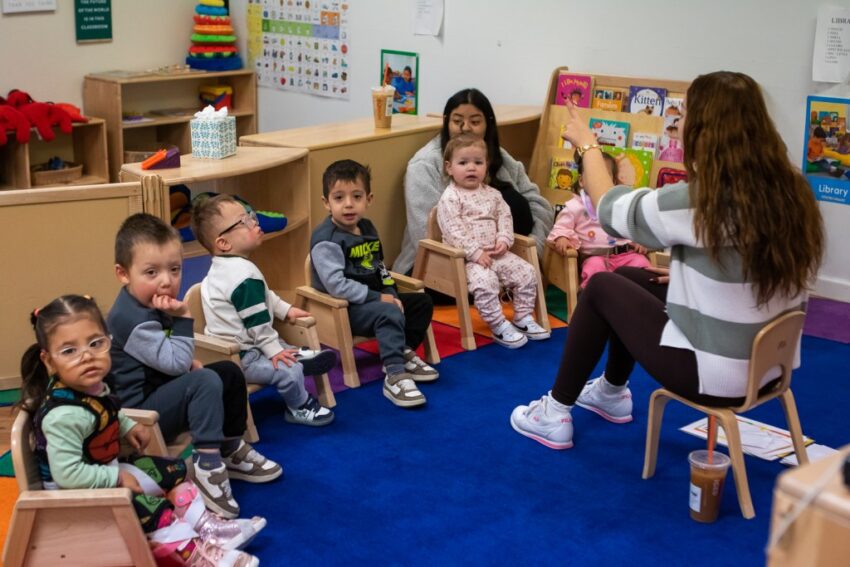

Two-year-old Zoe Hernandez’s face lit up as she clutched her teacher’s hands above her for support while walking to the toddlers’ classroom at the El Paso Special Needs Education Center.
The Westside nonprofit private school and daycare specializes in teaching children with Down syndrome using an inclusive education model that brings together students with and without disabilities.
After spending time learning and sharpening her fine motor skills, Zoe, who lives with cerebral palsy, used her purple walker to get to gym class and hug her friends.
Starting in August, Zoe and some of her classmates may be able to attend the school at no cost under the voucher-like Texas Education Freedom Accounts program that allows eligible families to receive state funding to pay for private school. The school recently received approval from the state to accept the vouchers.
Zoe’s mom, Alejandra Hernandez, said the funds could give her family some financial relief and help ensure Zoe, who now attends school only three times a week at a discounted rate, can go to class every day as she enters preschool.
“I’m considering bringing Zoe at least one more day. And it’s just numbers in my head,” Hernandez said.
Under the voucher program, eligible families can get $10,500 per student a year to pay for tuition and other approved expenses. Children with disabilities with an individualized education plan, or IEP — which outlines accommodations and modifications a school must follow for a specific student — may qualify for up to $30,000 a year.
Tuition at the center, also known as Every Little Blessings Preschool, comes out to $6,000 a year for students attending full time.
Applications for the state’s $1 billion voucher program, which was approved by lawmakers during the 2025 legislative session, opened Feb. 4 and close March 17.
SEE ALSO: Private school voucher applications open, Islamic school funding in limbo
Supporters of vouchers say it gives parents of students with disabilities more options for their child’s education.
“We know that money can be a factor, especially for children with disabilities and families because of doctor’s visits and all of the medical things that go along with that, so it’s nice to know that maybe places like ours would be an option for them because of the vouchers,” said Michael Phillips, the school’s executive director.
Meanwhile, critics, including David DeMatthews, an associate professor in the Department of Educational Leadership and Policy at the University of Texas at Austin, argue it can create further disparities for students with disabilities in an already uneven playing field.
“Schools serving high percentages of low-income students and high percentages of Black students have done a poor job creating high-quality programs for students with disabilities. It has just always been an issue in our country, across the board,” DeMatthews said. “Now, we have a voucher law that is set up and sort of a way where parents, by taking the voucher, lose all of their federal and state protections for special education if they enter into a private school.”
Unlike public school students, those attending private school are not covered by the Individuals with Disabilities Education Act — or IDEA — which outlines that students must receive a free education tailored to their needs.
Although students with disabilities must have an IEP to qualify for additional funding, private schools are not required to follow them.
Private schools can also decline students with disabilities from enrolling and do not have the same required oversight as public schools, such as publicly reporting student performance data.
Learning from students with different abilities

Jessica Quinn, the academic director at El Paso Special Needs Education Center, said the school’s small size allows its teachers to offer individualized care to every student.
“That benefits not only the children with disabilities, but also the children who are typically developing, because we can hold high standards for all of them,” Quinn said. Typically developing children refers to those who reach developmental milestones such as walking, talking and expressing emotions within their expected age range.
The El Paso Special Needs Education Center has about 25 students from ages 1 to 5, and has a capacity for 30 children. Students can qualify for Texas Education Freedom Accounts starting at age 3 if they meet the state’s public pre-kindergarten eligibility requirements.
The school is accredited by Coginia, one of the largest nonprofit organizations that accredits primary and secondary schools throughout the U.S. It promotes having a 3 to 1 student-teacher ratio.
Meanwhile, public schools are required to attempt to maintain an average 11 to 1 student-teacher ratio with a maximum class size of 22 for kindergarten through fourth grade.
Phillips said the school uses a curriculum that is geared toward children with Down syndrome, “which also happens to be just best practices for our typically developing kiddos.”
The school uses programs such as Teaching Strategies, which Quinn described as a student-led curriculum that allows children to investigate for answers, and Raising Robust Readers, a phonics-based program designed for children with Down syndrome and dyslexia, which uses music to teach them to read.
About half of the school’s students are considered typically developing children, and half have some form of disability, including Down syndrome or ADHD.
Phillips said this allows students to learn from children with different abilities.

“We really teach both sides how to interact with each other in a safe way. And so those typically developing kids grow up to be leaders. They grow up to have empathy for people with disabilities, they end up growing up to be business owners who are willing to hire people with disabilities,” Phillips said.
“Our children who are typically developing when they graduate, they’re usually at the top of their class once they go into public school,” Quinn added.
Phillips and Quinn said most children who attended the El Paso Special Needs Education Center went on to enroll in public school once they turn six, though the organization does not officially track where students go after they age out of the program.
They said the school helps students with disabilities address developmental delays and intervene before they go on to public school.
Hernandez said the center has turned Zoe’s life around, helping her get mobility equipment, learn to walk and do basic things her condition once inhibited, such as moving her right hand.
“Anytime I talk about the school, I want to cry. I feel very grateful,” Hernandez said.
“Since she started school, she moves her right hand more. She is able to use both hands for eating, and even able to buckle the seat belt on the car seat,” she added.
Phillips and Quinn said they hope the voucher program will allow the center to grow and encourage other preschools to offer inclusive education.
“Ultimately, one of our goals is to change our community, and we would like to be a model for other existing programs and teach them how to do it the same way. So rather than recreating the wheel, I think some existing programs can learn how to do this the best way for kids,” Quinn said.
Spending per student

Phillips said the school spends over $19,500 a year on each student, ages 1-5, enrolled in the program. About 30%, or $6,000, of that cost comes from a student’s tuition and the remaining 70% is paid through donations and grants.
Public schools in Texas, on average, spent about $12,900 on each special education student, whose ages range from 3 to 18, during the 2023-24 school year, according to data provided by DeMatthews. He was on faculty at the University of Texas at El Paso from 2013 to 2018.
During the 2023-24 school year, the El Paso Independent School District spent about $15,000 a year per special education student and IDEA and Harmony public schools, the two largest charter systems in El Paso, spent $14,600 and $9,300, respectively.
DeMatthews noted that these figures encompass all students with disabilities and may not reflect the true cost of educating students with more intensive needs.
“A lot of times they are in self-contained programs with no more than eight students. They may even have, like, an apartment that is part of the classroom where there is a dishwasher, a living room, a bedroom and a kitchen where they learn functional life skills,” DeMatthews said.
“Those supplies with a teacher and potentially one or two paraprofessionals could cost at least $30,000 to $40,000 per pupil, especially when you start adding children receiving occupational therapy,” he added.
DeMatthews said in some cases it may cost more to educate a student with more severe disabilities than what voucher programs can offer.
This has led some private schools in other states that have implemented voucher programs, such as Florida, to reject students with disabilities.
“They’ve had parents with $50,000 vouchers from the state and there have been stories where they have not been admitted to any school,” DeMatthews said. “That kind of gets lost because, in a big district, the average per-pupil spending might be $12,000 or $11,000, but, because they’re so large, they can make big investments into these programs for this very small subgroup of students,”
In Texas, Phillips said he is still unsure how the state will determine the voucher amount students with disabilities will be eligible to receive.
“It’s not real clear yet on how that’s going to be decided,” he said. “I know it depends on the nature of their disability, but there isn’t an amount of money that coincides with a disability.”
The post Private preschool centered on teaching children with Down syndrome to accept vouchers appeared first on El Paso Matters.
Read: Read More