



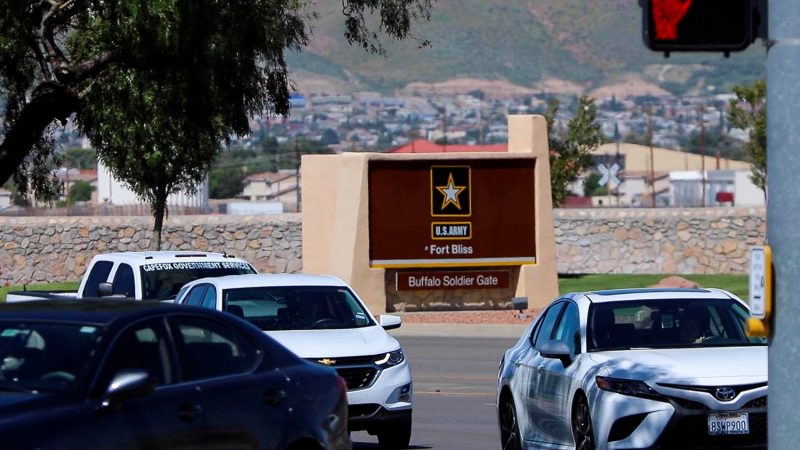

The U.S. Army is proposing developing a gargantuan, 3-gigawatt data center complex on Fort Bliss property that within a few years would consume more electricity than all of El Paso Electric’s 460,000 customers combined – even as questions about its development, water usage and air pollution remain unanswered.
If built, it would be the third major data center project in the El Paso region, along with Meta Platform’s $10 billion facility in Northeast and the $165 billion Project Jupiter campus that Oracle and OpenAI are building in Santa Teresa, New Mexico. The combined scale and size of the three facilities could quickly transform the Borderland into one of the nation’s core hubs of power generation and AI infrastructure.
The publicly-traded investment firm Carlyle Group would pay to build and operate the Fort Bliss data center – one of several planned in a national rollout under President Donald Trump’s administration to rapidly increase artificial intelligence technology for the Department of Defense.
At Fort Bliss, the Army is “targeting an initial operating capacity of about 100 megawatts on the compute side” by next year, David Fitzgerald, deputy undersecretary of the Army, said during a meeting with reporters April 22. An official estimated cost for the project has yet to be released.
By 2029, the complex on military land in far East El Paso would require 3 gigawatts of electricity, Fitzgerald said. By comparison, El Paso Electric currently maintains about 2.9 gigawatts of generation capacity across its entire system that spans from Hatch, New Mexico, to Van Horn, Texas. The highest customer demand the power company has ever seen was just over 2.3 gigawatts during the summer of 2023.
And whether most El Pasoans are on board with the rapid buildout of another data center here is not a question that Army leadership is asking at this point.
“What we’re trying to do is find where are the common interests, common ground that we can solve for?” Fitzgerald said, referring to coordinating with El Paso city leaders on the data center project.
“The state of modern warfare and future warfare is largely going to depend on the ability to capture, process and utilize massive amounts of data,” he said. “So, the reality is, this is a strategic priority, not just for the Army, but for the entire Department of War. So, we need these capabilities, and we need to put them somewhere.”
Combined-cycle natural gas turbines are the “most likely” source of electricity generation for the facility, said Jeff Waksman, an assistant secretary of the Army and former member of Trump’s first administration.
Waksman said the facility would undergo environmental review before construction starts.
Still, there are far more outstanding questions than answers about the proposed Fort Bliss data center.
It’s unclear if the facility would connect to El Paso Water’s water system. The city-owned water utility pointed out that Fort Bliss Water provides water service for the installation. However, El Paso Water can provide “backup” service to the base, according to the project solicitation documents.
“EPWater was just recently brought into the discussion, and we only have preliminary information,” El Paso Water said in a statement. “The construction and water use would be entirely on federal property.”
El Paso Electric said it’s also uncertain whether the data center will connect to the utility’s power grid and will figure that out in the future. To date, the Army hasn’t made a formal request for service from El Paso Electric.
Officials from the U.S. Army “confirmed that questions regarding the power source and whether it will be connected to the regional grid remain under review and have plans to establish a data center with a projected demand of 3 gigawatts,” El Paso Electric said in a statement. “Ultimately, decisions about these matters will be made by Fort Bliss leadership, and we defer to them for further comment.”
A representative with Carlyle Group at the community meeting didn’t answer questions or provide details about the proposed data center facility and the related power generation source.
Carlyle Group did not respond to a request for comment.
Army officials said they don’t yet have a definitive agreement in place with Carlyle, which was conditionally selected to enter into exclusive negotiations, so few details are finalized.
However, the Army has set a short timeline to start operating by late 2027. That means construction will have to start soon, Fitzgerald said.
“The ideal endstate is that we would be at least (operational) by the end of ’27, which is moving pretty quick,” Fitzgerald said. “That would mean construction would need to begin in the not-so-distant future.”
Water, electricity concerns
Meeting three gigawatts of electricity demand with natural gas-fired turbines – cited by Army officials as the most likely power source – would likely produce huge amounts of greenhouse gases in a central area of El Paso, such as carbon dioxide, as well as other harmful pollutants including particulate matter.
And even if the data center doesn’t take service from El Paso Water and instead receives water from wells managed by Fort Bliss, it would rely on groundwater pumped out of the Hueco Bolson aquifer, the city’s main source of water.
The solicitation issued by the Army cites water risk for El Paso as “extremely high” and notes that most of Fort Bliss’ water supply comes from wells within the installation.
Fitzgerald said the Army is aware of the public’s concern that the data center could unsustainably guzzle El Paso’s groundwater to cool the data center’s computer servers. He said the facility will be “water neutral.”

It’s also not clear how the project could replace the same amount of water that it consumes.
It’s possible the Kay Bailey Hutchison Desalination Plant – co-owned by El Paso Water and the U.S. Army – could play a role in making the data center water neutral. But El Paso Water said it has no details about how the data center facility could achieve water neutrality.
El Paso Water is “more than willing to continue to share ideas for best practices in sustainability to help protect our regional water resources,” the utility said in its statement.
As far as electricity generation, Army officials said they don’t know if El Paso Electric would build a new power plant to serve the data center. It’s also possible that Carlyle Group or another private company could build its own power generation source for the data center that’s isolated from the power grid El Pasoans use every day.
“We have to decide whether El Paso Electric is going to be the ones building whatever is coming, or if this is going to be some independent power producer,” Waksman said.
READ MORE: El Paso Electric filings detail power plant impact behind Meta’s $10 billion data center
El Paso Electric is planning to develop a 366 megawatt power plant made up of over 800 small gas generators to power Meta’s data center. The utility will build more generation in the coming years to meet 1 gigawatt of total demand from Meta’s facility. Meanwhile, as the technology giant Oracle develops Project Jupiter, the company said Monday it is seeking to power the campus using 2.45 gigawatts of fuel cell power systems provided by the company Bloom Energy.
For perspective, 3.45 gigawatts – the combined projected demand of those two major data centers – is enough electricity to power as many as a million homes, depending on the time of day and weather.
The Fort Bliss project would have to meet environmental regulatory requirements, and the developer needs to include a plan for providing utilities and infrastructure needs such as access to the facility, according to a request for proposals issued by the Army in December 2025. Army officials emphasized the project would not impact El Pasoans’ water or electric bills.
Who is Carlyle Group?
Carlyle Group is a global investment management firm that oversees $477 billion of assets from entities such as pension funds.
The company invests that money by buying businesses ranging from wine producers to Asian telecommunications companies, or by developing infrastructure projects such as renewable energy generation and data centers. The company in 2025 posted distributable earnings of nearly $1.7 billion on $4.8 billion in revenue.
The Army wants to build the facility at Fort Bliss in partnership with Carlyle because the installation has a large amount of available, unused land and because of the water and electricity infrastructure already in place in El Paso, Fitzgerald said.
The Carlyle data center planned for El Paso is part of a wider U.S. military effort to quickly build infrastructure that supports the use of artificial intelligence — both on the battlefield and in running its day-to-day operations, according to government documents.
Army officials nodded to the use of AI in drone warfare and targeting systems. And a hyperscale data center facility can also securely house information such as the military’s cloud database that details pay and entitlements for every U.S. soldier, said Maj. Gen. Curtis Taylor, commanding general of the 1st Armored Division and Fort Bliss.
Data centers are “essential parts of power projection,” Taylor said. “But we have to protect those servers. And that’s why there’s great utility in building that infrastructure on military installations.”
The Fort Bliss facility would be located on a plot of land near the intersection of Loop 375 and Montana Avenue. The site is just east of the Camp East Montana immigrant detention facility, and near El Paso Electric’s gas-fired Montana power station.
The plan is for Carlyle to utilize the majority of the data center’s capacity for its business needs, and the military would have access to a more secure portion of the data center for its own uses.
The Army is developing another similar data center project in Dugway, Utah. Other Army bases identified as potential sites include Fort Hood in Texas and Fort Bragg in North Carolina.
The U.S. Air Force in October issued a solicitation saying it is “accepting proposals for the development of Artificial Intelligence data centers,” on unused land at different bases, including in California, Georgia, Arizona and Tennessee. The push was enabled by executive orders signed by Trump that seek to speed up permitting and development timelines for AI data centers.
Would the Fort Bliss data center pay taxes?
A privately-financed data center on Fort Bliss would likely have to pay some taxes – unlike on-base government facilities – but there’s a lot of uncertainty.
Carlyle Group is leasing the land for the data center under an “enhanced use lease” that allows branches of the military to rent under-used land on bases.
Land on federal installations is not subject to state or local taxes. However, the statute that authorizes the U.S. military to lease excess land to private entities says that “the interest of a lessee of property leased under this section may be taxed by State or local governments.”
So, while the land the data center is built on would not be subject to taxation, the structures housing the data center could be subject to local property taxes.
But it depends on how the deal is structured, including factors such as whether Carlyle or the Army ultimately takes ownership of the buildings.
The Army in January awarded a contract to Korean-owned Hanwha Defense USA, which will invest $1.3 billion to develop a munitions factory at a base in Pine Bluff, Arkansas, using an enhanced use lease.
Fitzgerald, the Army undersecretary, acknowledged the public pushback to other data centers such as Meta and Project Jupiter. But he said the Army wants to ensure the project is developed “the right way.”
“There are always elements that will kind of make this an ‘us versus them’ sort of a construct, but I don’t think we view it that way from the Army,” he said. “I think there’s a path here that will benefit not just the installation, but the community as well.”
The post Proposed Fort Bliss data center could use more power than all of El Paso appeared first on El Paso Matters.
Read: Read More