



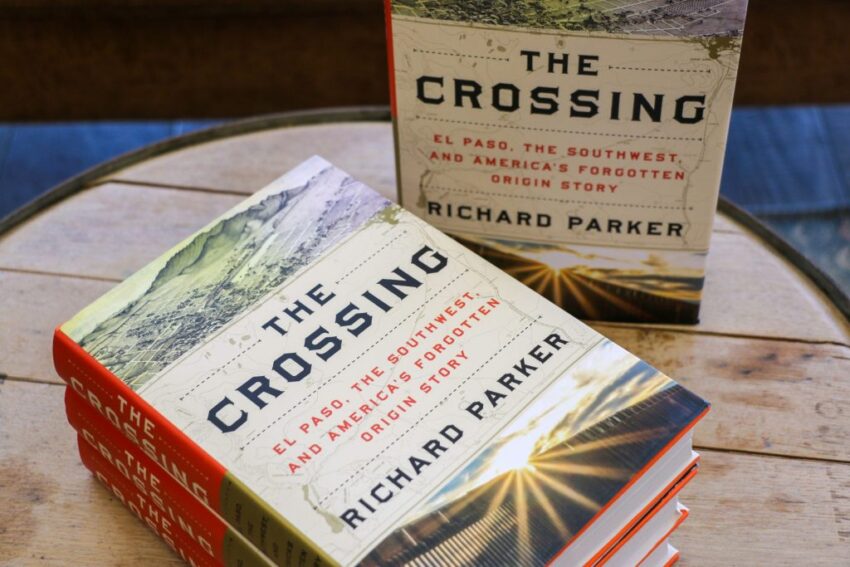

In his latest book, El Paso author Richard Parker calls El Paso the “heart of the American story” – saying it’s both the origin of the country and the pathway to its future.
“The Crossing: El Paso, the Southwest, and America’s Forgotten Origin Story,” explores the complex and multicultural history of the region. The book centers heavily on the Aug. 3, 2019, mass shooting at an El Paso Walmart that killed 23 people, pointing to the ethnic and racial demographics of the city that the gunman targeted.

“It’s not what most people think of as the heart of the American story. If they thought of the city at all, perhaps most people imagined El Paso as a dusty West Texan outpost on the Mexican border,” Parker, 60, a former journalist, writes in the prologue. “But the truth about my hometown is much more complex and important; it just took a massacre of global proportions for me to see it.”
“The Crossing: El Paso,” is the El Paso Matters Book Club’s latest selection.
His first book, “Lone Star Nation: How Texas Will Transform America,” was published by Pegasus Books in 2014.
Parker, who was born in Albuquerque but raised in El Paso, writes about political, economic, technological and social change and previously worked for the Albuquerque Journal. His work has appeared in the opinion-editorial and Sunday Review sections of the New York Times, Columbia Journalism Review and other major newspapers. His 2020 commentary piece about the El Paso Mass shooting in the New York Times was honored by the National Society of Newspaper Columnists.
Parker will participate in an El Paso Matters Book Club book launch event on Thursday.
For now, check out the prologue to his book, follow along with our reading schedule, and learn about upcoming book club events.
Prologue
August 3, 2019, was just another hot summer Saturday in America, until millions were struck with startling news from a place that few of them had given much thought to: El Paso, Texas. A gunman had massacred 23 people with an AK-47 while they shopped at Walmart because, as he later confessed, he “wanted to kill as many Mexicans as possible.”
Patrick Crusius, 21, had driven 600 miles from suburban Dallas to set a number of grisly records: the worst domestic terrorist attack since the 1995 Oklahoma City bombing; the deadliest assault on Latinos in U.S. history; and the highest death toll of any mass shooting outside the 2017 killings on the Las Vegas strip. I had just arrived in El Paso to visit my mother and was taking a nap when my phone buzzed repeatedly with urgent emails and text messages as my editor at The New York Times kept trying to hail me. He knew, after all, that this was my hometown.
Americans watched in horror as the body count mounted. The faces and names of the dead appeared on television screens and flickered on mobile phones while a vast, makeshift memorial of flowers, candles, photos and hand-written notes swelled at the site of the massacre. I roused myself out of bed, turned on the television, hurriedly packed a backpack, and headed out. “When Hate Came to El Paso” appeared in The New York Times the next day, August 4, 2019:
If you want to know what a mass shooting is like in your hometown, it’s like this: text alerts on your phone, a frantic woman on local television begging people to bring water to waiting families, 200 people lining up to give blood in the blistering heat, helicopters thundering overhead, the dead left lying inside the crime scene called “horrific” by the police chief. Those waiting on word of dead and lost stand calm and dignified as strangers pull up with truckloads of that bottled water. It’s also like this: a stab in the heart not just to your hometown, but to your people, in my case Latinos. Mr. Crusius specifically came here to my town, to kill my people.
In the subsequent days, Latinos across the country felt “hunted,” as one man put it. Most Americans felt that President Donald Trump, in his cruel treatment of Latino immigrants, egged on dangerous white supremacists such as the killer. Nearly six in ten Americans called white nationalism a threat to the nation. Yet that young man, Crucius, didn’t just murder Mexicans. In reality, he killed only one Mexican citizen, along with Anglos, Mexican-Americans, a German, and others all while wounding another twenty.
Crucius had come some six hundred miles to destroy El Paso’s unique feature: a big, bustling city, not just to kill people but a blend of Europeans, Americans, Native Americans, Mestizos, African Americans, all living side by side, inter-marrying—a multicultural society that dated back for centuries. More than five centuries older, the first person from the Old World glimpsed the New World’s Southwest. He went by his given Spanish man, Esteban. He was born in 1502 in Azemmour, Morocco, a bustling port city roughly 300 miles from the Strait of Gibraltar that thrived on the pragmatism of diversity: Jews, Muslims, and some Christians lived, traded, and worshiped in relative peace. Then in 1523 the Spanish raided the city and enslaved thousands, including then-twenty-one-year-old Esteban.
He was taken to Seville, another racially, ethnically, and culturally diverse city, despite the Inquisition, and sold for a high price to Andres Dorantes de Carranza. The lowliest of Spanish nobles, known as hidalgos or those without hereditary title, Dorantes would have to find fortune and reputation his own way. He needed a slave to make an impression in Spanish society, and he needed, indeed burned, to get to the Americas, where the future was being made. In compliance with Spanish law, Esteban was forced to convert to Catholicism. He learned to make the sign of the cross and pray the rosary and gave up the name of his birth, which had been Mostafa. Esteban was young and strong and a genius with languages. Those skills would keep him alive when almost every other person around him fell dead.
On June 7, 1527, five ships laden with six hundred soldiers, sailors, and colonists sailed down the Guadalquivir on the high tide, stopped briefly at the beach town of Sanlúcar de Barrameda, then slipped out onto the broad swells of the Atlantic Ocean. Dorantes had managed to secure a place for himself and Esteban as part of the Narváez Expedition, which set out to explore Florida and ended up traversing much of the perimeter of the Gulf of Mexico and more. It was a cursed voyage, with all but four of the group succumbing to shipwreck, attack, disease or starvation over the ensuing nine years.
As he wandered thousands of miles over many years, Esteban’s ability with languages extended to the native people, including Coahuiltecan, the lingua franca of the land. He became a skilled medicine man in his own right and was prone to adorn himself with a gourd decorated with owl feathers, which he took to be a symbol of death. His ability with languages and size, certainly, gave him authority with native peoples. But he was also quick to laugh and play with children, and girls and women, even the married ones —he frequently had sex with these girls and women, much to the rage of tribal leaders. Occasionally he was called Estevanico — Little Stephen or Stevie — either in irony or as a diminutive insult.
Along with another survivor, he eventually found a Jumano settlement. A Puebloan people, they lived in similar dwellings and grew corn and squash on the upper Rio Grande, probably about seventy-five miles downriver from present-day El Paso, Texas. Alone, Esteban walked further upriver, probably up the present-day Valley of Juárez. Esteban could not have known that he was now at nearly the exact same longitude on the globe as his hometown of Azemmour, 5,465 miles due west at 31.8 degrees north and -106.4 degrees west. He was as little as 20 miles from what would become downtown El Paso and Juárez, teeming 500 years later with well over 2 million people, a metropolis on a stretch of land as big as Los Angeles County today and as populous as Houston.
“The first white man we ever saw,” wrote the Puebloan historian Joe Sando, “was a black man.”
He was already one of the first foreigners to ever set foot in what became the United States. The Rio Grande flowed from the north and then squeezed through desert mountains to turn sharply left or east-southeast. What stretched out beyond it was a burning ocean of sand and desert seemed to go on forever toward the setting sun. The natives told him there was a sea, the Pacific, beyond what lay ahead, but it was far and the crossing was dangerous. He turned back and all the castaways tiredly turned west into Mexico, another year and five thousand miles of walking, finally finding the sea in February 1536 at a Spanish outpost on the rocky shore of present-day Culiacán, Sinaloa. Not long after, they were safely in Mexico City.
Esteban and his fellow castaways had made history by walking off the very edge of the known world. One was the first person not born in the Old World to see the American West, and the Southwest in particular. He was not an Englishman; neither Walter Raleigh nor John Smith had yet been born. Nor was he some homegrown American hero of exploration, like Merriweather Lewis or William Clark, who wouldn’t make it to the West for nearly three more centuries. No, Esteban was an African.
It’s not what most people think of as the heart of the American story. If they thought of the city at all, perhaps most people imagined El Paso as a dusty West Texan outpost on the Mexican border. But the truth about my hometown is much more complex and important; it just took a massacre of global proportions for me to see it. El Paso is where Native, Spanish, European, African, Jewish and Arab cultures fought, bled, died, married and forged ties: a vibrantly diverse culture that paved the way for a melting-pot nation and a model for an America ever torn over race, ethnicity, and religion. In fact, it’s the unacknowledged cradle of American history, with beginnings stretching back before the Paleolithic period.
Prologue excerpted from the book, “The Crossing El Paso, the Southwest, and America’s Forgotten Origin Story,” by Richard Parker. Copyright ©2025, Mariner Books. El Paso Matters Book Club selection, March 2025.
About the Book: “The Crossing”
- Author: Richard Parker
- Published: March 4, 2025
- Genres: History, political science
- Pages: 448
Book Club Reading Schedule
- March 5-11: pgs. 1-47
- March 12-18: pgs. 48-100
- March 19-25: pgs. 101-142
- March 26-April 1: pgs. 143-189
- April 2-8: pgs. 190-238
- April 9-15: pgs. 239-288
- April 16-22: pgs. 289-337
- April 23-29: pgs. 338-382
Book Launch

What: Book Launch: “The Crossing: El Paso, the Southwest, and America’s Forgotten Origin Story,” with guest, author Richard Parker
When: 6 p.m. Thursday, March 6
Where: Margin Notes Bookbar, 7460 Cimarron Market Ave. Building 2, Suite 300
RSVP: This free event is open to the public. Although not required, we ask that you RSVP here.
The post Read an excerpt from the latest El Paso Matters Book Club pick; find the reading schedule and more appeared first on El Paso Matters.
Read: Read More