



By Richard Yáñez / El Paso Matters
An artist’s desire to leave home is a pursuit for a singular voice that is as much a quest as it is an escape.
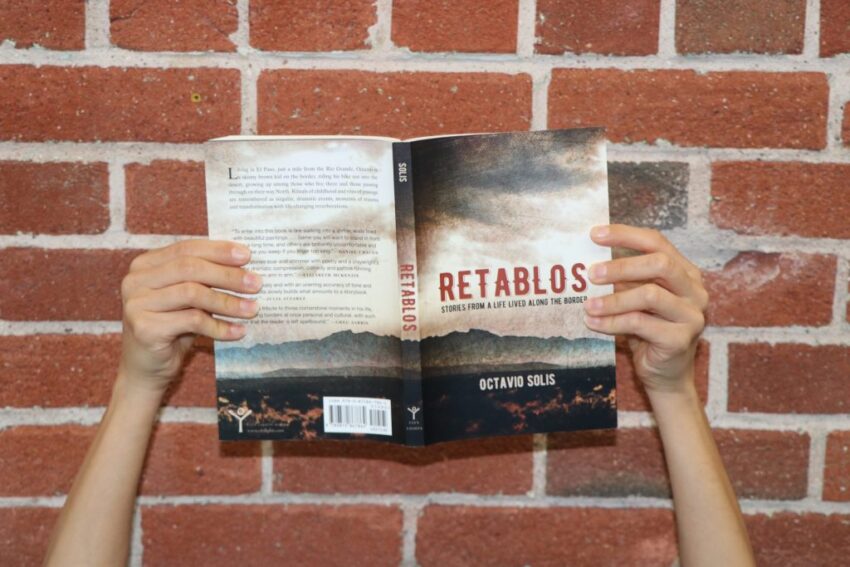
Inevitably, the artistic journey maps its way back to a place of origin — a familiar landscape, back home. Octavio Solis’ first book, “Retablos: Stories from a Life Lived Along the Border,” skillfully renders portraits of “being brown along the US/Mexico border.” Each is its own sacred space that locates autobiographical stories “unreal as memory.”
An award-winning playwright and director, Solis has created most of his work while living on the west coast. The psychic distance from El Paso/Juárez, his birthplace/ancestral home, is a creative force for this collection of “dreamlike” retablos. With the traditional Mexican devotional paintings as a medium of inspiration, the author depicts personal (often private) events and experiences in dramatic images worthy of the publication’s high praise.
Solis’ family appears in the book’s most memorable stories.
In “The Way Over,” their “American myth” is described as long days of hard work and negotiating citizenship status more than a dream arrival to the U.S. from México. His grandmother, Mamá Concha, helps his parents move to el Norte, insisting her grandchildren be born on this side. Mainly occupied with raising five children, Solis’ mother is a key figure in how he understands his surroundings.
Her guidance is evident in “El Segundo,” a notable example of how the lengthier episodes best reveal the author’s unearthing of his past. His father is an imposing presence whose struggles are both violent and silent.
In one of the most detailed episodes, “Mexican Apology,” a son’s wisdom materializes in striking observations: “He’s breathing into his huge hands like they’re a pair of bellows. I used to think I was another man’s son. … After all, what the hell do we have in common except a room and a name?”
Some of the most compelling moments in the book are when the author risks close emotional proximity with his father, his jefito.
The presence of cultural archetypes is another revelation in several of the literary retablos.
A reader will enjoy going through the contents page and picking any of the several colorful names, as if playing a special game of Lotería: El Judío, La Migra, Penitente, Demon, The Runner.
Whether it was visitors to the Solís home or the ever-present Border Patrol, from a child’s point of view, the author is a curious witness to the nuances of adult worlds.
There are also marginal figures — divine in ordinary appearance — that move from the periphery to be central characters in the first-person narratives. Each celebrates traditions (religion, emigration, labor) profoundly embedded in frontera culture.
The Lower Valley features prominently in the author’s tribute to 60s and 70s El Paso. The distinctive landscape plays as important a part in the vignettes as characters and events.
“The Little Woods” will be a favorite retablito for those who have ventured deep into the desert like “happy demons” on childhood bikes. The referencing of landmarks (Alameda, Big 8, Ascarate, Riverside High School) helps map the local geography that shapes the author’s often-humorous recollections.
Notably, Solis joins fellow El Paso authors Gris Muñoz and Sergio Troncoso in documenting the “secret testimonial” of growing up with a río-fence-wall as a daily reminder of borders — seen and unseen.
While the use of italics for non-English words may be strictly an editorial decision, the author’s use of Chicano Caló is authentic in capturing the fluid vocabularies of El Paso/El Chuco. Solis’ intention to write “beyond politics, beyond polemics and rhetoric” is most engaging when his memories surrender to the mysteries of the in-between.
Richard Yáñez is the author of “Cross Over Water” and “El Paso del Norte: Stories on the Border.” He is an English professor at El Paso Community College.
The post Review: ‘Retablos’ by Octavio Solis skillfully renders portraits of being brown along the border appeared first on El Paso Matters.
Read: Read More