



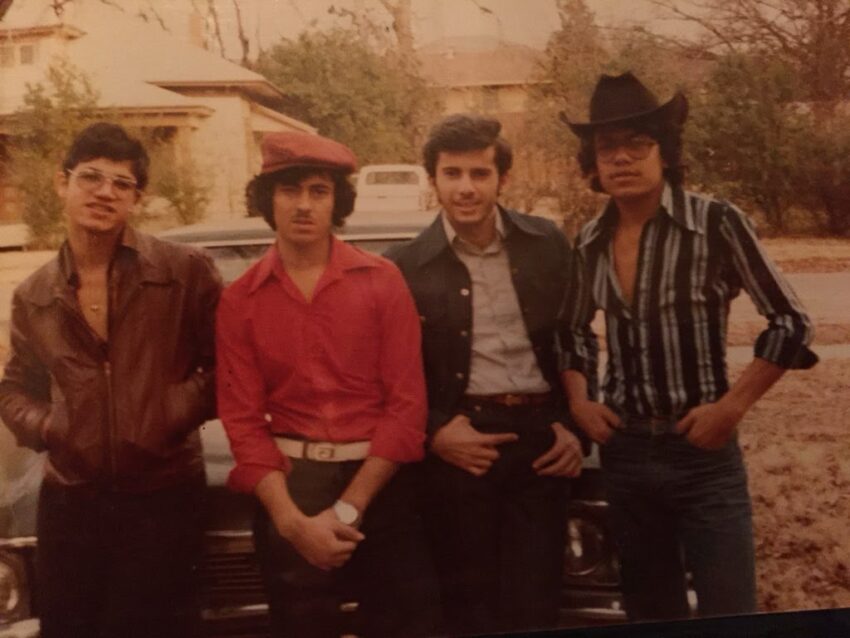

The Masoud family took root in El Paso in 1983 when Suleiman “Sal” Masoud arrived from the Dallas area, by way of Kuwait, and many miles, many years removed from his home village of Burqa in northwest Palestine.
Masoud, now 63, was among the Palestinian and Arab immigrants – mostly men, many of them engineering students – who trickled into El Paso from the 1960s to 1980s to study at the University of Texas at El Paso.
El Paso, where the cost of living was low and the sunny days were plentiful, enticed the students who touched down in other American cities first. Word of mouth helped – once someone knew someone in El Paso, it didn’t take much convincing to move, it seemed.
Tashin Atiyeh, owner of Tazza International Foods specialty grocery store, came to the border city in 1982 after a friend suggested the move to him. Atiyeh, a roommate of Masoud when they studied at Weatherford College near Dallas, then suggested the move to Masoud.
“It was the start of a chain migration,” Masoud’s sister Sanna said with a laugh one March night during Ramadan, where three generations of the Masoud family spilled through her brother’s house and into the backyard to break their fast.
They are among the Palestinian immigrants who have encountered everyday joys as they raise their children and grandchildren in El Paso. But their stories also share a common thread of displacement: They or their parents fled Palestine under duress. They did not leave by choice.

On Oct. 7, 2023, Palestinian organization Hamas, labeled a terrorist group by the U.S. government, attacked Israel. The militants killed nearly 1,200 people and kidnapped about 250 people. In retaliation, Israel unleashed a relentless and still ongoing bombardment of Gaza, attacking refugee camps, hospitals, schools and safe-zone homes, destroying historic heritage sites and blocking humanitarian aid. Israel has killed more than 50,000 people and injured more than 100,000, according to Gaza health officials.
For Palestinian immigrants in El Paso, this conflict is only the latest in what historian Rashid Khalidi describes as the hundred years’ war on Palestine.
It’s difficult to get an accurate count of the people in the Palestinian diaspora. Many Palestinians, including Atiyeh, lost their rights to Palestinian nationality after the Israeli occupation expelled them from their homeland. They immigrated to the United States carrying passports from their last country of residence, such as Jordan. Millions remaining in Arab countries are stateless.

The 2020 U.S. Census was the first census that allowed people of Middle Eastern descent to write in their specific ethnicity or nationality of origin. An estimated 14,890 Palestinians live in Texas, 179 of whom live in El Paso. The Center for Arab Narratives estimates the number of Palestinians is much higher because many respondents might have self-identified as generally Arab or Middle Eastern.
Atiyeh, now 67, described the Palestinian community as fairly young when he arrived. He hung out with other Arab students, often crossing the border to Ciudad Juárez to eat, shop and party. He met his wife, Rosalía, at the Electric Q nightclub in Juárez. They later opened Tazza International Foods, a small Middle Eastern market in West El Paso.
Their children are part of the second generation of Palestinian Americans born directly into a blended culture, picking up words in Spanish and Arabic. Now grown, Atiyeh’s children have left El Paso for better work opportunities. Most of Masoud’s grown children have also moved away. His daughter Summer Masoud-Tavakoli, a pro-Palestine activist in her early 30s, plans to move to Canada.
“I’m an El Pasoan, so I’ll always come back to El Paso because it’s my home,” said Annsam Jallad, a young woman whose parents are immigrants. “But at the end of the day, there aren’t jobs. I feel like it’s more of a place to settle down, like if you’re going to retire. It’s also good to build a family here.”

The option to return to their hometown is a luxury their parents don’t have.
“I’m too old right now,” Atiyeh said. “I mean, I cannot go back because we were not registered (in Palestine) when we went away in ’67. We cannot go back.”
How war became part of Palestinian journey to El Paso
By 6 p.m., Masoud’s house bustled with people weaving in and around the children, carrying trays of salads, yellow basmati rice and freshly butchered lamb from Jerusalem Market, stirring pots of yogurt sauce in the kitchen, opening bottles of Vimto, a British fruit drink that’s popular for iftar. The families usually eat iftar, the meal that breaks fast during Ramadan, in their own homes, but gather at least one Saturday at someone’s house during the festival.
“Sorry, it’s a little bit chaotic,” Masoud apologized, sounding amused.
Later in the evening, with bellies full, people began smoking and helping themselves to plates of oven-baked knafeh, a dessert Masoud’s sister Abeer made. Five of the nine Masoud siblings, all women except for Suleiman, live in El Paso.

“I have many mothers,” joked Abeer, the youngest of the bunch.
Their family comes from Burqa, a village in the West Bank, where olive trees 500 to 1,000 years old grow and time passes slowly, Sanaa Masoud said. There’s little opportunity for the village to grow, Masoud said. Burqa has been under Israeli occupation since 1967 and is now surrounded by a combination of military checkpoints, blocked roads and roads only Israeli settlers can use.
Because of the occupation, most of the siblings have spent most of their lives outside of Palestine – in Kuwait, Jordan and now the United States. One sister lives in Qatar, two live in Palestine and one lives in Frisco, Texas but visits her children in Saudi Arabia. The other sisters moved to El Paso beginning in the early 2000s after their brother, a U.S. citizen, petitioned for their immigration.

South of Burqa, Issa Khlayel’s parents lived in the centuries-old village of Bayt ‘Itab until the 1948 wars, during which Zionist forces established the Jewish state of Israel.
The Israeli military destroyed Bayt ‘Itab, turning it into piles of rubble from people’s homes and a Crusades-era fort.
Khlayel, who now lives in El Paso, spent the first 12 years of his life in a refugee camp near Bethlehem before fleeing Palestine altogether. If they tried to cross the border back into Palestine, Israeli troops would kill them, his father told him. He lived in Kuwait, then Jordan before moving to Boston in 1978 to study mathematics at Northeastern University.
One of 11 siblings, Khlayel recalled that his entire family slept in one room in the refugee camp with no running water. They relied on humanitarian aid to survive – food packages of cooking oil and rice, labeled “Gift from the people of the United States.”
“My family, my mom and dad, we lost everything,” Khlayel said. “We lost our farm, our homes. They just run away with their clothes on. That’s all, and they have to start again from zero. Back there, life was very tough.”
Building community in early El Paso years
Khlayel lasted three months of winter in Boston before two friends convinced him to move to El Paso in 1979. He had never heard of El Paso outside of Clint Eastwood Westerns.

They had a friend group of about a dozen students who would have potluck dinners together, treating themselves every so often to Pancho’s Mexican Buffet. While attending El Paso Community College, he approached a student named Martha Avalos in the cafeteria and invited her to one of their potlucks. Three years later they married and Khlayel went on to open Chihuahua Sound, a car audio shop in Downtown El Paso.
Cooking in the 1970s and ‘80s in El Paso was a way to stay connected to their homelands, Nasr Jallad recounted one night at a Village Inn, where he and a couple of his Palestinian friends like to catch up over coffee. The handful of Palestinians in town typically congregated in West and Central El Paso because of the proximity to UTEP and the mosque that was originally near the Sunset Heights neighborhood. There weren’t markets and restaurants that catered to the Middle Eastern community like there are today, he said.
If they wanted hummus, they had to wait for someone to travel to California or to Houston, which has the largest Palestinian community in Texas, Jallad said. Then they would gather at someone’s home and make a celebration of it. The same would happen if someone returned from visiting family in the Middle East – everyone would go visit just to get a piece of baklava, he said.
Jallad remembered buying little bottles of olive oil from the Walgreens beauty section to eat with flour tortillas (no pita bread back then, he recalled) and za’atar. These are items anyone can find at Walmart now, even falafel mix, he said.


Palestinians now own or co-own a few food businesses on the Westside: Jerusalem International Foods, Tazza International Foods, Nour Mediterranean Cafe and Ali Baba Mediterranean Kitchen. The Islamic Center of El Paso and its neighbor, St. George Antiochian Orthodox, are nearby.
Passing down history, tradition
Jallad said he and his wife tried to teach their children, who were born in El Paso, as much as they could about their history. His daughter Annsam said that while her parents didn’t try to shelter her from their experiences, she knew asking questions was the only way to prompt them to open up.
Annsam’s grandfather came from the village of Umm Khalid, where Israeli settlers evicted the residents and claimed the land for themselves during what Palestinians call the Nakba, the ethnic cleansing of Palestinian Arabs to create the state of Israel, Jallad said. The village is now part of the Israeli city of Netanya.
The family uses oral storytelling to pass down history that might otherwise become lost, Jallad said. Annsam said most of her friends and classmates growing up have asked her questions about her family origins. The Palestinian community is so small in El Paso that people don’t have much exposure to Palestinians – outside of the news lately, she said.
“I would explain to them a little bit more about my culture because a lot of people don’t know where Palestine is, or what Palestine is,” Annsam said. “I like to educate people and I don’t mind having people asking me questions. I’ll answer them the best I can.”
Masoud’s daughter Summer said she only came to terms with being Palestinian in recent years. She grew up with a Palestinian Muslim father and white Christian mother. Her father worked long hours, so her mother, a teacher, made an effort to connect the children to their Palestinian and Muslim side – doing crafts for Ramadan, making a board game to teach them about the Quran, learning Levantine recipes, Summer said.
After the Sept. 11, 2001, terrorist attacks, which led to increased incidences of Islamophobia, Summer avoided using her last name, which would “give away” her Arab identity, she said.

But during her teenage years, as her aunts moved to El Paso from overseas, bringing their husbands and raising her cousins, she became more interested in her Palestinian roots. She also learned Palestinian immigrants in El Paso have a tendency to find and know each other through just a few degrees of separation.
“Whenever I ask my dad, he’s like, ‘Oh, yeah, that guy’s from this village, which is just over the road from our village’ and that never goes away,” Summer said.
Then, while attending UTEP, she met similar-aged Palestinians who were more like her – from mixed-race families, less traditional and more socially progressive.
“After college was when I started realizing that there’s so many different versions of Palestinians – Palestinian Muslims, Palestinian Christians, Palestinian agnostics,” Summer said. “Like, oh, I can hold both parts of myself, I can appreciate the Palestinian parts of myself and it’s not a rejection of the other parts.”

Mark, who has aspirations to become a doctor, said his parents originally told him their family was from Jordan to protect him from discrimination. He asked for his real name to not be used in this story to avoid academic and professional repercussions for his comments.
It wasn’t until Mark traveled with his parents and brothers to Palestine, first as a child, that he started understanding where his family came from.
The journey involved flying into Jordan and then crossing the border into the Israeli-occupied West Bank, where his grandparents and relatives live in a predominantly Christian village. His cousins would explain how there was an illegal Israeli settlement nearby and settlers would terrorize the villages surrounding the settlement, Mark said.
“If you want to travel from village to village, there are a lot of Israeli checkpoints and to go through checkpoints there is a long line with cages everywhere,” Mark said. “My mom said they treat you like animals. They don’t speak with you.”
He recalls officers intimidating his younger brother and him at a checkpoint once.
“It was like a movie,” he said. “The inspection guy was yelling at my brother and three to four Israeli soldiers came out with guns. Turns out the person checking the passports was Israeli American, so when he saw the U.S. passport, he just switched. He asked where we were from. We said Texas. He said, ‘I’m from Chicago’ and I was, like, ‘bruh.’”
Mark remembered that summer playing soccer with his cousins while his grandmother sat on the porch when an Israeli tank drove by and someone tossed tear gas grenades at them.
“I was crying and my mom gave me a shower,” he said. “It was literally just our family that lives in the corner. There was no reason to throw it in our direction. We were the only ones there.”

Mark attends St. George Antiochian Orthodox Church in West El Paso, but as a child he felt forced. The church is one of a few Orthodox churches in El Paso and serves a mixed, mostly Middle Eastern community. The congregation hosts a Feast of the Middle East bazaar every fall.
It was only after his first trip to Palestine and visiting cities of historical religious significance, such as Jerusalem and Bethlehem, that Mark started taking his faith more seriously, he said.
“When I came back I actually tried to learn and read the Bible,” Mark said. “I don’t want to sound corny, but I think I found a good foundation in my faith.”
The next generation
Summer, an organizer for pro-Palestine group Viva Palestina in El Paso, said she recognizes the risk in speaking out and how as a white-passing U.S. citizen she’s afforded certain privileges that other Palestinians don’t have to feel safe at demonstrations.
She first became politicized about Palestine through her sister, who was part of then-San Antonio chapter of Jewish Voice for Peace, an anti-Zionist, Jewish advocacy organization.
Summer helped form Viva Palestina October 2023 to call for a ceasefire after the war on Gaza escalated. Since then, Viva Palestina has organized protests in Downtown El Paso and hosted fundraisers, recently selling traditional olive oil soap from Nablus.

Sometimes she sees parallels between the militarization of borders in El Paso and Palestine.
“It’s the presence of the wall and policing of the border, the control they have over people’s lives here and the difference in access,” Summer said. “My husband is visibly a brown man and his experience crossing the border here in El Paso is much more antagonistic, like he’s regarded with so much more suspicion than me.”
Many El Pasoans’ first introduction to Palestine is through social media and the news – images of bombed buildings and tortured people, starving children and body bags, she said. While all these atrocities are real, there’s also more to Palestine and Palestinians she wishes people could see: The lush countryside and bustling cities, how her aunts dance and sing at weddings.
“I’ve spent a lot of time talking about Palestine in the political sense, in the human rights and liberation sense,” she said. “Not so many people have asked me what my Palestinian family is like in El Paso.”
Khlayel’s son, Fareed “Freddy” Khlayel-Avalos, a former El Paso Independent School District school board member, said most of his father’s side of the family now lives in Amman, Jordan. His dad would come back from trips with Polaroid photos, but didn’t want to take him to Jordan until he was old enough to understand why they were there, Freddy said.

He described Palestinians in El Paso as a minority among minorities, often swept in with the Arab community at large or Muslims, though Palestinians can have a mix of religious backgrounds including Jewish and Catholic.
Freddy said he feels a sense of general apathy from El Paso toward what’s happening in Palestine – and how it’s connected to U.S. tax dollars. The U.S. government has sold weapons to Israel and sent it at least $12.5 billion for its military operations, according to an analysis by the Council on Foreign Relations, a nonpartisan think-tank.
Mark said his relatives in Palestine have told him to not advocate for them publicly because they don’t want him to face retaliation while he’s still in school.
But it’s painful to see the news of Israel bombing hospitals in Gaza and the education of medical students cut short. Mark said he would like to practice medicine in El Paso one day as a way of giving back to the community that’s welcomed his family
“Now that I’ve grown older, I see people in Palestine who are smarter than me and could be better doctors, but don’t have the same opportunities,” he said. “You have to worry about taking care of yourself and your family, find shelter. Here in El Paso all I have to worry about is passing my exams.”
The post Rooted in resilience: Palestinians build lives, community in El Paso appeared first on El Paso Matters.
Read: Read More