



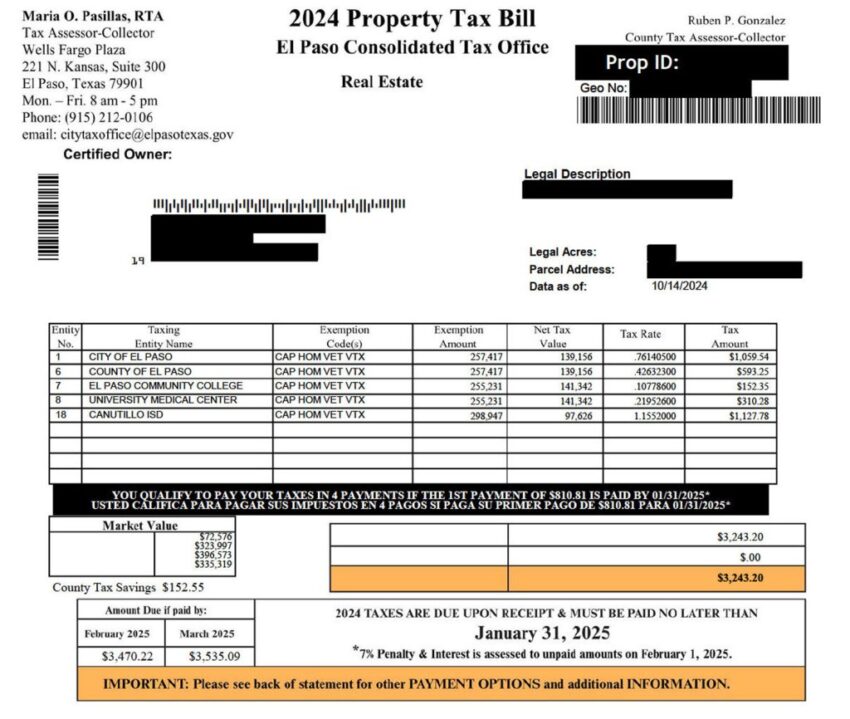

On Nov. 4, Texas voters will go to the polls to consider a state constitutional amendment to increase the homestead exemption for school taxes from the current $100,000 to $140,000. Texas leaders are promoting the measure as a means of relieving a major complaint of state residents – high property taxes.
But many taxpayers will still wind up paying a larger property tax bill this year than last year, for a variety of reasons – chiefly higher property taxes from other local governments and continually rising property valuations.
That’s true in El Paso, according to projections by El Paso Matters. The impact on individual property tax bills this year will vary widely based on several factors – the change in taxable value of the home since last year, the exemptions available to the homeowner, and which school district you’re paying taxes to.
People with homes below the average taxable value in the county – currently about $223,000 – generally will see their overall tax bill go down this year, especially if their valuation has risen by 5% or less since last year. Owners of lower-value homes who are 65 or older or disabled will see even more significant savings.
But people with higher-value homes, particularly those whose taxable values rose by the maximum 10% allowed by law, are likely to face higher tax bills this year, even with the reduction in school taxes.
The city and county governments, along with University Medical Center, have decided they need to increase the amount of tax revenue they collect this year. Elected officials who decide how much tax to collect cite rising costs due to inflation, a reduction in federal funding and other factors in deciding to increase taxes.
The board of El Paso Community College, which is responsible for the smallest part of the tax bill paid by people in the El Paso city limits, voted to adopt what’s known as the no-new-revenue rate, meaning they’re collecting the same amount of money this year from the property that was on the tax rolls last year.
Tax bills would be even higher without the additional homestead exemption for school taxes, so lawmakers can claim they’ve provided some relief. But that may be of little comfort for property owners who still wind up paying more in property taxes than last year.
Here are several scenarios that look at the impact on different kinds of homeowners.
For purposes of clarity, all the examples presume the property has a homestead exemption available to people who live in property they own. The examples use the tax rate in the El Paso Independent School District, the largest district in the county. The tax bills for homes in other school districts would be different, though the overall trend would likely be the same.
An average-value home
The average home in El Paso County had a taxable value of just under $206,000 last year, and just over $223,000 this year, according to the Central Appraisal District.
This is what the owners of this hypothetical home would pay in property taxes in 2024 and 2025.
In this example, the homeowner’s school taxes would drop by about $245. But the increasing taxes from other local governments would exceed that savings, leaving the homeowner paying about $16 more in total property taxes than last year.
However, if the owner of that home was 65 or older, or disabled, they would see a significant decrease in their overall tax bill. That’s because the school tax relief from the Legislature also includes an increase in a separate exemption for such residents from the current $10,000 to $60,000. The city of El Paso is also increasing its over-65/disabled exemption for homeowners from $27,500 to $30,000.
Here’s what property tax bills would look like for the owner of an average-value home who has the additional over-65/disabled exemption.
School taxes for this home would drop by almost $800, and the total tax bill would be about $550 less than the 2024 bill.
One other important note: In this example, the highest tax bill for both years comes from the city of El Paso. For the past several decades, the school district has been responsible for the largest part of the bill for most taxpayers. Because of rising school homestead exemptions, city taxes comprise the largest part of the bill for most homeowners.
A $150,000 home with modest valuation growth
Next, we’ll look at a home that was valued at $150,000 last year and rose in value by 5% this year, to $157,500.
This is a common type of house in El Paso – often smaller homes in older neighborhoods.
This hypothetical home would see school property taxes drop by almost $350, and the total tax bill decline by $240, or 8.5%.
If the owner of this modest home was age 65 or older, or disabled, the savings would be even greater.
In this case, the homeowner is now entitled to $200,000 in exemptions for school tax purposes– $140,000 homestead exemption and $60,000 for the over-65/disabled exemption. That’s more than the taxable value of the house, so the school tax goes to zero. That helps bring the total bill down by $340, or 13.3%.
With the expanded exemptions this year, 42% of El Paso County homeowners will pay nothing in school taxes because their exemptions exceed the taxable value of their home.
A more upscale home
People who own higher-value homes in El Paso are likely to see their tax bills rise this year, even with the extra break for school taxes. That’s particularly true for owners of such homes that have significantly appreciated in value.
For our example, we’ll look at a home with a taxable value of $500,000 in 2024 that rose by 10% this year, the maximum allowed by state law. This also is a fairly common scenario in El Paso, where rising home prices during and since the pandemic have locked many homeowners into years of 10% valuation increases.
In this case, the homeowner gets an increase in school taxes, despite the added exemption. That’s because the taxable value of the home rose by $50,000, more than the $40,000 increase in the homestead exemption. As a result, the total tax bill grew by $868, or 7.2%.
The situation is a bit better if the owner of this house also has an over-65/disabled exemption.
Thanks to the $50,000 increase in the exemption for people older than 65 or with disabilities, the owner of this home sees a $432 decline in school taxes. But the increase from other local governments more than wipes out that savings and leaves the homeowner with a total tax bill that’s $307 higher than last year, a 2.7% increase.
What’s ahead
Property tax bills for 2025 will start going out Oct. 1, and must be paid by Jan. 31.
Statewide voters will decide Nov. 4 whether to approve the expanded homestead and over-65 exemptions for school property taxes. It almost certainly will pass by overwhelming margins, and property tax bills going out in October presume it will pass.
The state government is providing funding to local school districts to offset property tax revenues lost to the expanded exemptions. The state was able to do so for the next two years because it has had huge budget surpluses. Critics of the expanded exemption plan have warned that the state funding could be harder to come by in the future, adding pressures to local school districts.
Property taxes are an increasing source of political unrest across Texas. State laws have long established the property tax as the main funding source for local government, and the state Constitution bars an income tax. State laws and policies have pushed much of the cost of governance to the local level.
In recent years, the state’s Republican leadership has responded to taxpayer frustration by increasing homestead exemptions for school taxes – from $40,000 to $100,000 in 2023, and to $140,000 in 2025. But homeowners across Texas are still seeing rising property tax bills as local governments seek additional tax revenue to fund services that many of those same property owners demand.
During the recently concluded legislative special session, Texas lawmakers considered proposals to limit the ability of cities and counties to raise taxes without voter approval. But ultimately they couldn’t reach agreement. The issue almost certainly will come up in the next Texas legislative session in 2027.
Some conservative groups have advocated abolishing the property tax in Texas, but such an approach would require years of implementation and relies on increasing the sales tax to replace property taxes.
The post Some El Paso homeowners will save hundreds with relief on school property taxes. Others may see their tax bills go up. Which are you? appeared first on El Paso Matters.
Read: Read More