




El Paso has done a great job aligning K-12 and higher education to give students the best opportunities to succeed in the workplace, but there is more work to do, the leader of the Texas Higher Education Coordinating Board said Thursday morning.
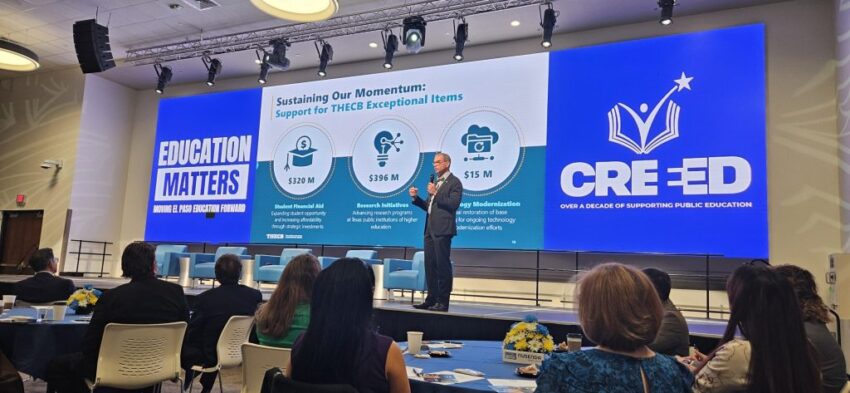
Wynn Rosser, who took the job as THECB commissioner in January, shared his positive message with more than 100 instructors, education administrators, elected officials and business leaders who gathered at the Starlight Event Center, 6650 Continental Drive, for the second annual Education Matters Summit.
The Council on Regional Economic Expansion and Educational Development, or CREEED, organized the event. The nonprofit, which launched in 2014, works to increase college readiness and completion rates of El Paso-area students.
Rosser, a veteran of more than 30 years in higher education, walked the stage during a 24-minute PowerPoint presentation where he talked about the present and future using data from the THECB, an organization that implements policy, evaluates academic programs, manages financial aid programs and offers data and analysis for policy decisions.
He recognized the school districts, postsecondary institutions and industries that helped build the pipeline where students can pursue careers in high-demand fields to include health care, skilled trades, transportation, advanced manufacturing, and information technology that will pay livable wages or better. That effort involves generations of leaders at those institutions who share the same vision over decades, he said.
“That’s something to be proud of,” he said near the end of his presentation. “That innovation doesn’t happen everywhere.”
Rosser shared other thoughts about his job, higher education and his leadership perspective during a telephone interview with El Paso Matters earlier this week – although his responses were more measured when the conversation turned to some of the recent state and federal governments’ more contentious policy decisions .
He said his time in higher education have prepared him for his latest job – from his start as a student at Kilgore College to his bachelor’s (1989), master’s (1993) and doctoral (1997) degrees in educational administration from Texas A&M University, his 10 years as an employee of the institution from director of campus programs to chief of staff and assistant vice president for Student Affairs, to his work with nonprofits that promote higher education and community service.
“Most of the decisions we make (at the THECB) are complex and nuanced, where judgement and experience really matter,” he said.
When asked about the recent interest by state and federal lawmakers who since 2023 have made controversial decisions that affect higher education, Rosser said there has always been interest.
He mentioned the G.I. Bill in 1944, the drive to land on the moon in the 1960s, and the civil rights laws passed in the 1970s to prohibit sex and disability discrimination in education as a few examples. He also referred to the billions of dollars that the state ($15.1 billion) and federal ($1.5 billion) governments award to Texas colleges and universities in fiscal year 2024.
“It shouldn’t surprise us that elected officials and voters have opinions about what we do in higher education, especially when there’s broad agreement that higher education is important for the students’ future,” Rosser said. “It’s important for our workforce. It’s important for our economy.”
He said the signals from the recent legislative session shows that the Texas Legislature values students. Case in point is the additional $320 million it added to needs-based aid. He also referred to the THECB’s Direct Admissions program and the My Texas Future as examples of state efforts to simplify and encourage college registration.
Additionally, he mentioned $4 billion that the legislature set aside to support research universities through the Texas University Fund and the Available University Fund.
“The Texas story is really one of supporting higher education and believing in what higher education does for individuals in our state as a whole,” he said.
However, when asked about the effect of ending in-state tuition for immigrant students and the cancellation of federal Hispanic-Serving Institution grants, Rosser did not want to hazard a guess.
“We’re still waiting to see how those things, you know, fully play out,” he said.

State Rep. Vince Perez, who represents El Paso’s Lower Valley, said he met with Rosser on Wednesday. He said he brought up the state’s decision to invalidate the Texas Dream Act, which allowed undocumented students to be eligible for in-state tuition.
He said some lawmakers painted a picture of undocumented students who paid in-state tuition as pillagers of the state’s bank account.
“That could not be further from the truth,” Perez said during a break from the summit. “There’s actually a $60 million net positive to the state of Texas. This whole notion that they’re taking money that would otherwise go to citizens is just completely untrue.”
When asked about the push back from college and university faculty and surveys that show a reluctance for some to come or stay in Texas because of the politics, Rosser said educators need to focus on students.
“If your mission is to ensure that … more young Texans leave postsecondary education prepared to succeed and earn a credential that matters in this workforce, then there’s a role for you here, and we would love to have you.”
Brian Evans, president of the Texas Conference of the American Association of University Professors, referred to results of an annual survey of higher education faculty in southern states to include Texas. The latest survey was done last August.

About 4,000 faculty responded to the Texas AAUP-AFT study. Almost 28% of the participants were from Texas. About a quarter of them said that they applied for a higher education job in other states during the past two years, and another 25% said they plan to start an out-of-state search soon. Of the instructors who stated they did not plan to move, more than a fifth said they planned to leave the profession in the near future.
The reasons faculty gave for wanting to leave included the uncertainty about tenure and academic freedom, the state’s ban on Diversity, Equity and Inclusion programs, and the limits on involvement in the creation of courses and the hiring of colleagues.
Evans did not release the full 2025 results, but sent these releases from 2024 and 2023.
“Campus policies related to academic freedom and free speech should be devised with the full participation of faculty in the spirit of a shared commitment to excellence,” Evans wrote in a prepared statement.
While a lot has gone on in the state and nationally when it comes to higher education in the past year, Rosser said that his time in office has gone by quickly. Part of the reason is because higher education has been his life’s work, and it is important.
“Coming up on the one year anniversary (in January) and thinking about it, on the one hand how much we’ve gotten done and on the other hand, how much we have to do.”
Rosser told the conference crowd Thursday that the Texas story involves students and families who believe in the importance of higher education, and a robust economy that needs workers who have earned everything from a credential of value to a research doctorate. He urged against complacency because the last chapter of the Texas story has not been written.
“There’s more work to do to keep us moving forward to achieve our larger goals,” Rosser said. One of the goals is for working-age Texans from 25 to 64 to have at least a credential.
The keynote speech was only one of the activities during his two-day stay in El Paso, which used to be a common stop for him from 2007 to 2016 when he served as president and CEO of the Greater Texas Foundation, a nonprofit organization that supports postsecondary education for Texas students.
Rosser planned to meet with community leaders and elected officials as well as the administrators of Texas Tech Health El Paso, El Paso Community College and the University of Texas at El Paso.
The post Texas higher ed leader praises El Paso progress, says challenges remain appeared first on El Paso Matters.
Read: Read More