



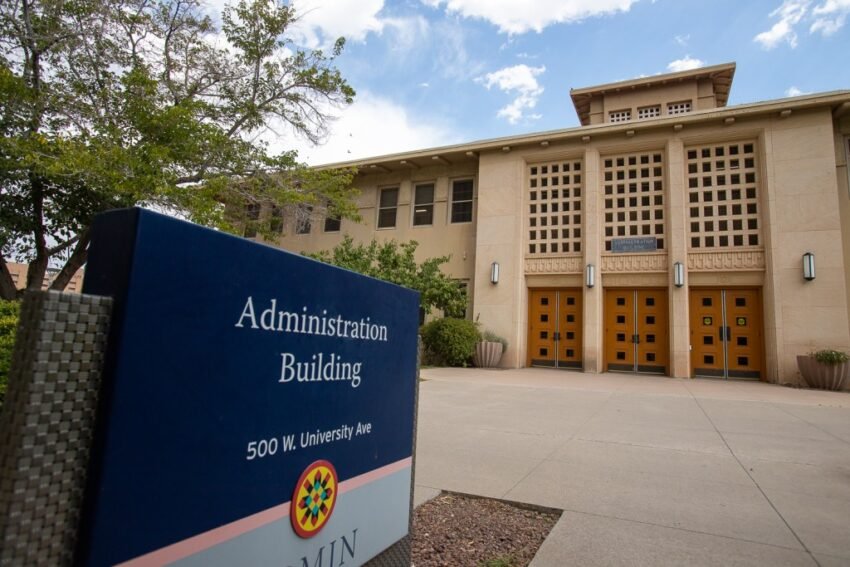

A student’s drive to stay in college semester after semester could be a key funding metric for public universities under a proposed state performance-based model to be considered in the next legislative session.
A University of Texas at El Paso administrator who helped formulate the proposal said student persistence is one the plan’s most unique – and important – aspects.
John Wiebe, UTEP’s provost and vice president for Academic Affairs, served on the committee that developed the plan. He said the proposal, if adopted, would be the first time the Legislature used persistence as a funding metric.
The Texas Higher Education Coordinating Board in July delivered its University Performance Based Funding Report to the Legislature, whose next session begins in January. People familiar with this effort said the plan will build the state’s future workforce, but a lot depends on funding and how it is structured.
The report recommends that 60% of funding would be based on students who earn “credentials of value,” which are degrees that will allow the average graduate to earn enough in 10 years after graduation to pay off their college education and surpass the earnings of a typical high school graduate.
The other 40% would be tied to persistence and progression milestones such as achieving 30, 60 or 90 credit hours. It usually takes 120 hours to earn a bachelor’s degree.
“I think it’s important to see the state take notice of (perseverance) and start to promote its importance and focus funding on the persistence of students,” Wiebe said during a telephone interview.

So as not to be a major financial disruption, the committee recommended that its plan supplement the current funding model that is based on enrollment and semester credit hours taught.
The UT System Board of Regents on Aug. 13 approved its systemwide budget for fiscal year 2027, which included a $739 million all-funds budget for UTEP. About $237 million of that is the education and general fund budget that pays for academic functions such as faculty, instruction, student and library services and other operational costs. That represents a 7% increase to the all-funds budget and a 2.5% increase in the general fund over the previous fiscal year.
UTEP President Heather Wilson said during the Aug. 21 convocation that the university expects a record enrollment of more than 27,000 students this fall semester, which started Aug. 24. UTEP will release its final enrollment number after Census Day, Sept. 9.
Wiebe, who started at UTEP as an assistant professor of psychology in 1998 and has served in many administrative roles through the years, has a deep understanding of the institution and its student population. His research has included the reasons why students drop out and the incentives that might entice them to re-enroll to complete their degrees.
The provost said a performance-based formula would benefit UTEP, which tracks students as they progress through their degree plans. The university has stood up many programs that address student needs from tutoring and advising to financial aid and emergency loans, to technology loans. It also provides services for healthcare and basic needs such as childcare and a food pantry.
The administrator said his main concern at the start of the task was if representatives from diverse institutions could agree on a model. He said that there was “healthy debate” about all aspects of the plan, saying he was pleased with the group’s ability to collaborate.
Wiebe was not sure what the Legislature would do with the concept that lays out a method for it to appropriate and allocate funding. It is unclear what the amount will be or how the funds will be assigned.
“I think it’s an open question what the impact on UTEP will be,” Wiebe said.

The Legislature will review the proposal carefully, said State Rep. Mary Gonzalez, vice chair of the House Appropriations committee, who serves District 75, which encompasses the eastern and southern portions of El Paso County.
Gonzalez said university funding needed to remain stable, but student success must be a core component of a funding plan. She said the coordinating board’s recommendation offered a starting framework, but it was too early to consider how much such a plan could possibly cost because of the variables.
“The state will work on this through the normal appropriations and legislative processes to arrive at a responsible solution,” Gonzalez said.
Grace Atkins, policy adviser for Texas 2036 who focuses on workforce and postsecondary education, said the report intentionally does not include many specifics because legislators will develop it through their deliberations.
Texas 2036 is an Austin-based nonpartisan policy organization that uses data to form long-term plans for many of the state’s critical issues such as healthcare, water infrastructure, natural resources, and education and workforce.

“A lot of the most consequential questions, including how much funding would actually be tied to performance and how institutions would transition into the model, still have to be worked out,” Atkins told El Paso Matters in an email. “How the model ultimately works in practice will depend largely on how lawmakers structure and fund it next session.”
Another issue is how a funding formula would affect the Institutional Enhancement Fund, a flexible general revenue fund that universities use for such things as faculty recruitment, specific institutional projects, and general campus operations.
The coordinating board’s plan called for a phase out of the IEF after the 2027 fiscal year. The state created it in 1999. The amount of IEF money that an institution receives varies from $56 per student to $5,734 per student. During the last legislative session, lawmakers approved $423 million for the fund.
Wiebe said UTEP received more than $4 million from the IEF for the last biennium while other institutions got over $60 million. He said the loss of those dollars could be a great financial challenge for institutions that received larger amounts.
The point of the proposed model is to help the state and its students to thrive, said Sarah Keyton, the coordinating board’s deputy commissioner for Administration and Operations. She said the new funding template will support workforce-ready graduates and keep university operations focused on student success.

“The new (performance-based funding) model incentivizes innovation, efficiency and academic excellence,” she said in an email response to El Paso Matters. “This ensures Texas students are supported, engaged and empowered to launch meaningful, in-demand careers.”
The Task
As part of the state budget passed last year, lawmakers asked the coordinating board to study performance-based funding formulas for four-year institutions. The agency formed a 21-member committee made up of leaders from the state’s universities and university systems.
The team worked for the better part of a year studying funding models from a few other states, and speaking with legislative staff, industry stakeholders and university leaders to create a framework for legislators.
The Texas committee’s proposal included incentives for producing graduates in high-demand fields, and serving historically underserved students, such as adult learners (those age 25 and older), students who stopped out for more than a year, and students who are economically and/or academically challenged.
Institutions could earn additional incentives if they graduated students with no more than 120% of the required credit hours for their degree, or about 144 hours. In those cases, students may have changed majors, double majored, added a minor, repeated a class that they initially failed, or simply took additional electives.
Among the states consulted for the study was Florida, which launched its performance-based funding model in 2014.
Florida’s goal was to enhance higher education accountability and align funding incentives with university goals and student success metrics, said Ray Rodrigues, chancellor of the State University System of Florida.

The state has earned the No. 1 ranking for higher education in U.S. News and World Report for 10 straight years based on low in-state tuition, high on-time graduation rates and minimal student debt.
Rodrigues shared several before-and-after statistics from 2019 to 2026 that he tied to the state’s funding formula. They included first-time-in-college student four-year graduation rates rose from 51% to 66%; and Pell Grant recipient graduation rates jumped from 46% to 62%. He also pointed out that within one year of graduation, the percentage of students employed or enrolled in advanced study rose from 68% to 75%. The median wage range moved from $38,300 to $52,600.
“The performance-based funding model has proven transformative for our students,” Rodrigues said.
Some history
The roots of this funding effort dates back to the 1980s, according to El Paso businessman and philanthropist Woody Hunt, who has studied workforce development and played a vital role in the development of House Bill 8, the performance-based funding formula for the state’s community college districts that the legislature approved unanimously in 2023.
Hunt said the state began to notice 40 years ago that its workforce was less competitive than other states in general and it needed to address it.
In 2015, the state launched the Texas 60×30 campaign with a goal of getting 60% of Texas adults – ages 25 to 34 – to earn post-secondary degrees by 2030. Six years later, the state rebranded the promotion as “Building a Talent Strong Texas” and expanded its goals. Now the state wanted to involve adults up to age 64 to earn degrees, and emphasized credentials in high-demand fields such as health care, advanced manufacturing and automotive technology to name a few.

That led to the Legislature’s decision in 2021 to establish the Community College Finance Commission, which Hunt directed. He said the group’s recommendations were for a state intervention via funding to improve workforce readiness.
It also was a pivot point because the state funded non-credit courses for vocational jobs, and encouraged colleges to connect with employers as partners interested in their “supply chain” of better prepared graduates. The collaboration also allowed employers to tell colleges the kind of training future employees needed.
Hunt said the momentum from HB 8 probably is behind the interest in doing something similar with four-year institutions. Passed in 2023, the funding law focused on student outcomes instead of just enrollment and credit hours. Students were encouraged to earn credentials in high-demand fields, transfer to four-year institutions, or enter the workforce.
“I think it aligned everybody’s interests appropriately,” Hunt said. He referenced a 2023 paper from the Georgetown University Center on Education and the Workforce that reported 72% of U.S. jobs will need a postsecondary education by 2031.
The key test from his perspective is whether performance-based funding changes behavior with higher education leaders in the students they recruit, the degrees offered, time to graduation, and the compensation those graduates earn. His bottom line is that the state needs to do better.
“My argument would be that if you’re the government and you’re spending public dollars for an educational outcome, then I think you have a public responsibility … tied to skills that can be monetized in the workforce,” he said.

State Rep. Vince Perez, whose expansive District 77 includes UTEP, is part of the House Higher Education Committee. While supportive of the community college funding formula, he believes his legislative peers need to understand its shortcomings as it develops a similar plan for four-year institutions.
He referred to the state’s June decision to not pay community colleges the money they were owed based on the funding formula the legislature approved in 2023. The problem was the colleges outperformed projections and should have earned more than the $1.2 billion the state allocated.
Perez said the students who suffer the most from those kinds of mistakes are often the ones who enroll at UTEP – first-generation college students and students who work full-time as they pursue their degrees.
“If we build a formula the state cannot fund and it shortchanges those campuses the way it just shortchanged our community colleges, we will have created a funding problem for the universities doing the hardest work in Texas,” Perez said.
The post Texas Legislature to consider funding formula that rewards student persistence and degrees tied to earnings appeared first on El Paso Matters.
Read: Read More