



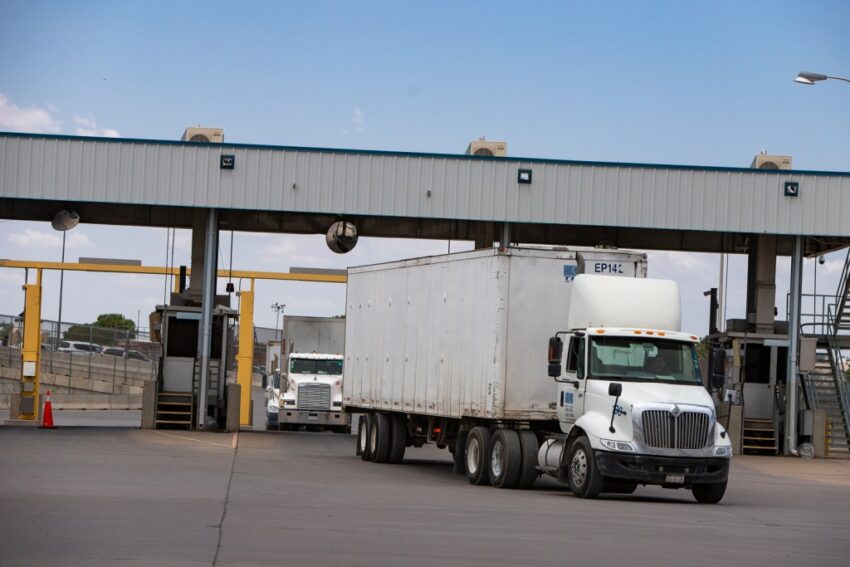

President Donald Trump’s administration has paused a major renovation of the Bridge of the Americas international crossing in South-Central El Paso worth hundreds of millions of dollars, and local officials are uncertain about whether the project – in the works for years – will still happen.
The General Services Administration, the agency that handles federal real estate and contracts and is overseeing the reconstruction of BOTA, was set to submit a so-called “record of decision” for the project in early February, essentially a final approval. But the Trump administration placed a 45-day pause on the BOTA renovation and the environmental review that had been underway.
The GSA’s plan was to award construction contracts in August, but the timeline now is unclear.
“On Feb. 3, to ensure immediate compliance with all issued executive orders, GSA placed a 45-day pause on all NEPA activities, including the Record of Decision for the (Bridge of the Americas port of entry) modernization project,” a GSA spokesman said in an email. NEPA refers to the government’s lengthy environmental analysis process that it conducts before constructing a project.
“This short-term measure permits the new agency leadership to review existing draft documents and help direct any needed course corrections,” the spokesman said.
The administration’s 45-day pause isn’t the only roadblock for the renovation of BOTA.
A separate lawsuit against federal agencies forced the GSA in mid-February to cancel the solicitation of contracts for the design and construction of BOTA. A court agreed with a group of plaintiffs who sued the federal government and argued that labor agreements for workers on federal projects that were mandated by former President Joe Biden’s administration violated federal contracting laws.
“In light of the Court’s decision, GSA will be conducting market research to assess the specific needs of this project related to the (labor agreement) and anticipates posting a new solicitation in the upcoming months,” the GSA spokesman said. “We’ll share more information on the BOTA LPOE modernization project as soon as we’re able.”
What happens to $700 million BOTA allocation?
The pause and lawsuit have scrambled plans for the BOTA modernization project, which is meant to update the land port of entry for the first time since it was built in 1967. The project is funded by the $1.2 trillion Bipartisan Infrastructure Law that Congress passed in 2021 under Biden.
“The fact is that we don’t know what’s going to happen with the $700 million that were allocated to GSA for the Bridge of the Americas,” said Omar Martinez, assistant director with the city who is in charge of federal and grant policy. The GSA allocated $700 million to modernize BOTA, but the estimated cost range for the project is between $474 million and $579 million.
“Regardless of what happens to the Bridge of the Americas, the city of El Paso is prioritizing the expansion and modernization of the Ysleta -Zaragoza port of entry,” Martinez said Wednesday during a meeting at the El Paso Zoo with nonprofit and private sector leaders about climate change.

In a briefing with reporters Feb. 12, U.S. Rep. Veronica Escobar, D-El Paso, said she was “very concerned” about the status of federal funding El Paso recently secured either through grants or through legislation such as the infrastructure bill.
“We are seeing Republicans trying to seize that money, basically freeze it and take it away from communities across the country,” Escobar said.
“Right now, we are in a wait and see posture on much of this,” she said. “As far as we know, the Bridge of the Americas funding is status quo, meaning there’s been no change. We haven’t heard of anything any different, but we are keeping a close watch on that.”
Looming over the BOTA project is the specter of major staffing and funding cuts at GSA, as the Trump administration has sought in recent weeks to slash spending and fire employees at numerous federal agencies.
The White House couldn’t be reached for comment.
The GSA’s recently-appointed administrator has announced plans to slash the agency’s spending in half by significantly lowering GSA’s nearly 13,000-person workforce, terminating leases and selling some of its real estate holdings, according to reporting by Federal News Network. It’s not clear how many GSA employees are based in El Paso or how those cuts will affect GSA personnel here.
Environmental justice, DEI add to commercial truck ban debate
Another major factor in the reconstruction of BOTA is that, after its completion, the GSA has planned to ban commercial trucks from crossing at the bridge, where roughly 700 diesel big-rigs cross to and from Mexico every day.

Residents in the Chamizal neighborhood adjacent to the bridge for years have said the trucks spew pollution and particulate matter throughout the residential area, taking a big toll on the health of area residents.
They called on federal officials to force semi trucks to cross the border elsewhere, and seemingly notched a win when the GSA said last year its preferred option was to halt cargo trucks from crossing at BOTA going forward.
For business groups and companies here tied to trade, stopping cargo trucks from crossing at BOTA is highly controversial and would likely lead to longer routes to other international bridges and higher transport costs.
The phrase “environmental justice” appears over 100 times in a document that details the BOTA project and explains why the GSA said it preferred to ban trucks from crossing at the bridge.
Trump, however, issued an executive order in January that targets for elimination “environmental justice” programs and policies, part of the administration’s deprioritization of initiatives that fall under the broad scope of “diversity, equity and inclusion.”
The Jan. 20 executive order calls for agency heads to send a list to the White House’s Office of Management and Budget of “agency or department DEI, DEIA, or ‘environmental justice’ positions, committees, programs, services, activities, budgets, and expenditures.”
Eduardo Calvo, executive director of the El Paso Metropolitan Planning Organization, said transportation-related projects that require any federal approvals now have to be reviewed by Trump administration lawyers in Washington, D.C., in addition to reviews by staff at regional offices.
It’s an extra layer of scrutiny that could delay some projects that are federally funded, he said.
Calvo acknowledged that projects with a focus on addressing issues related to equity or diversity may be canceled by the Trump administration.
“We do know that there are certain keywords that are going to be flagged,” he said. The MPO will “try to work on dealing with this to ensure our projects move, that they don’t get stalled because there’s one word that shouldn’t be there.”
Cemelli de Aztlan is one of the key Chamizal residents who, for years, has highlighted the concentration of pollution in South-Central El Paso and organized to get trucks banned from crossing at BOTA.
She said her group – Familias Unidas del Chamizal – expected that the Trump administration could change the course of the BOTA renovation.
Pushing trucks to Ysleta-Zaragoza, Tornillo bridges
Regardless of what the federal government does, however, she said local governments in El Paso should focus on convincing the Mexican government to invest more on roads on the Mexican side of the Marcelino Serna Port of Entry in Tornillo, so that the crossing can handle more truck traffic.

And she welcomed the city investing to expand the Ysleta-Zaragoza bridge in the Lower Valley just off the César Chávez Border Highway to handle additional trucks, especially those that could get routed away from BOTA.
“Add up how much they’re losing in tolls from all those trucks,” said de Aztlan, who argued the city of El Paso could collect millions of dollars in additional revenue if commercial trucks crossed at the city-owned Ysleta-Zaragoza bridge instead of at the toll-free Bridge of the Americas.
“This administration is concerned about tolls, tariffs and taxes. That’s an industry that is definitely not paying them,” de Aztlan said, referring to firms that import or export products across BOTA.
On Tuesday, El Paso County Commissioners Court voted to send a letter to El Paso’s congressional delegation – Escobar and Republican U.S. Rep. Tony Gonzales – restating that El Paso County prefers to see truck traffic banned from BOTA to alleviate pollution near the bridge.
“This is an unprecedented expenditure that’s coming to our community and an unprecedented opportunity to do the right thing when it comes to the negative impacts that the trucks are causing,” Precinct 2 Commissioner David Stout said. “We want to make sure this project happens, first of all, and that it is the best possible outcome for our community.”
The post Trump administration, federal lawsuit delay massive renovation of federally-owned international crossing in El Paso appeared first on El Paso Matters.
Read: Read More