



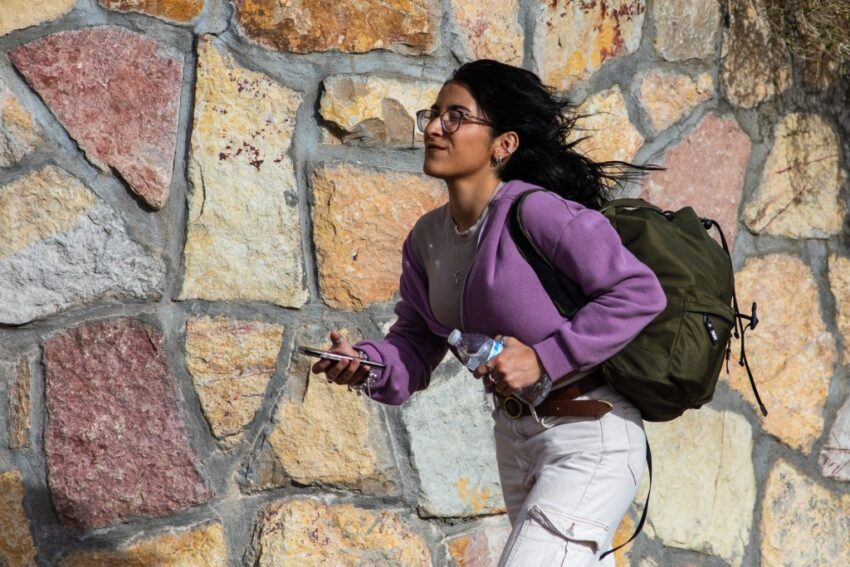

“Maybe less dust than before, but still dust.”
That’s how El Paso National Weather Service meteorologist Greg Lundeen described potential conditions for this year’s windy season. With gusts peaking at 61 mph at El Paso International Airport yesterday, Tuesday’s wind advisory marked the start of what may be a blustery spring for the region, which includes southern New Mexico and Far West Texas.
From the NWS office in Santa Teresa, New Mexico, Lundeen watched satellite camera footage of dust plumes Tuesday afternoon. He eyed one forming over plowed fields in Deming, New Mexico, west of Las Cruces. Another dust plume forming in northern Mexico will blow into Socorro, Tornillo and Fort Hancock, he said.
The dust events are starting a little early this year, though it’s not unheard of to have high winds and blowing dust as early as January, Lundeen said. El Paso’s windy season typically climaxes from March to April.
Last spring, El Paso experienced the most dust storms since the 1930s Dust Bowl. Preceded by a dry winter, intense winds kicked up dust that obscured the city’s scenery in a light gray cast. On at least one occasion, a dust storm coated the air in a thick, reddish haze like a scene out of science fiction.

But, this winter, El Paso had its third wettest January on record. Lundeen hopes the wet January will help suppress dust emissions.
“There was a significant amount of rain that fell over the course of a couple days that allowed for a greater soaking in of the soil,” Lundeen said. “Some of our normal dust source regions in dry years may not be as active this year.”
Lundeen emphasized that a wet winter is not enough to completely eliminate dust. Some dust comes from disturbed soil, such as from farmers plowing their fields.
The playas, or dry lake beds, near Lordsburg, New Mexico, are one significant source of dust in the region, he said. Those playas are full of water now – nothing more than 6 or 7 inches as they’re fairly flat beds, he estimated.

There are also dust sources just south of the U.S.-Mexico border, but the NWS does not know how much water is in those dry lake beds, he said. Based on camera footage, dust activity appeared quiet at one playa just 50 miles southwest of Downtown El Paso.
“The key part is it only takes a little bit of soil to create a dust plume,” Lundeen said. “Even if dry lakes are mostly wet, a little part that isn’t wet can become a source of dust.”
What causes El Paso’s intense dust storms?
Not every dust event is a dust storm and not every dust storm is a haboob. A dust event is dusty enough to restrict visibility by 1 to 10 kilometers, while a dust storm has less than 1 kilometer of visibility. A haboob is caused when a thunderstorm collapses and the sudden downrush of air hits the ground, pounding up dust. Most of El Paso’s dust events come from large-scale weather systems that last several days – not thunderstorms.
Tuesday’s dust event would have been significant most years, but would not have stood out last year, said Thomas Gill, environmental scientist at the University of Texas at El Paso.
Last year, El Paso had 12 dust storms and saw more hours of brownout conditions than all of 2000 through 2021 combined.
“I think the biggest reason was that last year, especially late winter and early spring, was unusually windy in El Paso,” Gill said. “And you need wind as much as anything else to get dust. The number of dust events will rely on the number of wind storms.”
This was not just a local phenomenon – wind records broke nationwide last March, he added.
Last year, the NWS recorded the highest wind speed in El Paso on March 18 when gusts peaked at more than 70 mph at the airport. In total, El Paso had 36 dust events from February to June, Lundeen said. El Paso usually sees an average of 22 dust events per year, according to the study from Texas Tech University.
“If this looks to be becoming a trend every year, then we’ll have to prepare for even more dusty conditions here and the effects they bring,” Gill said. “And if we can pin it down to a particular atmospheric or ocean pattern happening in advance, then we could prepare for more dusty springs with more lead time.”

A combination of heat and years-long drought from climate change has dried out El Paso and the surrounding area, killing off vegetation and organic material that hold soil in place. The topsoil then erodes into loose, powdery particles that can be picked up by the wind. Human activities such as agriculture, construction and driving on unpaved roads can also kick up dust for the wind to carry.
El Paso’s dust tends to be whitish in color because the soil in the Chihuahuan Desert contains calcium carbonate and the dry lake beds contain salt. The reddish, Martian appearance of some dusty days likely came from another source, Lundeen guessed.
“The color depends on the dust source region,” he said. “Unfortunately, we don’t have records that show where that [reddish] dust came from. We don’t track that.”
PM 10 pollution – inhalable particles 10 micrometers or less in diameter – reached hazardous levels Tuesday, according to the U.S. Air Quality Index. Along with poorer air quality, disturbed dust can lead to a variety of health problems, from allergy flare-ups to asthma attacks to debilitating Valley fever infection. A study of dust events in El Paso from 2010 through 2014 found the number of hospitalizations was five times higher after a dust event than before.
The low visibility and strong winds can also create dangerous driving conditions. On Tuesday, a semi-truck flipped over on Loop 375 Woodrow Bean Transmountain Drive. Areas such as mountain passes can create conditions for even higher wind speed because the air is flowing from a broader space and then squeezing into a more confined space, Lundeen said.
The post ‘We’re entering the windy season:’ What to expect after El Paso’s historic dust storms of 2025 appeared first on El Paso Matters.
Read: Read More