



Election Day is a month away and you’re likely seeing politicians’ campaign signs on lawns and fences throughout El Paso.
But, what are the races that will be on your ballot? Why can you vote in some races and not others? And why are some races partisan – party affiliated – but not others?
Elections can be confusing and the choices sometimes overwhelming even for frequent voters.
Here’s an explainer to help you decipher election and voting chatter all around.
What is a precinct or district?
Different government entities – the city, county, state and school districts, among others – are divided geographically by precinct or district, typically based on population and geography. The address where you’re registered to vote dictates your precinct and district – and in which races you’re eligible to vote.
So, if you live anywhere within the boundaries of El Paso County, you’ll be able to cast a vote in the county’s bond propositions and for county sheriff, for example, because they’re countywide races.
But you’ll only be able to vote in the El Paso mayoral election if you live within the boundaries of the El Paso city limits – but not if you live, say, in the cities of Socorro or Horizon.
What’s the difference between partisan and nonpartisan races?
Partisan elections field candidates from differing political parties – Democratic, Republican, Libertarian. Federal and state elections – president, senators, state representatives – are partisan. County elections – sheriff, district attorney, county commissioners and others – are also partisan.
Nonpartisan elections are those where candidates don’t have to declare a party affiliation to run for office. Those include city offices such as the mayoral and city representative seats, as well as local school board trustee seats.
An El Paso County Elections Department employee demonstrates how to use the ballot-marking machine, which allows voters to choose selections from a touch-screen and then print their marked ballot, Monday, Feb. 12. (Corrie Boudreaux/El Paso Matters)
What are primary, general and special elections?
Primaries are essentially two separate elections held on the same day – one each for the Democratic and Republican parties. During the March primaries, voters in each party selected their nominees to advance to the general election in November.
General elections determine the winning candidate that will take office.
Special elections refer to elections where voters can decide whether to allow government entities to borrow money – typically bond elections – or vote on state constitutional or municipal (city) charter amendments. They are also used to elect candidates to fill unexpired terms of office – seats that were not up for vote in the regular election cycle.
Special elections can be held on the same day as primary or general elections, or on separate dates altogether depending on election laws or other guidelines.
Can I vote for candidates from either party in the general election?
Yes, you can vote for candidates in either party in partisan races during the November general election regardless of what party you voted in during the primaries. (During the primaries, you had to choose one party in which to vote.)
Voters can no longer vote “straight ticket” in either party, however, so you have to manually select each candidate for whom you want to vote even if they’re all from the same party.
What federal or state elected offices will be on my ballot?
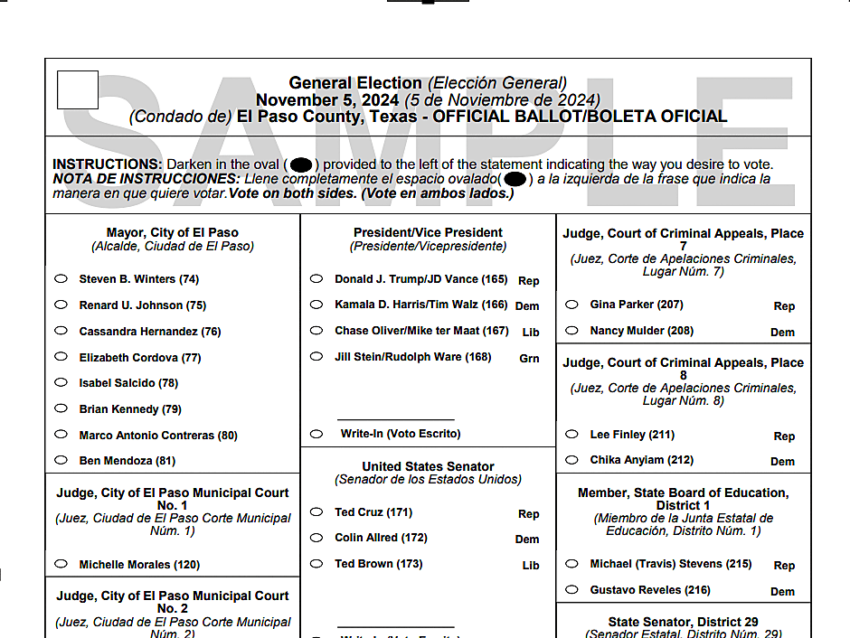
The presidential race, a U.S. Senate race, a Railroad Commission race and a State Board of Education race will be on the ballot for all El Paso County voters, as well as several state judgeships. Congressional races and state representative races will also be on the ballot for those who live in certain districts up for election.
In El Paso, contested congressional seats on the ballot are in Districts 16 and 23, and the contested state representative seat is in District 74, which includes a small sliver of El Paso County.
Many of the races are uncontested – only one candidate running for the seat – and those will also appear on the ballot.
Not sure what house or congressional district you live in? Check out the Texas state representatives and congressional map here.
For the easiest way to find your elected officials precincts and districts, check out the My Voter Dashboard from the El Paso County Elections Department.
Only the races in which you are eligible to vote will appear on your ballot.
Which local elected offices will be on my ballot?
El Paso voters will be able to vote for a slew of local elected offices within the county and city limits, depending on where you live. Find exactly what’s on your ballot here: My Voter Dashboard.
Here’s how it generally breaks down:
Voters within El Paso County boundaries:
County bond propositions totaling $323.8 million. You can vote for or against any of the five propositions separately.
El Paso County Hospital District (University Medical Center of El Paso) $396.6 million bond proposition.
County sheriff race pits Democrat Oscar Ugarte against Republican Minerva Torres Shelton.
District attorney race pits Democrat James Montoya against Republican incumbent Bill Hicks. Voters in Culberson and Hudspeth counties also vote in this race.
A slew of judgeships are also on the ballot for voters countywide.
Voters within certain precincts in El Paso County:
Two county commissioner races are on the ballot: Precinct 3 is uncontested; and Precinct 1 is contested. You can only vote in these races if you live within the precinct boundaries. Check out the county commissioner precinct map.
Constables: Only one of seven constable races is contested in the general election. You can only vote for the constable office in your precinct.
Voters within the El Paso city limits:
The city of El Paso bond revocation proposition asks to vote “for” or “against” revoking the city’s authority to issue the remaining bonds for the Downtown arena.
Mayor of El Paso. Eight candidates have filed to run in the nonpartisan race. If no candidate wins the majority votes, the two candidates with the most votes will advance to a runoff election Dec. 14.
Five municipal court judge seats and one municipal court of appeals judge race are on the ballot.
Voters within certain districts in the city of El Paso:
Six El Paso city representative seats – in Districts 1, 2, 3, 4, 5 and 7 – are on the ballot. Two of the seats – Districts 1 and 3 – are special elections for unexpired terms. You can only vote for the city representative in your district.
Find your city representative district here simply by keying in your address. You can also see a map of all the districts at that link.
Several area school districts also have trustee elections on the ballot open to voters who live within the district boundaries, including Canutillo ISD (four at-large seats); Clint ISD (one at-large seat), and Fabens ISD (four seats). Anthony ISD has a tax ratification election on the ballot.
Only the races in which you are eligible to vote will appear on your ballot.
Where can I find and print a sample ballot?
If you are a registered voter, you can review and print a personal interactive sample ballot of all candidates and propositions in your voting districts and precincts. Only the races in which you are eligible to vote will appear on your ballot.
The ballots for El Paso County residents are accessible on your “My Voter Dashboard” from the County Elections Department. Just enter your name and date of birth – or your voter ID found on your voter registration certificate – to create yours.
You can take a printed copy of the sample ballot to the polls when you vote. But leave your phone in your pocket; you cannot use your phone while at the polling site.
The post What’s on my ballot? El Paso races in 2024 elections explained appeared first on El Paso Matters.
Read: Read More