



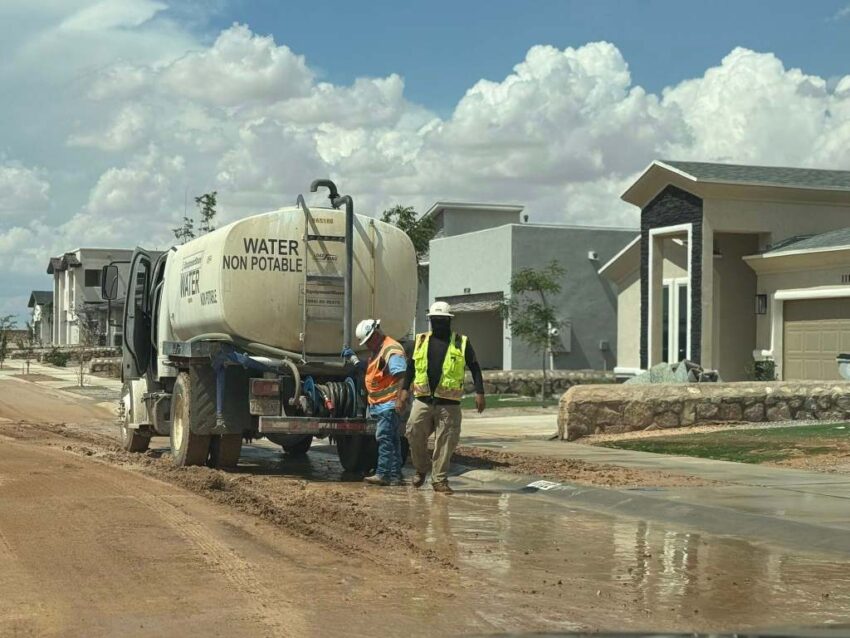

It’s been a dry year in El Paso by historical standards, but pockets of the city have experienced flash floods due to brief, powerful rainstorms. And images of inundated streets here raise a question: Despite a long list of flood control projects funded by El Paso Water customers, why does the city experience flash flooding even after only brief rainfall?
In a typical year, El Paso by mid-July has usually seen 3.1 inches of rainfall, according to National Weather Service data. This year, only 1.85 inches of precipitation have been recorded, but most of that rainfall has come over the last month, including the June 25 flash flood.
The area hardest hit by the recent monsoon storms was the Palomino neighborhood in Northeast El Paso, where low-lying homes have sandbags piled up ahead of more potential rain this week. El Pasoans also reached out to El Paso Matters about some flooding that damaged rock walls and left mud-covered streets in neighborhoods in Central and on the Westside near Franklin High School.
El Paso’s soil makeup is a big reason why the city experiences flash flooding even though it only usually receives 9 inches of rainfall annually. And floodwaters can enter homes when storms hang over a neighborhood for a prolonged period of time.
Houston, for example, receives an average of 50 inches of precipitation every year, but the soil can much more easily absorb rainfall compared with the loose soil in El Paso, said Tom Bird, a senior forecaster at the local NWS office in Santa Teresa, New Mexico.
“In our area, we’re very susceptible to flash flooding, because we don’t have underground drainage,” Bird said. “We have very thin and rocky soils, which don’t absorb moisture and allow it to run. We have all these canyons and arroyos which collect the water and focus a lot of that rain into” residential areas, he said.
District 4 city Rep. Cynthia Boyar Trejo shared numerous updates in recent weeks about the flooding in Palomino within her district, as well as some flooding that led to muddy streets in the newly-developed Campo Del Sol neighborhood in far Northeast El Paso.
Trejo didn’t respond to a request for comment from El Paso Matters. In Facebook posts, she said El Paso Water arrived in the Palomino area with heavy equipment to pump out standing water and prevent mosquitos from proliferating. Going forward, she said in the posts, the city and the utility will collaborate on a project to improve drainage on the block that experienced the worst flooding.
The city created the stormwater utility within city-owned El Paso Water in 2008 after the historic floods in the summer of 2006. When the stormwater unit began, it identified $650 million worth of construction projects – such as ditches, dams and ponds – that were needed to prevent catastrophic damage from flash floods.
El Pasoans pay $7.42 per month on their water bills to fund projects that limit flooding in the city. That stormwater fee has increased from under $5 per month as recently as 2022, after another bout of flash flooding in 2021 prompted City Council to have El Paso Water speed up its stormwater construction plan.
Instead of spending 20 years building out flood control projects, El Paso Water committed to do the same amount of work over 10 years by spending around $70 million annually on projects.

Projects include the massive retention ponds north and south of Interstate 10 and Piedras Street, which help prevent flooding on the freeway, as well as the Pico Norte Pond in East El Paso. The utility will unveil the recently completed Arroyo 1 dam on the Westside on Thursday.
In all, the stormwater utility has spent $362 million since 2008 building out the city’s flood prevention infrastructure – just over half of the investment the city identified in 2008.
But the fast-rising stormwater fee coupled with water and wastewater rates that increase every year are quickly making water bills less affordable in El Paso.
This year, the stormwater utility has a budget of $101 million, which includes $66 million for capital construction or improvement projects and $13 million for operations. The last $22 million are for debt payments because the stormwater fee customers pay – despite the recent increases – doesn’t generate enough revenue to cover the utility’s spending on flood projects.
El Paso Matters reporter Diego Mendoza-Moyers recently spoke with Gilbert Trejo, vice president of engineering, operations and technical services for El Paso Water, about the utility’s stormwater function and how it manages flooding problems throughout the city.
The following transcript has been edited for clarity and brevity.
Diego Mendoza-Moyers: What would you say to a customer who says “Hey, I pay this stormwater fee on my bill of $7 per month. Why do we still have flooding?”
Gilbert Trejo: I get asked that question from my own family and friends all the time. What I tell them is that, when El Paso Water took over the stormwater system, it was a tall task and a lot of work that needed to be done.
For decades, the stormwater system was neglected because it doesn’t rain a lot here. So, it’s hard to justify, I think, funding constant improvements or maintenance to a system that doesn’t get used very often.
FEMA gets a lot of funding to help communities impacted by flooding, and a big part of what they do is to help prevent flooding. But, not everything can be funded. So, the benefit-to-cost model to make decisions is really how it’s done. What is the benefit to the community for the cost? Because there can be a huge amount of cost.
These are very expensive projects (that) impact property, impact lives every day with roads, and can require people’s private property to build a dam. They’re highly impactful. So, you see the cost and you see the benefit. And it is very difficult to tell our own ratepayers who are being inconvenienced.
So, this concept of “What is the benefit to the community as a whole? What is the benefit to a neighborhood?” Whether they are, I’ll say, truly flooding: their house is full of water. There’s that type of flooding that ranks very high in the benefit-to-cost. Versus “I have a lot of water in my street and my car gets dirty and I can’t go outside and go to the store because there’s 2 feet of water in the street.”
Those are two very different types of benefit to the community as a whole: inconveniences versus actual loss of property, damage to property, in some cases, as we see, loss of life, unfortunately, because the stormwater system is inadequate.
That is how we frame these conversations with customers, and we try and give the perspective to them. And, surely, that’s not enough, right? They do not like that their neighborhood is being impacted, inconvenienced with this water. But frankly, we have a lot of work to do still.
Initially, $650 million worth of stormwater projects were identified in 2008. These have to be done just from the big flood of 2006 And off of that list, we’ve completed ($362 million) worth of it.

Diego: Is the calculus from El Paso Water’s perspective “What is the stormwater fee we think our customers can afford or bear to pay?” You don’t want to have people paying $50 a month for the stormwater fee, or $20 to $30. So, is it that: “We think $7 – our customers can bear that, and that provides us the funding to do these high-priority projects, but maybe not everything around the city”?
Trejo: That’s it. And, frankly, we are getting to a point where we’re being very conscious of what our customers can pay during the month.
Now, we’re seeing the stormwater fee creep up in terms of how much it is relative to our peer cities in the state of Texas, relative to Tucson, relative to Phoenix. We compare ourselves to the state, (and) we compare ourselves to other arid cities. And we’re seeing that our rate at $7.42, right now, it’s getting up there.
So, for us, we do not want to say that El Paso, Texas, has the highest stormwater fee in the state of Texas. Yet, we’re approaching there. Like, if we keep going on at the rate that we are with fee increases to try and meet our demands, we will be the highest stormwater fee in the state of Texas and we don’t want to be.
So, we have to strike the balance of prioritizing the most impactful projects, the highest benefit for what we can afford. Everyone says the same thing about government agencies: “You guys have got to tighten your belt, you have to figure out what you can do with the money that you have. You just can’t keep putting it on the backs of the ratepayers.” We agree. So, now, we are tightening our belt. There’s only so much we can do with our $7.42.
And yes, customers will say: “What am I getting for it?” Well, they get a long answer the way you just did. But, we also remind them that these are projects that benefit the entire community. I-10 getting flooded and stopping commerce across the city, stopping traffic like that, that’s not good for anyone.
There’s people in the Northeast that get 2-3 inches of water in their homes. So, for us, it’s just to listen, empathize and, I think, respond operationally. And this is one of the things that we’re doing for them. Where they (say) “I want inlets, I want a stormwater system, I want a pond. I don’t want to see any water.” It’s a very high cost.
But, we tell them: “Although that’s not worth a $25 million investment, we will commit to you that we will get you our vector pump trucks out there to extract the water as soon as we can. Give us a day, give us two.” But, we do commit to operational improvements and operational response to remove the water that they may be speaking about.
Diego: Can you share an example of what makes managing stormwater in El Paso complex relative to other places?
Gilbert: I’ll start with what makes El Paso great and so unique. We have a mountain and a state park that cuts our city in half.
A lot of cities all over the country have one terrain, maybe two terrains that they have to deal with, whether it’s river valleys or whether it’s mountainous, maybe hill country like Dallas and San Antonio. We have at least four different types of terrains that we have to deal with. The first one being the mountainous terrain, foothills and the flooding that causes as water is trying to rush off of the mountain, not into creeks and not into rivers the way (it runs off) in other communities. It runs off right into our neighborhoods because this mountain is in the middle of our city. No one else gets to say that.
We have 60 to 70 dams along the foothills and up on the mountain to stop the water from rushing down. There is a lot of infrastructure to hold the water up there and, in a controlled way, let it flow down.
Now, in hindsight, Central El Paso and the Westside, which is beautiful, could be filled with dams and ponds instead of all of these houses. But, I think planners said, “No, it’s a beautiful feature that we have in the city. Let’s celebrate this feature (the mountain range) and put in infrastructure to try and control the flows.” It rains 9 inches a year. We’re not dealing with this every single year. It goes back to benefit-to-cost.
Mountains, river valleys – and the Upper Valley and the Lower Valley – share their own characteristics in terms of how different they are. You have the desert plains of the Eastside and the Far Eastside, which is flat, think more Dallas and Houston. It’s this network of pipes, ponds, dams, pump stations, natural wetlands, greenbelts like we have in the Northeast, the two slopes, the east side slopes are much more gradual, the Westside slopes are very steep. It is very complex.
Diego: During the (July 9 Public Service Board) meeting, (Board Chairman) Bryan Morris started off talking about how stormwater flooding affects “legacy neighborhoods,” and that in the older neighborhoods, it costs a lot of money to solve the flooding issues.
Can you distinguish between trying to address stormwater issues in a “legacy neighborhood” versus a newer development?
Gilbert: Everything goes down to the design standards at the time the neighborhood was developed. And, what is now known as the city planning department, historically, has been responsible for the drainage design standards.
So, these legacy neighborhoods that are in beautiful parts of town, not only Manhattan Heights with Elm Street, the Upper Valley, I’ll refer to parts of those as legacy. In order for those parts of town to develop, you have to balance the cost to develop on a mountain – expensive – and the cost to develop in a river valley with high groundwater tables.
Developers are here to build homes and build out neighborhoods according to city standards. So, they’re simply just following city standards at the time. And, at that time, the drainage concepts in Manhattan Heights was for the streets to be conveying structures for draining the mountain.
Why? Because the alternative to using the streets as conveyance for these large amounts of water would be for the developer to then build a dam up on the mountain. Because, why should the city build a dam up on the mountain?
Then, that kills the development. It costs too much. The developer is going to say, “I’m not going to build a dam on the mountain, I’m just trying to build a house.”
So, the problem-solving you get between city engineers and city planners, developers, they come up with a good benefit-to-cost solution. “Well, you know what? Let’s build the streets, let them carry the water.” And that will avoid huge investment costs from the developer that will allow for the development to happen. Plain and simple. Those houses are there because the streets are used for street conveyance.
Diego: Can you talk about the move by El Paso’s City Council to accelerate the city’s stormwater plan? It went from a 20-year plan to a 10-year plan that City Council pushed El Paso Water to initiate. What’s the impact of trying to speed up the stormwater plan?
Gilbert: We were excited from an engineering and project delivery standpoint. The original fee that was recommended in 2008 was just short of $5. It was not adopted – there were people who were saying that’s too high – so it came down to just above $3. So, from day one, our mission was underfunded.
After the 2021 flood, that’s really what triggered it. (City Council representatives) said “We’ve got to go faster.” So, then they gave the mandate to us to go faster. So, we did. We’re like, “Yeah, we’ve got a list of projects here that we can get going on.”
Will Ruth (Pond) – large, just classic, complex stormwater project. The large amount of water causing a lot of flooding issues in the Northeast requires a large hole in the ground in the lowest spot; that’s Will Ruth. It impacted businesses, families, I believe a fire station nearby that we worked around.

Arroyo 1 up on the Westside is another really good example of a large project – very, very impactful to the Westside. One of these large arroyos and dams that now we’ve constructed.
Silver Springs right there just north of Sunland Park Drive – another large project with high, high benefit to the community that ranked high in terms of benefit-to-cost.
So yeah, when we got that mandate, we were ready to go. We’re executing these projects.
The issue goes back to our budget and how the utility is funded.
The fee that people pay is just enough money to fund operation and maintenance. These projects are in the tens of millions of dollars. So, every year, every project that’s done by the stormwater utility that we’ve done, we issue bonds for – we have to issue debt to do these projects.
There is no capital project that the stormwater fee funds. So, now, we’re in year 17 for the stormwater utility, of issuing debt every single year. We’re getting to a point where we’ve issued so much debt and paying off that debt, and the only way to pay off that debt is with the revenues that we get from our customers from our fee.
It goes back to your original question. How much do we expect our people to pay? We’re up against it right now. We just can’t keep going at the rate that we were going because it’s too much debt and we’re not getting enough money in the door to pay off debt and to keep maintaining operation and maintenance needs.
So, last year, you actually saw we’re starting to come off this $70 million a year – that was the mandate: $70 million every year for 10 years, $700 million. Well, the finances don’t support that.
We issued 20-year bonds. So, the 20-year debt that we issued in 2008, some of it’s going to end here in 2028. That’s a big deal. So then we get to kind of reset the clock a little bit.
Diego: So, could we see a deceleration in stormwater projects in the next couple of years relative to the last few years?
Gilbert: I’m going to say no, because we have so much working right now. And design projects are something we can still do. And we have so many already designed. So, as soon as the ability to issue more debt is available, we have projects ready to go. We’re still churning out projects at a very fast rate.
One of the things that the stormwater utility found out in 2008 when it was created and everyone was gung ho, like, “Yeah, let’s go start building things. Oh, wait, stormwater impacts private property so much.” So, it’s hard. You can’t spend the money as fast as you want to sometimes.
Land is always a challenge with the stormwater system. It’s OK to give us time to acquire land, to do all the planning and engineering associated with it, so that we can get going. That’s some of the complexities behind stormwater engineering that (El Paso Water’s Stormwater Chief Operations Officer) Gisela Dagnino does such a great job at.
There’s already a lot of projects designed and ready to go with land issues resolved so that as soon as the money comes in, off we go.
They’re not all these mega projects. Here in these next three years, let’s catch up to just some of the smaller ones: the Kentucky Dam project, the Feather Lake project. These are all very important projects too for managing the stormwater system as well. So, no, progress won’t be impeded.
Diego: What do you think is the most important stormwater project underway or set to begin soon?
Gilbert: Well, underway is Will Ruth, without a doubt, and then the Palisades Dam. So, these are two that I’ll refer to as mega-projects. One is a brand new dam up in the Palisades Arroyo right there off Robinson (Avenue).
And then Will Ruth, of course, is ongoing for many years now. Very complex, but finally we’ve got contractors on board working with the engineers to get those going, working with the community, especially in Palisades, so they can prepare themselves for what’s about to occur when they break ground.
Diego: I also want to ask you about the insurance aspect. Is the goal of the stormwater utility to gradually remove the number of households or businesses that are in the floodplain and considered flood prone – is that the basic idea?
Gilbert: Yes. There are many people in the floodplain that do not realize that they’re in the floodplain. Our goal – one of the big benefit-to-cost aspects for us – is taking folks out of the floodplain. That reduces their requirement to pay flood insurance, that reduces their risk.
There are people without flood insurance that should have flood insurance. They are 100% in the floodplain, but they don’t think about it because they live in the Pebble Hills area, they’re off of Montana, they’re in the middle of a highly-developed area. They’re like, “Flooding? I’m not in the river.”
But, they just probably have never seen a FEMA floodplain insurance map that shows inundation and shows how Pico Norte Pond, for example, takes out all those neighborhoods out of the floodplain. Because if it wasn’t there, if it would rain, all of those properties would flood.
Diego: Last question: Any thoughts on the long-term outlook for the stormwater utility? Is there a world in which we’re here 20 years from now and it’s like, “Man, El Paso Water solved flooding in El Paso?”
Gilbert: I hate to be doom and gloom, Diego. I’m usually pretty positive, but the reality is that Mother Nature is undefeated.
It all goes back to benefit-to-cost. And, frankly, Mother Nature will always find a way to drop more water than what the infrastructure was designed for. And we’ll never get ahead of that.
What we can do is to ensure that we complete projects that are highly beneficial, highly impactful, (that) protect lives, protect private property with the rates and the revenue streams that we have.
It is a flat fee across the city. People in the Far Eastside say, “Why am I paying for dams on the Westside?” This is the city strategy. This is part of being in a big city. You can’t bifurcate everyone’s different situations. But I think protection of life and public and private property is our goal. And I think we’re achieving it, and we’re going to keep achieving it.
The post Why do El Paso streets flood despite little rain, millions in stormwater projects? appeared first on El Paso Matters.
Read: Read More