



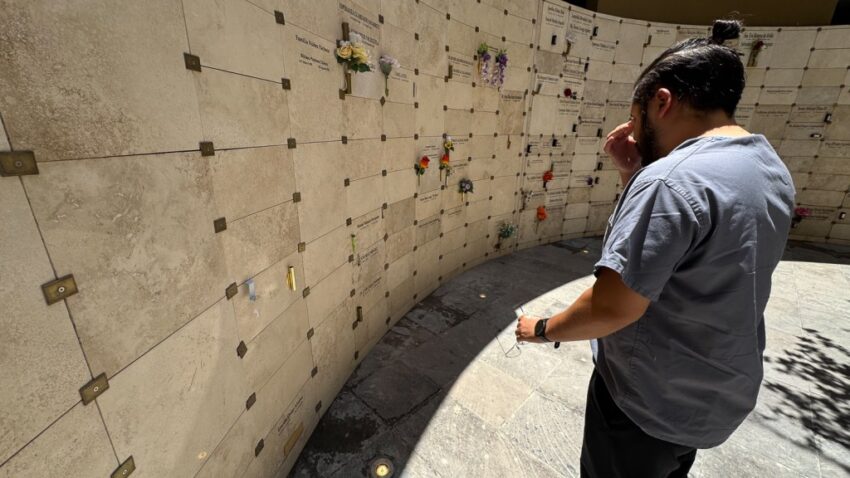

CIUDAD JUÁREZ – Norma and her son Erick stood before a wall of niches in an outdoor courtyard at Mausoleos Luz Divina. For a few moments, Erick was silent and unmoving as he looked at an unmarked plaque that was supposed to bear his father’s name. Then, his body heaved with a sudden intake of breath. He removed his glasses and wiped his eyes, shoulders trembling.
“I really hope he is here,” Norma said softly in Spanish about her husband, Conrado, who died of chronic heart issues in 2024. He was 63. El Paso Matters is not identifying the family by their full names to protect their privacy.
Conrado’s cremated remains were to have been interred at the mausoleum. But on this day in mid-July, Norma and Erick questioned if instead, his decomposing body might be wrapped in a black bag at Crematorio Plenitud, stacked among several hundred that should have been cremated.
It’s been two months since 386 decomposing bodies were discovered at the crematorium just south of Juarez, where they were sent by various funeral homes to be cremated. The bodies were to have been cremated within 48 hours after death. Some families discovered the urns that were supposed to hold their loved one’s ashes do not appear to.
The family still has no answers.
“With the bodies that remain, it seems like they will not be easily identified. I just want to have an answer, whether it’s good or bad,” Erick said. “I still have the feeling like his body has been desecrated, but I don’t know who to blame for that. Who am I angry at? And sometimes, it feels easier to convince myself that he was not there, that we were not affected by it. It’s a way of protecting myself.”
Authorities said the crematorium had been operating unlawfully and had not been inspected for more than three years, La Verdad reported. Two individuals, the crematorium’s owner and a worker, have been charged in the case. Three others linked to one of the funeral homes were arrested after a “days-old” body was found on their premises.
A neighbor of Crematorio Plenitud placed a 911 call on June 26 to report the odor. By the following morning, investigators found piles of decomposing bodies, some without clothes. Rodents and other pests roamed over the corpses, according to testimony and photos from a June 30 hearing reported by La Verdad.

During the hearing, investigators noted that the facility lacked electricity, drinking water, refrigeration chambers, and had no valid environmental certification.
“Why? That’s what I want to know,” Norma said. “What was their motive for doing this?”
As of Aug. 11, 39 bodies have been identified, 27 of them returned to their families, La Verdad reported. Authorities said they don’t expect to find any more bodies. The bodies are being kept in a 700-capacity cold storage facility, installed during the COVID-19 emergency, in a space provided by a private individual, La Verdad reported.
The process of identifying the bodies has been slow and painful, with some families having to identify their loved one’s bodies. Other family members have been fingerprinted, and several bodies were being rehydrated to obtain fingerprints, officials have said.
“They opened up our grief process, which had already been concluded,” Norma, 59, said. “It’s very, very painful. I’m indignant. I don’t have words for the people who did this. Evil? Indolent? There are no words for the kind of person who would do this.”
Norma and Conrado met as students at the Universidad Autónoma de Ciudad Juárez and married in 1989. Erick was born several years later, followed by his sister, Mariana. The couple owned several businesses before Conrado’s heart problems began in 1999. He never regained his health.
“He always had hope that he would be able to (work again),” Norma said. “But the last time he had an EKG, it showed that his heart was functioning at only 16%.”

“(My dad) had a very strong character,” Erick said. “It made me very sad to see him as this grand figure and then see him so deteriorated.”
Norma had seen news about Crematorio Plenitud when the story broke, but was not concerned until a co-worker brought a list of funeral homes that had contracted cremation services with the crematorium. There, she saw Funeraria Luz Divina, which had handled Conrado’s body.
Five other funeral homes linked to Crematorio Plenitud are Amor Eterno, Latino Americana Recinto Funeral, Capillas Protecto Deco, Ramirez and Del Carmen.
“I took out all the documents and there was the name of the crematorium, Plenitud,” Norma said. “The next day I went to the prosecutor’s office with my daughter and made a report.”
The Fiscalía General de la Zona Norte, the branch of the Chihuahua state prosecutor’s office responsible for Ciudad Juárez, said in a press release that they interviewed over 1,000 people whose relatives are possibly among the remains.
“What Plenitud did is barbaric. It’s barbaric. There’s no way to describe such inhuman conduct,” Fiscal de la Zona Norte Carlos Manuel Salas said.
Among the bodies are 165 women, 213 men and eight undetermined. Four were children. One body was still in a hearse, but others were so decomposed that investigators were at first not sure how many different individuals they belonged to.
The profound disrespect shown to the bodies is what haunts Erick.
“During his last days, I didn’t want him to be afraid (of dying),” said Erick. “Now he has been desecrated, and it is very painful.”


On July 19, about 100 family members of the people whose bodies were found at the crematorium marched to the prosecutor’s office with a list of demands. They asked to be allowed to identify their loved ones by clothing, scars, tattoos or medical implants.
Coordinator of Ministerios Públicos Michelle Rodarte, who is spearheading the crematorium investigation, insisted that identification must be “scientific” because there is no “margin for error.”
“You are living a hell right now, and we want to give you certainty and peace that if I give you a body, [it] belongs to your family member,” Rodarte said.
The bodies “had no identification. There was nothing to indicate how they had arrived there or who they were,” Salas said, adding that the crematorium’s owner and employee refused to provide any information.
“It is an enormous pain that we suffer, again and again each day, with the anguish of not knowing if they are there or not,” said Kevin Canales, whose mother and sister died in 2020 and 2023, respectively. The paperwork from both cremations show that their bodies were sent to Plenitud. “We want answers now.”
Norma fears being asked to look at a photograph of Conrado’s remains to identify him.
“I don’t think I can do it,” Norma said. “I can’t go and look at him or look at a photo of him in that condition. I know that my children will help me, but it will damage them too.”
Erick doesn’t believe that call will come. And neither will answers. He focuses instead on being there for this mother.
“She still cries when she hears a song on the radio that reminds her of him,” he said.
The post ‘Why?’ Grief, questions linger months after 386 bodies found at Juárez crematorium appeared first on El Paso Matters.
Read: Read More