



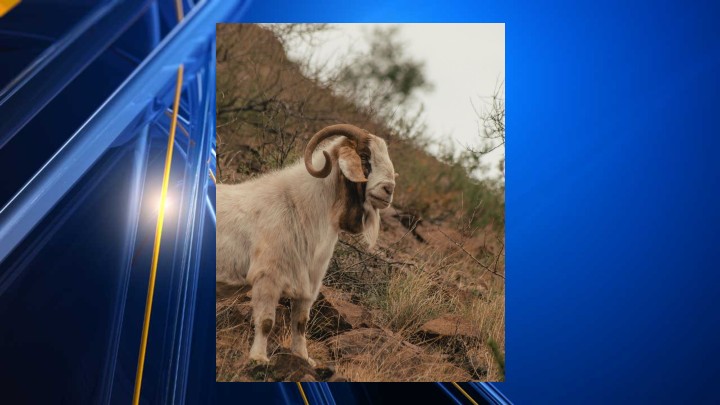
EL PASO, Texas (KTSM) — A goat who had been seen by hikers and many El Pasoans living in the Franklin Mountains has died after the Texas Parks and Wildlife Department attemped to relocate the animal in preparation for the reintroduction of desert bighorn sheep to the area, the state parks department said on Tuesday, Sept. 10.
On Aug. 13, after what were called several unsuccessful attempts to use different methods of trapping the goal were unsuccessful, TPWD staff tried to relocate the goat, according to the parks department. The goat needs to be relocated to minimize the possibility of disease being spread to the native desert bighorn sheep, the parks department said.
Bob the Goat in the Franklin Mountains Photos courtesy Carlos Martinez
Bob the Goat in the Franklin Mountains Photos courtesy Carlos Martinez
A local farmer had agreed to have the goat relocated to his property.
The goat, called “Bob the Goat” by many El Pasoans, was roped, a “standard practice in the livestock industry,” but died during the relocation process, TPWD said.
The goat was at least 9 years old, but was suspected to be “significantly older” than that, TPWD said.
The typical life span of domestic sheep and goats in free-range settings is about 10 to 13 years, the parks department said.
“The death of the ‘Trans Mountain Goat’ was an unfortunate and unintended result of the relocation effort,” said Froylán Hernández, TPWD desert bighorn sheep program leader. “Staff took the opportunity to collect tissue samples to better understand the cause of death and determine if the fatal bacteria, Mycoplasma ovipneumoniae (M. ovi) which causes infectious pneumonia in bighorn sheep, is present in the Franklin Mountains.”
The parks department said “one of the biggest challenges” to successfully reintroducing native desert bighorn sheep into the Franklin Mountains, their historic habitat, is limiting exposure and transmission of the fatal bacteria M. ovi.
M. ovi is highly transmissible between domestic and wild goat and sheep species alike, the parks department said.
“The impact of M. ovi on desert bighorn sheep in Texas has been devastating, and the risk of the ‘Trans Mountain Goat’ spreading the disease was too great to allow it to remain on the mountain during restoration efforts. Keeping it there would have jeopardized the successful establishment of a healthy desert bighorn population,” the Texas parks department said.
Read: Read More