



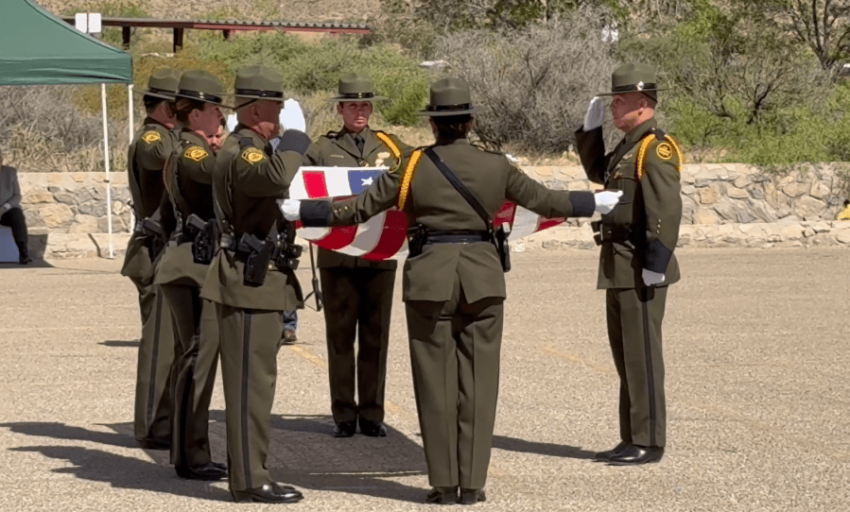
EL PASO, Texas (Border Report) – Homeland Security Secretary Alejandro Mayorkas was in El Paso Friday to honor the 156 U.S. Border Patrol agents who’ve lost their lives in the line of duty since 1924.
“I served as a federal prosecutor, but it wasn’t until I arrived in the Department of Homeland Security and saw the men and women in green of the Border Patrol out in the field, in the desert on the water, often alone that I really understood the depth of the sacrifice they make, the risks they take to serve this country and keep all of us safe,” Mayorkas said.
The memorial ceremony at the National U.S. Border Patrol Museum on Transmountain Road coincided with the 100th anniversary of the Border Patrol’s founding.
Agents representing all agency sectors in the southwest border were present along with relatives of the deceased. The most recent fatality took place just this week when a border agent who contracted COVID-19 died in a hospital.
U.S. Customs and Border Protection Acting Commissioner Troy Miller said border officers and agents often work under dangerous conditions.
That includes being exposed to infectious diseases or prone to unexpected attacks. On Thursday, for instance, the Texas Department of Public Safety released an aerial video showing migrants and presumed smugglers attack Border Patrol agents at the border wall in the desert of New Mexico.
“The work of the U.S. Border Patrol is rewarding but is difficult and dangerous. Tragically, too many have paid the ultimate price. Today we join together as a CBP family to remember those we have lost, to honor their families and to recommit ourselves to never forgetting their sacrifice,” Miller said.
The memorial included a 21-gun salute, a wreath and flag presentation to the fallen, and musical tributes.
Neither Mayorkas, Miller nor U.S. Border Patrol national chief Jason Owens made themselves available for interviews to the press before or after the memorial.
Border Patrol El Paso Sector Chief agent Scott Good reflected that the job of a border agent has evolved over the years.
Agents a century ago patrolled the border with Mexico on horseback; they now ride four-wheel drive vehicles, monitor the border with electronic sensors, infrared and thermal-imaging cameras and many are trained paramedics and emergency medical technicians capable of assisting migrants who’ve been injured or abandoned by smugglers.
“Before they learned to use the telegraph. [….] Today we have facial-comparison ability, we have biometrics instead of ink and fingerprints for our information gathering and identification. We have scope towers that just weren’t available in the past,” Good said. “And we have a lot more folks in the Border Patrol than we have in the past. We have close to 20,000 people. When we started, they were just a few hundred.” The Border Patrol typically guards the U.S.-Mexico and the Canadian borders between ports of entry, with CBP officers handling ports of entry and most of the commerce and legal entries into the country
Read: Read More