



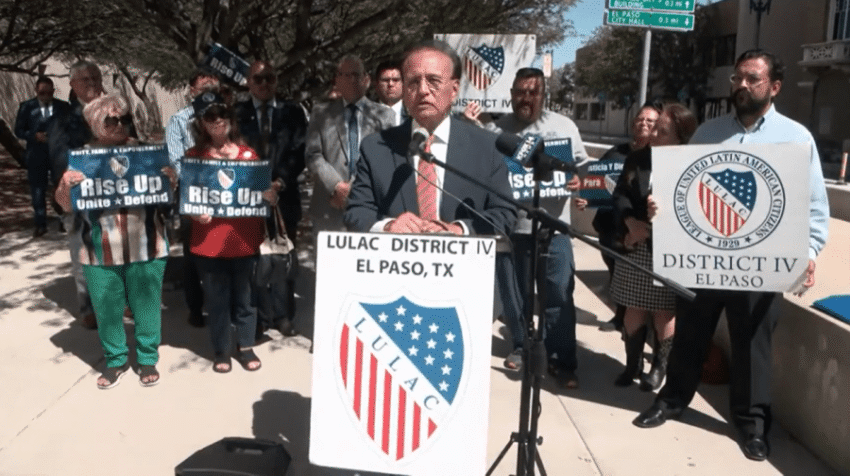
EL PASO, Texas (KTSM) — A three-judge federal panel in El Paso is weighing whether Texas’s newly redrawn congressional map can be used in the 2026 elections, or whether it must be blocked for violating voting rights.
Republican leaders pushed the map through a special session this summer, aiming to add five GOP-leaning U.S. House seats. The League of United Latin American Citizens (LULAC), represented by the Mexican American Legal Defense and Educational Fund (MALDEF), argues the plan dilutes minority voting strength by dismantling “coalition districts” where Black, Latino and other voters could join to elect their preferred candidates.
“Coalition districts are districts where the majority is made up of multiple minority groups,” Nina Perales, MALDEF’s vice president of litigation, said. “There were a couple of these districts in the map that were dismantled… one example would be Congressional District 9 in Houston that currently elects Congressman Al Green.”
Perales added that the plan also splits two Latino-majority districts that, according to plaintiffs, were already electing Latino-preferred candidates.
Some state leaders dispute those claims, saying the lines were drawn for partisan advantage, not racial discrimination. The U.S. Supreme Court has ruled that politics can be a factor in redistricting, but race cannot be the motive.
The proceeding is expected to last about 10 days, with testimony from lawmakers and redistricting experts. Judges are under pressure to issue a ruling quickly, as candidates must file for office by Dec. 8. If no decision is reached by then, Texas could see delayed primaries, as happened in 2012 when redistricting litigation pushed elections into the summer.
At a news conference, LULAC leaders framed the lawsuit as part of a decades-long fight over representation. “We feel that we should not be discriminated against based on our ethnicity or our race, our language or our appearance,” one official said.
State Rep. Barbara Gervin-Hawkins, D-San Antonio, who testified in the case, urged voters to stay engaged. “Our Black and brown communities need to unite and join together in this effort… And for those particularly young people out there, politics is a game-changer. You want to improve your life and your quality of life. You gotta get engaged. You got to get involved,” she said.
The panel will ultimately decide whether Texas can use the map in 2026 or whether new lines must be drawn.
 Read: Read More