



EL PASO, Texas (Border Report) – The president of Mexico is calling for calm as the clock ticks toward potentially devastating U.S. tariffs on exports from her country.
“We had good meetings in the U.S., we are in permanent communication with (their) security and trade people, and we will see what happens,” President Claudia Sheinbaum said on Monday. “We must have fortitude, serenity and patience. … We have a plan A, B and C. Whatever the decision, we have a plan and we have unity in Mexico. And that is good.”
U.S. Commerce Secretary Howard Lutnick said on Sunday the U.S. would impose tariffs on Mexico and Canada this Tuesday. Trump previously threatened 25% tariffs on all products coming into the U.S. from both North American partners for alleged failure to stem the flow of migrants and drugs. But the extent of the March 4 levies remained under negotiation, officials from both countries said.
Industry leaders in both countries have told Border Report the tariffs would have a major impact on U.S.-run manufacturing operations in cities like Juarez, Tijuana and Nuevo Laredo that assemble products for the American automotive, electronics and medical industries.
Some components that go into appliances and cars sold in America must cross the border, sometimes more than once, before they become part of the finished product.
“Companies are operating in an environment of uncertainty right now,” said Jerry Pacheco, president and CEO of the Border Industrial Association. “That uncertainty is preventing them from making major business decisions. Investments are being put on hold, there is people who would have been hired are not being hired until we figure out if (Trump) is going to impose the tariffs or if they’re going to be of a limited nature.”
Thor Salayandia, head of the Border Business Block (BFE) in Juarez, Mexico, said maquiladora growth and employment had already slowed down last year. So, tariffs come at the worst possible time and could mean a permanent loss of jobs.
“Corporations are holding meetings to see their options. Will they have to move (operations) to Central America? Will they move to southern Mexico? Will they go back to the United States? Will they automate production lines? All of this is on the table,” Salayandia said.
‘We are cooperating and coordinating’
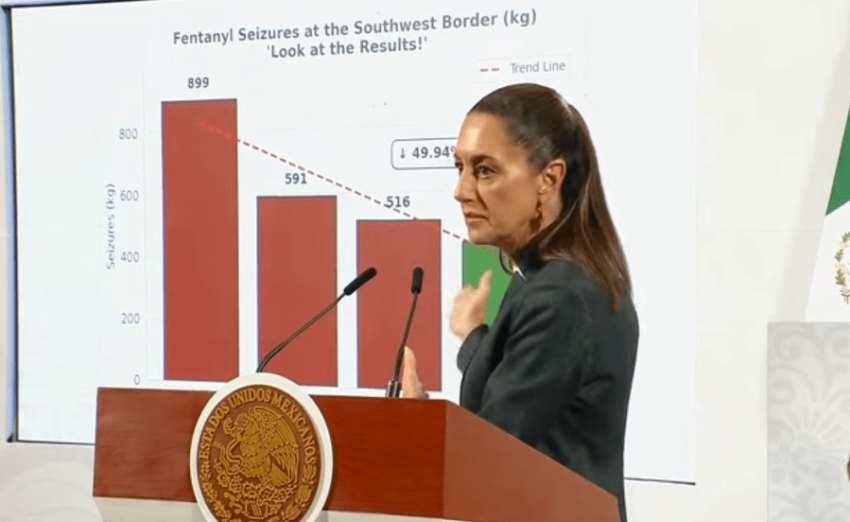
At her Monday news conference broadcast on YouTube, Sheinbaum talked about plummeting migrant encounters and fentanyl seizures at the Southwest U.S. border, and answered questions about the 29 suspected drug traffickers her government delivered to U.S. prosecutors last week.
“There is coordination and cooperation. We want to reduce the flow of fentanyl and other drugs to the United States, and we want to stop guns from coming into Mexico. There has been good collaboration and cooperation this month,” she said.
She presented a chart with U.S. Customs and Border Protection data through Jan. 31 showing fentanyl seizures are down 50 percent since Oct. 31 – days before Trump won the Nov. 4 election.

She acknowledged a final decision on tariffs is all up to Trump but declined to specify what would be Mexico’s response. Her administration last month threaten to impose reciprocal tariffs on U.S. exports to Mexico, which include about $15 billion in food and food-related products on which Mexican people depend.
Salayandia said the situation is a strong wake-up call for Mexico to invest in its domestic industry rather than relying so heavily on the export economy.
“We are only reacting (to the tariffs). The Mexican government is not doing anything, the federal government is just saying, ‘We will wait to see what they tell us.’ But we are not shoring up our internal market, we are not working on stimulus for our entrepreneurs,” he said.
 Read: Read More