



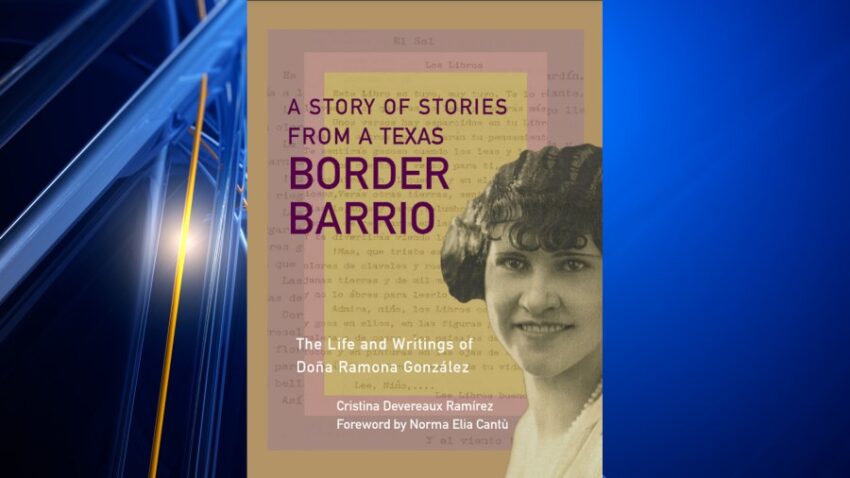
EL PASO, Texas (KTSM) — Cristina Deveraux Ramirez calls it a “destiny moment.” In 2015, she received a call from her mother, telling her that her aunt had discovered a vegetable box containing over 750 pages of her “abuela,” (grandmother) Dona Ramona Gonzalez’s unpublished writings.
“We knew she had been writing, but we didn’t know to what extent,” Ramirez said.
Gonzalez wrote and published five short stories in Spanish, in “El Grito: Chicanas en la literatura y el arte,” a 1973 issue which Ramirez describes as the “most significant literary journal” of the Chicano Movement in the 1970s.
Front cover of “El Grito: Chicanas en la literatura y el arte” (Courtesy: Trinity University Press)
“For the longest time we thought it was just these five pieces that she wrote and published all in Spanish, but then we discovered the vegetable box of all of her writings,” Ramirez said.
Her family calls it the “magic box,” where they discovered her grandmother’s writings. Ramirez said her grandmother never discussed her writings, likely because she was raised during a time when there were “Mexican sensibilities” that as a woman you “didn’t talk or brag about yourself.”
These writings are what make up “A Story of Stories: The Texas Barrio Life and Writings of Dona Ramona Gonzalez,” Ramirez’s third book and what she describes as a family project.
Courtesy: Trinity University Press
Ramirez is a professor and the head of the English Department at the University of Arizona. She is also an author and researcher with her work centered around historical textual recovery.
Gonzalez was Ramirez’s maternal grandmother, but her father Dr. Neil J. Deveraux, a textual translator and retired university professor, helped her research, transcribe, and translate over 400 pages of her grandmother’s writings, which were for the most part all in Spanish.
“She only had a typewriter, and they did not have accent marks. My grandmother was not formally educated in Spanish, so she writes with that language of the ‘barrio’ (neighborhood) which makes it all that much more significant,” she said.
“El Barrio Chihuahuita,” the historic neighborhood and district in Downtown El Paso, is where Gonzalez’s stories and this book begin.
Ramona Gonzalez on the steps of her home on Durazno Street, El Paso, Texas (1920)
Severa Valles, Ramona Gonzalez’s grandmother (left), and Asencion Rodriguez, Gonzalez’s mother (middle), with an unknown woman.
Ramona Rodriguez (Gonzalez) in the 1925 El Paso High School yearbook, The Spur
Sisters Ramona Rodriguez (Gonzalez , left) and Blaza Chafino in Chihuahuita
Courtesy: Trinity University Press
Ramirez explained that her abuela was born in Chihuahuita after her parents migrated to the Borderland from Parral, Chihuahua. Her stories vividly describe life in the historic neighborhood in the early 20th-Century.
“She writes about the people, ‘la gente,” Ramirez said. She explained that in her research about Chihuahuita, the narrative was mostly negative and unfavorable. The newspapers of the time most;y depicted that Chihuahuita was a “problem, dirty, and that it didn’t have the proper infrastructure,” Ramirez said.
“But my grandmother ignored that, she had a completely different perspective because she lived here and knew the people ,” Ramirez said.
“In these stories she brings to life a ‘Barrio Chihuahuita’ that a lot of people didn’t know, with a love and respect for the people. She does not focus on the negative aspects that the newspaper media did. She remembers fondly through her writings of the generous heart and the spirit of the people. That’s what she captures in these stories,” Ramirez said.
Gonzalez’s writings also capture her later years as a mother and grocery store owner in El Paso during the Great Depression.
Gonzalez and her husband, Don Manuel, would open Gonzalez Grocery in 1934, located at the corner of Missouri and Ochoa streets. They would operate the store until 1964, when it was purchased by the state under eminent domain to build Interstate 10, Ramirez said.
Her grandmother’s writings overall encapsulate the “rich Mexican American culture of Chihuahuita and the barrio of her grocery store,” and “resembles” the stories of American immigrant families during the early to mid-20th Century, Ramirez said.
Ramirez did extensive research to determine that her grandmother is the first literary writer to emerge out of Chihuahuita. She acknowledged the historical research of Freddie Morales, a community historian to come out of Chihuahuita, and David Romo, another historian that has recounted some of the neighborhood’s historical aspects.
“I don’t know of any other literary writers to come out of Chihuahuita, and that’s really the significance of my grandmother, and the retrieval, recovery, and translation of her writings,” she said.
Ramirez also noted how her grandmother’s stories give an often overlooked and distinct perspective.
She said that when historians write about the border, they often do so from a “masculine” perspective.
“They talk about the (Mexican) revolution, the railroads, the industry, the saloons, the shootouts, the brothels,” Ramirez said. She explained that these histories are an important essence of what El Paso was, but that when history is written from a woman’s perspective, they often tell untapped stories.
“They talk about relationships, the home, the kitchen, the patio, the stoop, and the people that they interacted with,” she said.
Ramirez said another significant aspect of the book and her grandmother’s writings is that it reflects the stories of so many El Pasoans — stories of their families immigrating to El Paso from Mexico “looking for a better life.”
“I dedicate (this book) to all the tias (aunts), abuelas (grandmothers), hermanas (sisters), mamas (mothers), all the women in El Paso to encourage them and say, ‘I know that you have journals and letters, recipes, and music that capture the El Paso Borderland. Let’s claim these stories for ourselves instead of the outside,” Ramirez said.
The book will be released on Tuesday, Aug. 20, and will be published through Trinity University Press.
You can also find Dona Ramona Gonzalez’ papers online here: https://usldhrecovery.uh.edu/exhibits/show/the-ramona-gonzalez-papers
Read: Read More