



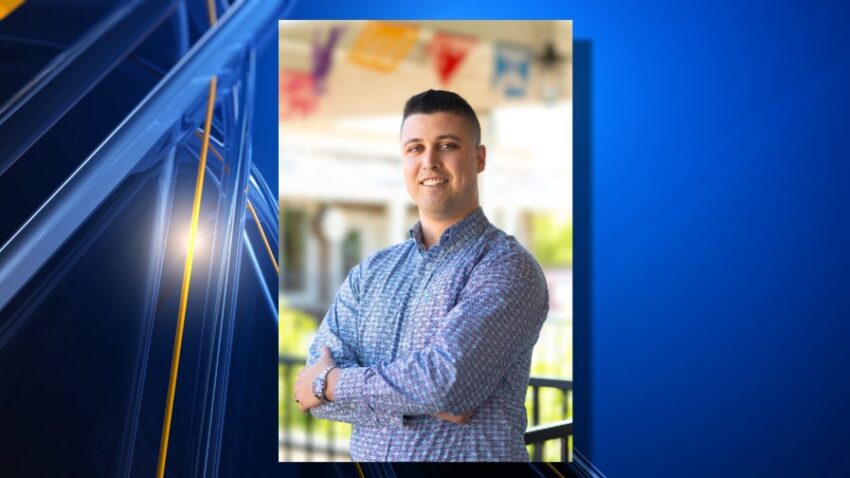
EL PASO, Texas (KTSM) — Inspired by his Borderland upbringing in Vado, New Mexico, Jorge Hernandez is conducting his doctoral dissertation on studying urban displacement of Mexican-American communities in the Southwest.
Hernandez is a New Mexico State University (NMSU) alumnus, where he obtained a master’s degree in Spanish, and bachelor’s degree in foreign language and history. He is currently a Ph.D. student at the University of New Mexico specializing in Hispanic literature within the Department of Spanish and Portuguese.

Hernandez’s dissertation is titled, “Corazones Urbanos: Literary Cartographies and Southwest Cities in the Mexican American Spatial Imaginary.”
Hernandez said his research will analyze the work of Latino writers and historians from Tucson, San Antonio and Albuquerque during the 20th century. He will look at how their writings depict the formation of all three cities’ Mexican-American communities, the subsequent displacement of those communities through gentrification, and how the communities responded through activism and cultural production.


“’Corazones Urbanos’ looks at Mexican-American writers through the panoramic lens of the 20th century and how these writers have come to represent, through literary production, the kind of subtle and often very radical changes that their communities have gone through,” Hernandez said. “It is an unveiling of stories, but it’s also ultimately about humanity in the U.S. Southwest.”
Hernandez said that because most literary work on the Chicano urban experience is often associated and focused on major U.S. cities like Los Angeles, the stories of Mexican-American communities in Southwest urban cities are not written or talked about enough.
“Often when we look at urban literary production or anything that’s associated with Chicanx urban literary production, it is often seen from a transnational or Borderlands theory kind of view. ‘Corazones Urbanos’ shifts that conversation. I’m not so much interested in the transnational or the broader scope of the Borderlands. What I’m really interested in is how these writers come to represent very critically regional experiences,” Hernandez said.
Hernandez talked about the recent years-long battle to preserve the Duranguito neighborhood in Downtown El Paso as an example that he said showed how urban displacement and gentrification continue to be an ongoing experience for Mexican-American communities in the Southwest.
Duranguito celebrates future after City Council decision to build arena elsewhere


That is why Hernandez said it’s extremely important to learn and discuss the writings and histories he’s researching. He said they can inform today’s communities about the complexity of these issues.
“These problems are not new. I think they are recurring because we never really solve them. And so to look into the history, to look into the community, to look into the stories of communities across the Borderlands offers a profound view of things going on and it offers a really broader scope whenever we talk about, for example, gentrification,” Hernandez said.
Hernandez said that when he completes his dissertation, he intends on conducting a similar research project on his home, the El Paso, Juarez, and Las Cruces Borderplex.
 Read: Read More