



If you’ve ever heard of Brackettville, in the border county of Kinney, straddling Hill Country and the South Texas Plains, it’s probably been about immigration.
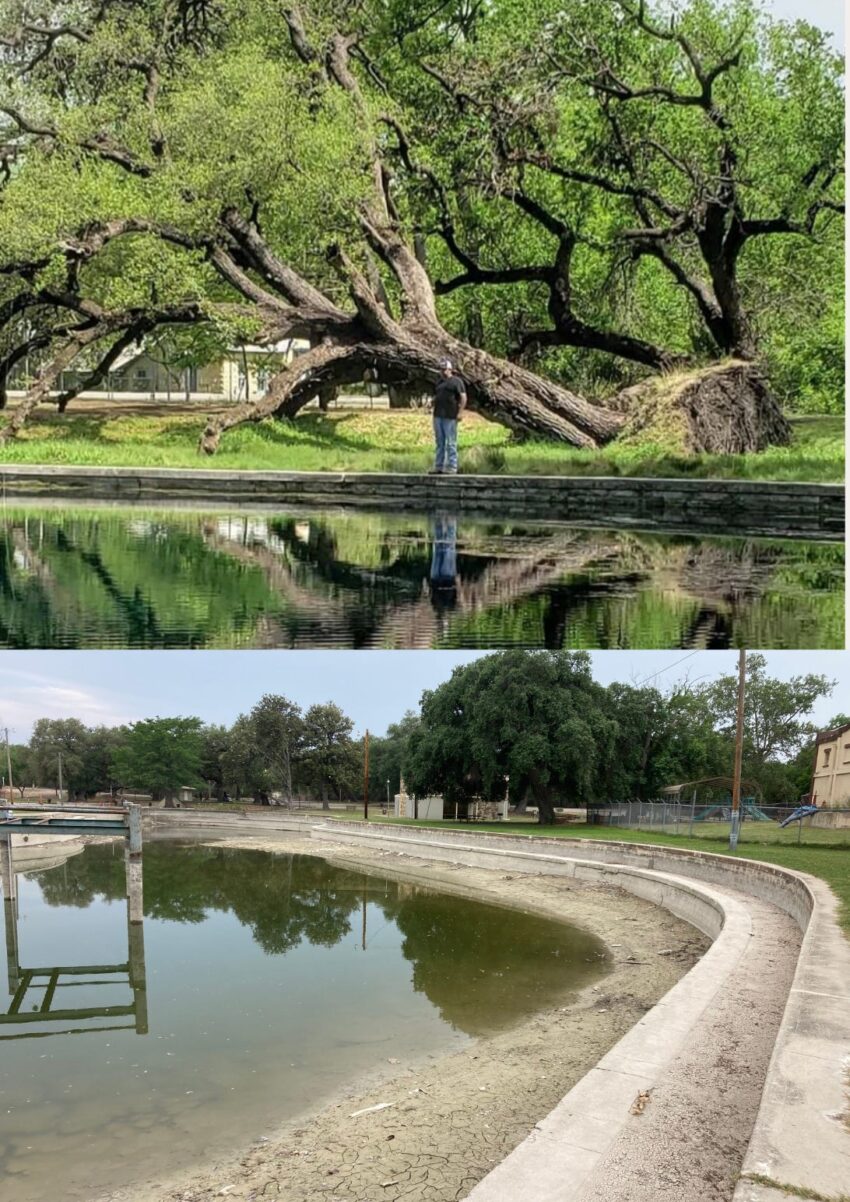
But that’s not the only controversy simmering here. Water, or the lack of it, is another big issue. One of the community’s biggest springs, Las Moras (named by Spanish explorers after the native mulberry trees), has gone dry. And it looks like it’s going to stay that way for a while.
When I was looking for land here in 2016, I visited Brackettville and Fort Clark Springs (once an army fort, now a gated community) to get an idea of what I was getting into.
I hiked some of the fort trails and wandered the creek, all the way up to the spring pool where Las Moras Springs bubble up out of the ground. The spring pool is a good-sized pond with fish and aquatic plants. Its waters flow into a swimming pool and a channel that feeds Las Moras Creek. The pool has a capacity of about one million gallons.
The first day I was there, water was hurtling along the channel. What a sight. Millions of gallons roaring along what is really a small stream. And the creek was flowing all the way through the fort and out, probably two miles of waterway festooned with huge trees and greenery. And animals and birds and bugs and everything else associated with a permanent water source.
That was seven years ago. Today, the spring is stagnant, and the creek is dust. There’s been a drought here, but we also have plenty of people who use the aquifers. Several farmers irrigate cotton and corn and hay and more, and a population of about 2,500 people live in town and on the fort, and they all depend on water pumped out of the ground.
The aquifers here are under the supervision of the Kinney County Groundwater Conservation District, which is tasked with ensuring that our water sources are used properly. The district also ensures that farmers with pumping permits are protected. But the district has allowed the farmers’ property rights to take precedence over the health of Las Moras Springs.
Everyone knows pumping the groundwater in this county has an impact on the spring’s flow. Pumping also affects the flow of the county’s other two large springs, at the heads of Pinto and Mud Creeks.
Drought does the rest.
The water authority says severe drought is responsible for drying up the spring. Yet it has never imposed drought restrictions on irrigators.
The reason for this lies in the district’s formation, in the mid-2000s. Some pumpers put up a huge legal fight to win the largest permit amounts possible; some of them wanted to sell water to cities such as San Antonio or Laredo. Other pumpers wanted permits large enough to thoroughly irrigate their crops, year in, year out, no matter the drought conditions.
But science and the legal system didn’t consult each other when the water authority was formed. There’s a “disconnect,” as the authority’s hydrologist called it, between the amount of pumping, the total permit limits, and how much the spring will flow.
And what a disconnect that is. The spring’s flow right now is zero, many times less than what makes it a wild, rollicking creek that talks and moves like a living thing. That would be about 24 cubic feet per second (cfs). The math is long, so figure it this way: one-half a cfs over one month’s time is about 10 million gallons of water, or about 30 acre feet (af). (One af covers one acre of land in 12 inches of water.)
The amount of water that was pumped in this county last year was roughly 10,000 af. The amount of water that is permitted to be pumped in this county is nearly 80,000 af. And the district can’t cut those permits without a legal fight.
So the hydrologist has suggested that the district ask the pumpers to cut back voluntarily. I don’t know how many people heard him. Not the pumpers, certainly. Their whole focus is keeping their entitlement as it is.
It’s only a handful of people. There are 32 permit holders, out of more than 3,000 property owners who pay taxes to the district.
Some irrigators might be persuaded to voluntarily reduce their pumping, but what about those who refuse? One farmer said he needed eight acre feet of water to raise one acre of alfalfa. Nonsense. That’s equivalent to 96 inches of rain. He could manage on three acre feet, equivalent to 36 inches of rain. I grew coastal hay in North Central Texas, without irrigation but with 33 inches of rain a year. I got three cuttings those years. One year we got 42 inches, and I got four cuttings.
And the pumpers say there’s no point in reducing the permits. A large volume of water is permitted, they say, so there must be that much water under the ground.
But we don’t know how much water there is. Never did, never will. We have lots of science, but unless we can get an X-ray of the underground, of every square inch of this county, we really haven’t got a clue. We’re going by feel.
There’s also no point, apparently, in doing what the Edwards Aquifer Authority does to enforce pumping restrictions: saving an endangered species. That’s because we don’t have an endangered species here. Not anymore.
The Devils River minnow was discovered some years ago to be swimming about at the head of Pinto Creek, minding its own business. Not now. Creek is dried up.
With all the volunteer hours spent by district board members and citizens, and staff hours and paid scientists and software and instrumentation—and paid lawyers—one would think it would be possible to save Las Moras Springs.
But the political will just isn’t there.
Las Moras doesn’t have to go dry. It’s been around for a long time—since way before we European settlers appeared on the scene—and it should be babied and cared for like the fragile treasure it is.
Perhaps it’s time to let the Edwards Aquifer Authority take over. They have a lot more leverage than the Kinney County Groundwater Conservation District ever did. The EAA covers 8,000 square miles of the Edwards Aquifer and serves more than 2.5 million people. Its budget comes from about 3,000 taxpayers and its permit holders.
Everyone—pumpers included—says they don’t want Las Moras Springs to go dry.
So, everyone—pumpers included—should be willing to sacrifice to save it.
Carolea Hassard’s Kinney County ranch depends on a windmill for water that is used for the house and to fill three troughs for wildlife. She started writing about the spring after discovering the Las Moras Springs Conservation Association, a local advocacy group dedicated to educating people about the plight of the spring and declining groundwater supplies in Kinney County. Find LMSCA on Facebook and Discord, and watch meetings of the groundwater district and more on LMSCA’s YouTube channel.
Read more: Read More