



If you are in southern Arizona on Saturday at 10 a.m., come listen to authors Petra Molnar and John Washington talk about their new books about the border. Molnar’s book, The Walls Have Eyes, is “a chilling exposé of the inhumane and lucrative sharpening of borders around the globe through experimental surveillance technology.” Washington’s book, The Case for Open Borders, “is a beautifully written, broadly accessible, and forthright argument for a solution to the migration crisis: open the gates.” The event, cosponsored by The Border Chronicle and the Green Valley/Sahuarita Samaritans, is free and will take place at Good Shepherd United Church of Christ, 17750 South La Cañada Drive, Sahuarita, AZ 85629.
Reporter’s Notebook: A Dispatch from the Border Security Expo
Photos and observations about the controversy, bloated border budgets, and surveillance technology as the Border Patrol celebrates its centennial
This year, a mini-scandal preceded the 17th Border Security Expo, an annual gathering of the border industry and the Department of Homeland Security’s top brass (mainly from Customs and Border Protection and Immigration and Customs Enforcement). In May, photographs appeared of Border Patrol chief Jason Owens and Rio Grande Valley sector chief Gloria Chavez “partying with” Mexican tequila mogul Francisco Javier González in Jalisco. González’s distillery was hoping to make a Border Patrol–branded tequila to celebrate the agency’s centennial. After the photos leaked, the U.S. Border Patrol, which was inaugurated on May 28, 1924, canceled a black-tie gala as the incident went under investigation for ethics violations, but the rest of its birthday events were to go on as planned: two golf tournaments, a parade, and the Border Security Expo, which was held May 21–23 in El Paso, Texas, and it is from here that I am sending this dispatch.
According to organizers, this year’s expo was the “largest on record.” An important note this year, however, was the astonishing development that the press and media were not allowed to register for the first time in 17 years. Perhaps this was the real scandal? I came in my capacity as an academic.
Regardless, the Border Patrol’s centennial was mentioned a lot during the three days. In his opening keynote, Owens asked the audience—which included representatives from nearly 200 private companies—if they could imagine how far the Border Patrol has come, starting from a few hundred agents with a badge and a gun right where we were in El Paso (and Detroit) when the border force began. And he was right. In those 100 years the Border Patrol and its related agencies have expanded massively, sometimes at breakneck speed. But, yet again, everything came down to a truism I’ve heard at every expo I’ve attended since 2012: “We need more people, we need more stuff,” as Owens put it. The “more stuff” part was right there at the conference, with all kinds of products on display. Owens hailed the innovative products as “force multipliers.” Praising the industry, Owens joked, “If it was left to the Border Patrol, we’d still be on horses.” What follows are photos I took at the expo and in the surrounding El Paso/Juárez borderlands. It is a quick run-through with a few scattered observations. Stay tuned for a larger piece sometime in the next few weeks. I’ll be digging in on the industry’s dynamics as showcased at the expo.
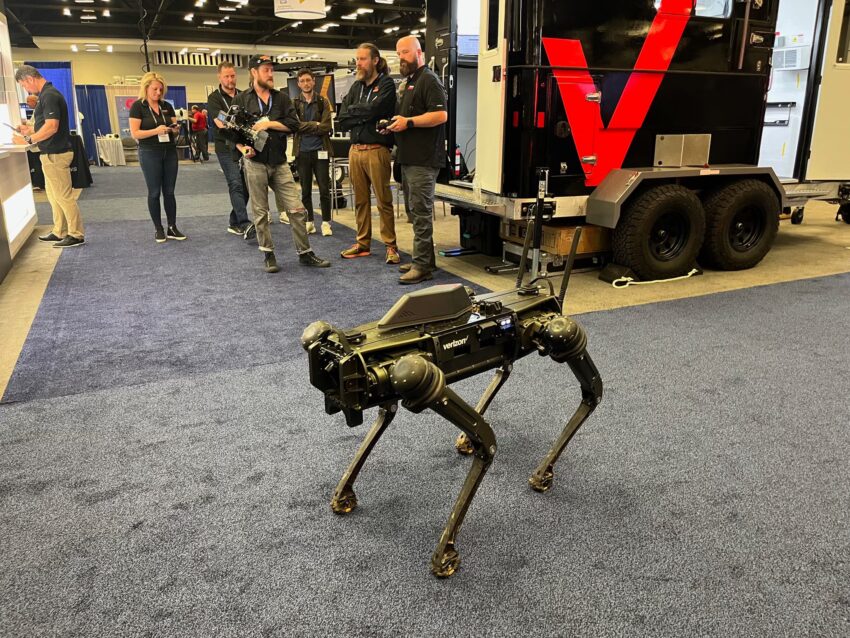
The robotic dogs were back. But this time Ghost Robotics was not present; the company had first contracted with CBP in 2021. Remember their slogan? “Robots that feel the world.” This time the robodogs were in the hands of the major phone companies. This first picture below is of Verizon’s robopooch; according to a vendor, the company partnered with Ghost Robotics to make the unmanned ground vehicle (UGV). The vendor also told me Verizon is not selling the robotic dog. At least not yet. It’s part of Verizon’s Front Line Crisis Response Team, a unit that law enforcement can call to respond to any situation, often disasters like the 2023 fire in Lahaina, Maui. But, the vendor told me, the robodog had not been deployed yet. It had been used only in trainings. Will it be deployed to the border? He didn’t know. When I talked to Verizon at the 2022 Border Security Expo in San Antonio (before they had the robotic dog), a representative told me that they had helped CBP set up phone services in remote areas where they detained kids.
A little later I ran into another robotic dog (second photo, this time AT&T) wandering the floors of the expo. The use of UGVs is definitely something to keep an eye on.
Once again, Israeli companies stood out at the expo this year. These included Elbit Systems, a company that has built many surveillance towers in the U.S. borderlands, as we have covered here at The Border Chronicle. And Israel Aerospace Industries was there, offering a demonstration of a Border Patrol vehicle that looks like it might be patrolling the Gaza Strip (which is a “good laboratory,” as an Israeli brigadier general put it in El Paso many years ago at another border convention I attended). Much of this technology is first tested in the Palestinian Occupied territories.
And speaking of many years ago, I was surprised to see the company StrongWatch’s Freedom-on-the-Move, a mobile surveillance system that was one of the first technologies I wrote about when I attended my first Border Security Expo in 2012. That was the year when No Protesting Allowed signs were posted all over the Phoenix Convention Center (where the event used to be held).
I don’t know if you caught this Border Chronicle article from a few weeks back about the Border Patrol removing razor wire from the border wall in Nogales, and that it might install new capacities as part of the wall’s maintenance. In the article, I wondered what those new capacities might be. When I visited this company, as you can see in the photo, they have a bollard wall model, which has a metal strip along the top that contains a black cable. This is a “smart wall” sensor that can detect if someone is touching the wall (or sawing through it, the vendor told me). I asked the vendor if this was deployed anywhere in the world. “The U.S.-Mexico border,” he told me.
An artificial intelligence self-portrait at one of the vendor booths at the expo.
Rapid DNA Service.
Finally, I had to take the 10-block walk from the convention center to the border, and cross into Mexico to see all this enforcement in real life and time. The trickle of the beautiful Rio Grande looked sickly as it traversed the heavily militarized border between Ciudad Juárez and El Paso (stationed on the Mexican side of the river was a small unit of the Guardia Nacional, who do not like their picture taken). The razor wire barrier (which you can see in the below photos, courtesy of Operation Lone Star) and the border wall gave the feeling of a fortress, especially for people (many of them presumably asylum seekers) staying in a tent encampment right across the river. Although the river lacked vegetation, the birds and a bunch of purple flowers (see last picture) showed that there is still an alternative to all this.
Read more: Read More