



I’m not going to lie. I’ve been dreading 2024. I’m trying to get my mind right for the marathon that will be border theater, militia madness, and disinformation galore this year. With presidential elections in the United States and Mexico, border communities are going to be caught in the middle of escalating tensions over migration, security, trade, and dwindling water resources.
Here are few key things on the horizon, which The Border Chronicle will be covering this year.
First let’s highlight the good news …
Mexico’s First Female President
Mexico outlawed slavery nearly 30 years before the United States. Mexico is going to outshine the United States again, by electing its first female president in the general election on June 2, 2024.
President Andrés Manuel Lopez Obrador (AMLO), who is constitutionally barred from running for reelection, has anointed a successor in former Mexico City mayor Claudia Sheinbaum for president. With AMLO’s building of the Morena party into a political juggernaut, Sheinbaum’s path to Los Pinos seems almost assured. Although she is receiving formidable competition from Xóchitl Gálvez, a former senator from the conservative PAN party. Sheinbaum is a 61-year-old physicist who holds a doctorate in environmental engineering, and very capably steered Mexico City through the pandemic as mayor. Recent political polls show Sheinbaum, who is of Jewish ancestry with a 2-to-1 lead over Gálvez, who claims indigenous ancestry and was the former head of indigenous affairs under the Vicente Fox presidency. Gálvez could still pull ahead, but it will be tough. Either way, Mexican voters will be deciding between two female presidential candidates in June. Either one will make history. ¡Viva la mujer!
For more on the Mexican candidates and current polling information click here.
Meanwhile, in the United States … Another Old White Guy in the White House (and Possibly the End of Democracy)
Barring a miracle, Donald Trump, who will be 78 by the November 5, 2024, presidential election will be the Republican candidate running against Democrat Joe Biden, age 81.
The stakes couldn’t be higher and the dread more existential in this upcoming presidential election. MAGA extremists backing Trump are betting on “border chaos” to catapult Trump back into the White House. Meanwhile, Trump is channeling Adolph Hitler von der Mar-a-Lago, promising vengeance for his enemies and that he will be a dictator. He also declared in a December political rally that immigrants are “poisoning the blood of our country.”
Border Chaos as a Political Platform
MAGA extremists in the House of Representatives, holding emergency funding hostage for Ukraine, cut out early from Congress for Christmas vacation, but they were willing to shorten their holiday break to make an appearance in Eagle Pass, Texas, on January 3, setting the tone for the coming months leading up to the general election. House Republicans will begin holding hearings on border security in February and are planning to impeach DHS secretary Alejandro Mayorkas.
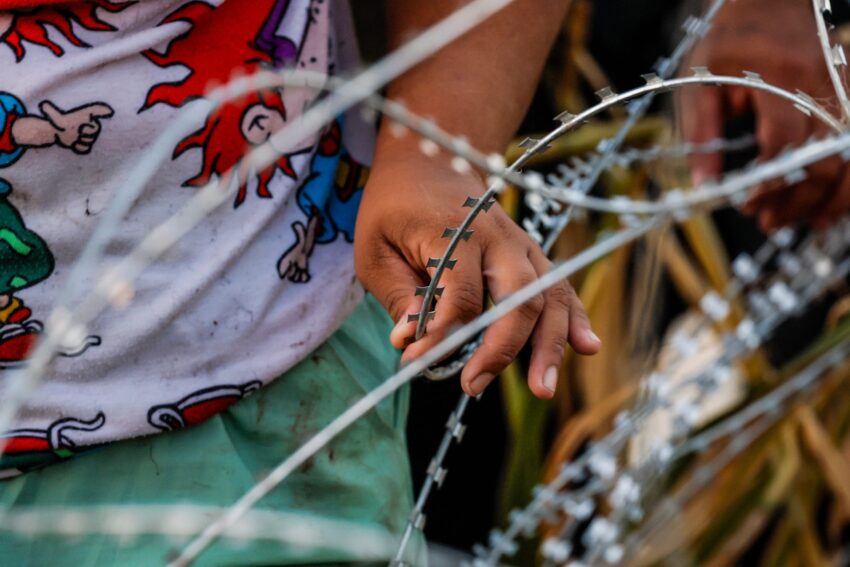
In Eagle Pass, House Speaker Mike Johnson, along with 60 other Republicans, held a press conference in front of coils of razor wire placed along the Rio Grande by Texas governor Greg Abbott’s Operation Lone Star. During the visit, Republicans declined to meet with local community leaders who had erected a public memorial in Eagle Pass for more than 700 people who had died trying to cross the border in 2023.
Johnson and Republicans want to reestablish family detention and Remain in Mexico, build 900 new miles of border wall, and to essentially end asylum. Republicans passed these measures in H.R. 2, with no House Democrat support. The Senate, which is controlled by Democrats, has said it will not support the legislation. But now Republicans want the language added into the emergency security funding bill.
In the legislation, Biden and Democrats have already included funding for 1,300 more Border Patrol agents, 1,600 new asylum officers, and 375 judge teams to tackle the more than four-year asylum backlog.
The United States badly needs both parties to decide on meaningful changes to the immigration system, which hasn’t been updated since the 1990s. But don’t expect any bipartisan cooperation this election year. Republican Representative Troy Nehls of Texas made headlines after the visit to Eagle Pass for saying the quiet part out loud. “Let me tell you, I’m not willing to do too damn much right now to help a Democrat and to help Joe Biden’s approval rating,” Nehls told CNN. “I will not help the Democrats try to improve this man’s dismal approval ratings. I’m not going to do it. Why would I?”
You can read more about what Republicans and Democrats want in the emergency funding bill here.
More Men with Guns—Humanitarians and Migrants Caught in the Middle
Leading up to Christmas, fierce cartel battles in Mexico among factions of the Sinaloa Cartel forced Casa de la Esperanza, a migrant resource center in Sasabe, Sonora, to close it doors until conditions become less dangerous. The town of Sasabe has become a ghost town as residents have either been killed or fled. Other towns on the migrant corridor in Sonora have also seen gun battles as the factions fight over control of lucrative smuggling corridors. The conflict has affected migration patterns, funneling many migrants from as far away as Africa and Ecuador to more isolated, remote sections of the border wall in Arizona.
On the U.S. side, armed militia members, including Veterans on Patrol (who aren’t veterans) have also started to arrive at the Arizona border along with MAGA content creators such as Ben Bergquam from Real America’s Voice, which hosts Steve Bannon’s “War Room” podcast, and is funded by a Colorado media mogul. Bergquam arrived at the border wall in Arizona, an hour east of Sasabe, on New Year’s Eve and began harassing humanitarians at a temporary camp built for asylum seekers waiting for Border Patrol to pick them up and transport them. In a video published on X, Bergquam referred to the aid volunteers as “leftists aiding and abetting cartel members at their camp and inviting an invasion into this country.” Bergquam went on to tell his viewers that the aid camp, which has shelter and food, was a “guerilla [sic] camp and frontline of the invasion.” Bergquam also called them “enemies within this country” and “pure evil.”
Bergquam has been targeting humanitarian aid workers for years. This type of hate speech has deadly, real-world consequences, inciting people to arm themselves and show up at the camp and possibly attack volunteers or migrants. I visited the temporary camp last Friday, and two men in trucks attempted to drive through the middle of the camp, filled with children and families, while filming on their phones. Another group of three men, who were visibly armed, also showed up at the camp while I was there, photographing the camp and humanitarian workers.
These agitated men (and sometimes women) with guns are putting longtime aid organizations at the U.S-Mexico border in the crosshairs. In remote areas like Jacumba Springs, California, and Lukeville and Sasabe in Arizona, border residents are working to reduce misery caused by politics, bad governance, and other manmade disasters that lead people to flee their homes and seek protection in the United States. December was particularly brutal for local aid organizations, with at least 250,000 people arriving to seek asylum in December, according to DHS figures. Many of the arrivals included families with small children in remote sections of the wall, who sometimes waited for more than a day for Border Patrol agents to arrive and pick them up for processing.
At the camp I visited on Friday, volunteers with the Green Valley/Sahuarita Samaritans told me that December 23 was especially brutal, with freezing rain and nearly 250 people stranded in the mud, some who were critically ill. With slow response times from Border Patrol, and no other U.S. agency such as FEMA offering any type of assistance, local volunteers face life-and-death choices. “Where’s FEMA, where’s Red Cross or the National Guard?” asked Randy Mayer, a United Church of Christ pastor and longtime border humanitarian. “They have the money and the capacity to deal with this, but they haven’t shown up. We are out here on our own.”
Humanitarians have had to evacuate critically ill people and children to the nearest Border Patrol facility for emergency care and to be processed, which right-wing agitators like Bergquam are equating with “aiding and abetting the cartels” and “breaking U.S. law.” This type of disinformation puts a target on the backs of local volunteers and brings more misery and violence on migrants who already survived horrific conditions on their journey north.
Ports of Entry as Political Pawns
On December 1, Mexico suddenly announced it was out of money to deport migrants. Within days, in the United States, Customs and Border Protection shut down ports of entry in Lukeville, Arizona, and Eagle Pass, Texas, and a pedestrian crossing in San Ysidro, California, citing the escalating number of migrants arriving at the border and the need to repurpose agents for processing people. This dealt a heavy financial blow to Mexican tourist towns like Puerto Peñasco in Sonora and communities up and down the border. CBP also closed two cargo train routes for five days, dealing another economic blow to Mexico and the binational economy.
The closures left border residents—and Arizona’s governor—shaking their heads and wondering why, when CBP has handled similar numbers of border crossers in the past, it needed to close vital trade and travel routes.
In hindsight, it looks like the entire exercise was a political chess match. The closures very quickly got the attention of Mexico’s president, whom the Biden administration very badly needs focused on detaining and deporting migrants. Just two days after Christmas, U.S. Secretary of State Anthony Blinken and other U.S. cabinet members were in Mexico meeting with AMLO and his cabinet. Mexico is now detaining and deporting migrants again and ports of entry have reopened. The two countries will meet again in Washington this month on the management of migration and bilateral trade.
The sacrificing of millions in trade with the port closures is a sign of just how high the stakes are in negotiations over migration in a presidential election year. It’s also a worrying precedent for border communities and the shared binational economy.
The Real Ticking Time Bomb—Water
What should be a priority for both countries is climate change and the dwindling water supply in the Rio Grande, which they desperately depend on. In Mexico, farmers rioted in 2020 over the release of water to pay the U.S.-Mexico water debt. And last year, some Texas towns and Mexican cities nearly went dry. Border Chronicle cofounder Todd Miller crisscrossed the border last year, reporting on the water shortage and climate crisis for a book about the Rio Grande. He’ll be continuing this beat in 2024, and you’ll be the first to read his dispatches. The Rio Grande is in terrible shape, and binational leaders can no longer afford to ignore this emergency.
As 2024 unfolds, we’ll also be delving deeper into border security spending, surveillance technology and other pressing issues on the U.S.-Mexico border. Stay tuned and thanks for reading and listening to The Border Chronicle. Together we can get through 2024 with our sanity intact (we hope)!
Read more: Read More