



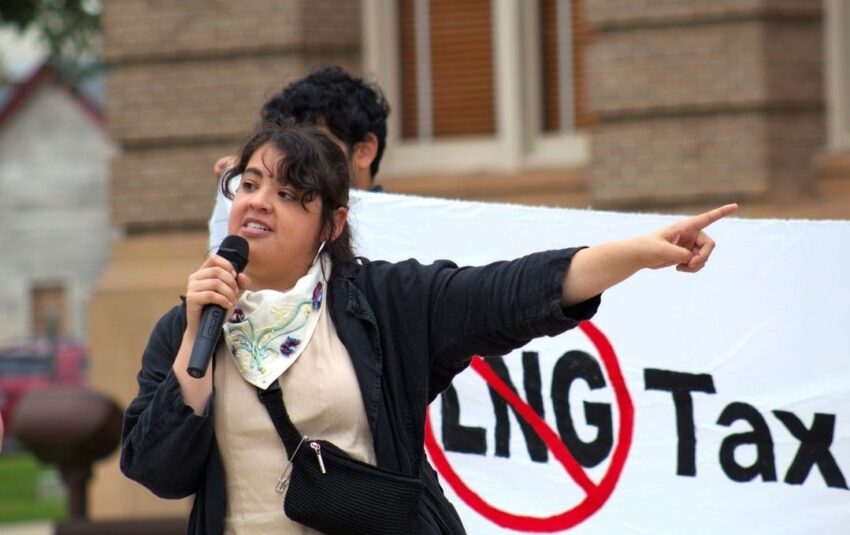
The Rio Grande Valley, on the southern tip of Texas, is a fertile subtropical delta rich in animal and plant species. It’s also home to Latino-majority communities, many of them low-income, who are fighting several battles at once—against border militarization, environmental pollution, and gentrification, says Rebekah Hinojosa, 33, an artist and environmental activist based in Brownsville. Hinojosa cofounded the South Texas Environmental Justice Network and the environmental organization Another Gulf Is Possible.
Hinojosa’s hometown is 20 miles from Elon Musk’s SpaceX South Texas facility, which manufactures and tests rockets. When the rockets explode, they rattle her windows, and debris falls from the sky for miles around the launch site, located on Boca Chica beach, which is part of a federal wildlife refuge and coastal wetland. Musk has applied to launch up to 25 “superheavy” rockets a year from the site.
In addition to the world’s richest man, the powerful oil and gas industry has the region in its crosshairs and is pushing to install liquefied natural gas (LNG) terminals in the Brownsville ship channel. The terminals would condense Texas shale gas from fracking and liquefy it for export.
Then there’s Texas governor Greg Abbott’s Operation Lone Star, an $11 billion and counting border deployment of police and soldiers, and the building of a state-funded “Texas border wall” in Hinojosa’s community.
Despite all these challenges, Hinojosa and other activists have had some truly impressive wins, including the recent Washington, DC, court ruling that federal permit approval for two LNG projects will be canceled because, among other issues, it lacks environmental and climate impact assessments. In this Q&A, Hinojosa talks about what it’s been like to organize against all these powerful entities impinging on her community.
When did these proposed LNG projects come on your radar, and what is the status of these projects now after their permits were canceled?
I did a lot of anti-fracking organizing when I was in college, so I was very aware of how LNG just demands more fracking, which is very dangerous all over Texas. So when I heard in 2014 that these companies were trying to build out the fracking industry in my community, I quickly got involved. It’s been a long, long battle.
On Tuesday [August 6] we had two big victories. We got a major insurance company to pull out of the Rio Grande LNG project. And then the court issued its decision on our lawsuit and canceled the Federal Energy Regulatory Commission’s permit authorization for all the LNG projects: Texas LNG, Rio Grande LNG, and the Rio Bravo pipeline. These are huge, historic victories that are the result of 10 years of community organizing and a diverse coalition of people from the valley working together. And we’re going to continue pressuring banks, investors, and insurance companies to pull out of these LNG projects.
We’ve been able to get several banks to do this. But recently we’ve seen a number of new banks loan money to Rio Grande LNG, so we’ve had to escalate our campaign and include even more banks. We don’t want to see these companies continue to get funding and keep trying to build these facilities.
How far away is the SpaceX rocket launch facility from these proposed LNG sites?
SpaceX is between six and seven miles away from the LNG site, and there’s been some local reporting where they’ve mapped out rocket debris, the radius where rocket debris has fallen, and it’s definitely fallen on the LNG site. And so we’ve also been raising the alarm about explosion risks.
I was in the Rio Grande Valley in November, and I saw one of the SpaceX rockets explode, and it left a turquoise cloud up in the sky for a bit, and it was pretty ominous looking. It made me wonder what kind of impact rocket launches have on people who live there.
With the November explosion I felt my entire apartment shake in Brownsville, which is 20 miles away. Two years ago, I was at the birding center on South Padre Island and heard this huge explosion, and then saw this big plume of smoke. Turned out it was SpaceX deciding to do some static testing on its raptor engines. I was 10 miles away on the island, and the boom and smoke it made was terrifying. In April, I watched another rocket explode from my apartment.
While watching the rocket explosion in November, I was with a couple of valley residents who were deeply concerned. One of them told me, “All that needs to happen is that the rocket goes sideways and hits the LNG plant, and we’re all toast.” Do local and state elected officials respond to community concerns? Is there any government oversight?
If the LNG plants were built and hit, I imagine it would have a huge explosion radius. It could potentially wipe out Port Isabel, South Padre Island, all the Laguna Madre communities, and Brownsville. Our lawyers have sent letters to the FAA and FERC demanding explosion risk analysis reports, but these regulators don’t respond.
Local elected officials also ignore the problems with SpaceX. Right now, we’re trying to get a meeting with Congressman Vicente Gonzalez’s office to talk about the problems with the Federal Aviation Administration’s review process. And we haven’t been able to get a meeting. We’ve seen city of Brownsville officials roll their eyes at us when we bring up our concerns at city council meetings. We’ve also seen just about every regulatory agency rubber stamp and give SpaceX whatever it wants.
Has Governor Abbott responded to community concerns?
No, he hasn’t. Instead, Abbott is actively trying to push LNG down here. And, of course, he’s building his own border wall right now in Brownsville, behind the old Amigoland Mall.
The governor’s wall building is part of his $11 billion and counting Operation Lone Star effort, which he says is to secure the border, but then he’s not listening to border communities’ concerns about safety when it comes to exploding rockets and LNG plants?
The state of Texas is giving tax incentives and green-lighting everything for Elon Musk, and it’s throwing money into border militarization and excessively policing people in our community. This is just making problems worse for us.
It sounds like it’s incredibly tough to do environmental justice work in the Rio Grande Valley, especially when you’re up against the world’s richest man and the powerful oil and gas industry. Do you feel like the issues your community is facing have gotten enough coverage in the media?
It’s very tough. Our community has become a militarized border zone, and we’re also on the Gulf Coast. I mean, we’re routinely sacrificed and used as bargaining chips by politicians and by the fossil fuel industry and now Elon Musk. We are a severely disadvantaged community that has a long history of being exploited.
Even locally, I don’t think we get enough coverage. It’s difficult for us to get our protests and statements covered in local media. It seems like local media is intentionally not resourced enough to do deeper digging into what’s going on.
What are your hopes for future environmental justice work in the Rio Grande Valley?
We have a diverse coalition of organizations working together on these issues. At the South Texas Environmental Justice Network, which has an office in Brownsville, we’re going to keep organizing against LNG terminals, SpaceX, and any other environmental problems in our region. Our work is funded through grants, so finding enough funding is always an issue. That’s the goal right now. We need more funding.
Learn more about the South Texas Environmental Justice Network and its work here.
Read more: Read More