



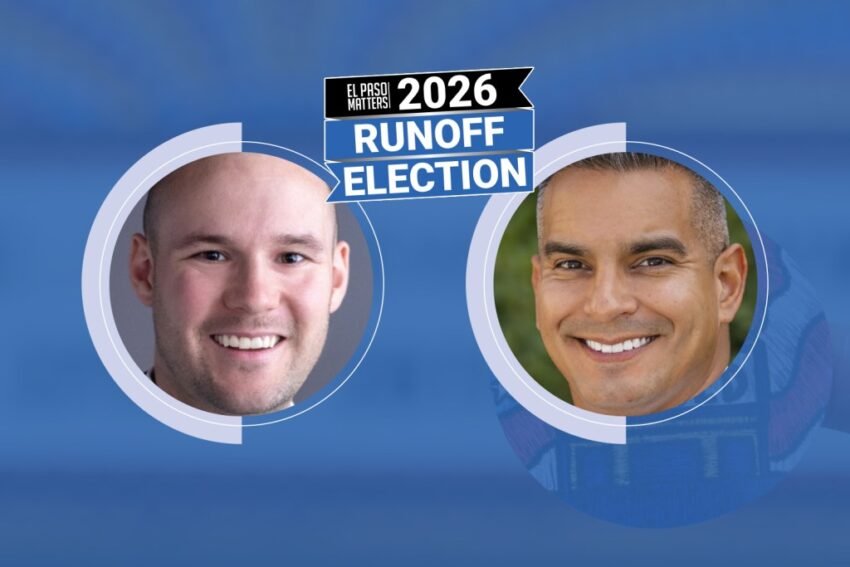

In the upcoming El Paso City Council runoff election, Matthew Guzman, executive director of the Mary L. Peyton Foundation, challenges incumbent city Rep. Chris Canales for the District 8 seat.
District 8 covers South-Central El Paso, Downtown and part of the Westside.
Canales, 34, was the chief of staff to his predecessor, Cissy Lizarraga, and Guzman, 41, previously worked as a financial adviser in Chicago. In the November general election, Canales received 34% of the vote and Guzman received 25% of the vote in the five-person race.
The candidates recently sat down with El Paso Matters to talk about police accountability and the revitalization of South El Paso neighborhoods, while expanding on previously discussed topics such as the Meta data center, commercial growth, sprawl containment and the Downtown deck plaza.
VOTER GUIDE: El Paso City Council Dec. 12 runoff elections
Here are a few questions selected from the interview with answers edited for brevity. You can watch the full interview in the video above.
El Paso Matters: In June, El Paso City Council directed the city manager and city attorney to negotiate a legally binding community benefits agreement with Meta. City attorneys said the city cannot force Meta to participate in negotiations and as of November, no such agreement has been finalized.
If Meta fails to meet its employment or investment commitments in its Chapter 380 agreement, what consequences should the city be prepared to enforce? How would you ensure that an additional community benefits agreement is legally enforceable rather than just a list of promises?
Canales: I don’t think we are at risk of Meta not meeting those minimums that they agreed to because they are talking about a project that has grown massively in scale. What the bigger issue is addressing the problems that come with that increased scale. I don’t think they will be failing to meet the minimums. If they do, the city has options. It’s an enforceable agreement so we would essentially be able to not pay out the rebates that would be entitled to. There’s standard compliance that the city does for all the chapter 380 and other types of economic development agreements.
The concern is definitely that they are going well beyond what they said they are going to do, so that causes pretty great strain on our utility infrastructure, roadway infrastructure, lots of other things that have these negative impacts were not anticipated because the scale has now grown by about 10 times.
Unfortunately, I think probably whatever is negotiated with Meta (in a community benefits agreement) won’t be legally enforceable, and that I think is a very difficult thing that we have to approach because you know they seem to be willing to make some commitments, but they’ve made other commitments in the past that they haven’t held to, and so I have a lot of heartburn with the possibility that they can make big promises and not deliver on them, and there’s very few consequences for that. Anything they come to the table on is going to be voluntary on their part.
Guzman: I think that gives us the opportunity to cancel the (Chapter 380) contract. The way the contract is written provides a certain number of parameters that they need to follow, and if they don’t follow those, now we have means to renegotiate that contract.
I think where a lot of people are misunderstanding my stance on the data center – I don’t necessarily love data centers, but I did not agree with canceling the 380 agreement because we don’t have grounds to do so. I think if we did have grounds to do so, then we could discuss that, but at this point, they haven’t breached the contract in any way, but I think we should be auditing that project to make sure they are following every single letter of it.
I think what we’ve seen out of Meta right now is a lot of promises and nothing is legally binding, and I think that’s where the community benefit agreement needs to come in. Whenever we do sit down at the table with them, that all needs to be not only legally bound to Meta, but to the actual property.
What we’ve already seen is they’ve sold off the majority share to BlackRock and they’ve agreed to be the first tenant of that project, but we don’t necessarily know they are going to be the forever tenant for that project. So whatever community benefit agreement is drawn up and legally bound, it needs to be the actual project itself, not the current tenant.
El Paso Matters: The El Paso Police Department has been scrutinized for allegations of misconduct, including within the department and against women, and for wrongful use of force that has led to the deaths of community members. How would you ensure accountability and transparency within the department?
Canales: They have definitely faced some increased scrutiny, and I think a lot of that is merited based on some of the things that we’ve seen happen. There’s been a push, and I’ve supported it from some of the community organizations who are active in this space. Border Network for Human Rights is one of the big ones. It’s not even a wholesale change, but just to do a refresh of the way that we think about citizen oversight or citizen accountability for police here in El Paso.
Like we currently have a review board that’s made up of half community members and half representatives of the police department plus one. So the police department has one additional vote more than the community does, and we think there are ways that we can add more community representation onto those review boards that are making decisions about like disciplinary actions for police officers, for example, to just make sure that there’s extra citizen oversight.
Guzman: Correct me I’m wrong, but I think their accountability board right now is all internal. I think if we want to build public trust it makes sense to have some civilians on that board, whether that’s city appointed or civilian appointed, I think there needs to be an outside voice in there so that one, it doesn’t just turn into an echo chamber with police officers all making decisions amongst themselves without community feedback. And two, it gives a community member the opportunity to hear from police officers, what they’re doing day to day, and they can report that back to civilians. I think that’s a good start to a conversation there between us and them.
I think it would be better if it (community members appointed) came from outside of the police officers. City Council or the mayor, someone like that making an appointment would be a good start.
El Paso Matters note: El Paso police’s accountability review board is made up of community members and police officers of various ranks. The department appoints and manages the board itself.
READ MORE: Previous El Paso Matters interviews with Canales, Guzman
El Paso Matters: Your district includes Chihuahuita and Segundo Barrio, culturally significant neighborhoods threatened by neglect, but also displacement. How would you address preservation and improve the quality of life for residents there?
Canales: There’s a definite balance to find there as well, right? As redevelopment happens and infill development happens, you don’t want people to be displaced. A couple years ago, I brought it forward to the City Council, and I’m grateful that they adopted it, an anti-displacement policy framework. So it’s been a couple of years in the works, in parallel with the housing plan that’s coming forward at the same time as our comprehensive plan, kind of our overall city planning document for El Paso – for a vote in a couple of weeks, actually, towards the end of this term.
So there’ll be a bunch of anti-displacement strategies that are included in that, and those have been driven by the public’s participation over the last several years in developing that plan, and specifically what people in those neighborhoods that are more vulnerable to displacement have said are important to them.
The homestead preservation reinvestment zone that I mentioned earlier is one of the possible strategies from a whole menu of strategies that can help with preserving some of that already existing affordability in these neighborhoods, and making it so that rising property values that might result from increased development don’t force people out.
Guzman: Obviously you want the units that they have to be sustained. You want them to be maintained, but I know one of the things that was recently proposed was having some sort of log about where all of our units were and force inspections annually. Which I think on paper sounds like a good idea, but if we look at the second or third order sort of ramifications of that, we could see people displaced as we force landlords to make improvements. Just like any other business, costs go up for them. They pass those costs to the individual that’s renting. I think we have to figure out a way to do it, but I don’t think that’s the way forward.
But I’ve spoken to the president of the Southside Neighborhood Association. We did a walk-through of Segundo Barrio and had these very conversations. I think everybody there wants to see these neighborhoods come back to life.
When you look at South El Paso Street, and all the adjacent streets down there, you see just a bunch of boarded up facilities or under-utilized facilities, so we have to find a way to redevelop those and kind of modernize them because I think the days of relying on foot traffic from Juárez to businesses there is likely gone.
I don’t think that model exists anymore with the advent of Amazon, Mercado Libre in Mexico and things like that, so we need to think about how we can create new life in that corridor and hopefully create jobs for people in the barrio so that will improve their quality of life as well.
It’s a ripe opportunity for an entertainment corridor. I think with all of the influx of tourism that comes into our hotels, South El Paso Street is walking distance, right? So people can leave their hotels and go down to a restaurant or a food truck. If there was a pedestrian-friendly corridor, that’s what I’d really like to see, closing off maybe a couple of blocks for having pedestrian only because when people are in their cars, they’re not spending money.
What’s next?
District 8 is one of three races left undecided in November. The other two, Districts 1 and 6, are also headed to runoff. Only District 5 city Rep. Ivan Niño was reelected outright in November.
Early voting runs from Nov. 30 to Dec. 8. Election Day is Saturday, Dec. 12.
The City Council comprises eight representatives who make policies, adopt the annual budget and set the tax rate. The council also hires, evaluates and can fire the city manager, city attorney and chief internal auditor.
City representatives serve four-year terms and are paid $72,800 a year. The positions are nonpartisan.
The elected city representatives will take office Jan. 5. The other four city representative seats, as well as the mayor’s position, are up for election in 2028.
The post VIDEO: We talk with District 8 city rep candidates Chris Canales, Matthew Guzman appeared first on El Paso Matters.
Read: Read More