



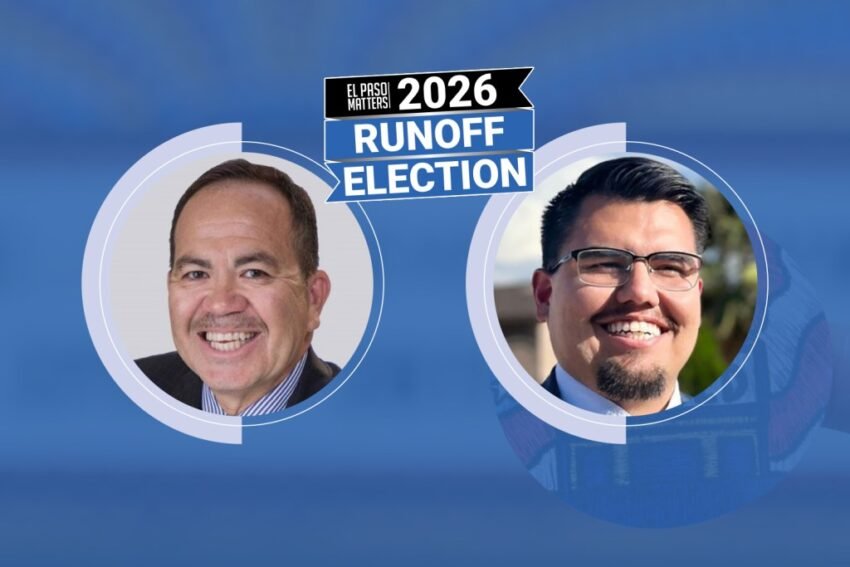

Incumbent city Rep. Art Fierro and challenger Jesse Moreno will face off in a Dec. 12 runoff election to represent District 6, an Eastside district that includes much of the 79936 ZIP code including neighborhoods around Marty Robbins Park and Montwood High School.
Fierro, 64, is seeking a second four-year term on City Council. He works in marketing and previously served in the Texas House and on the El Paso Community College Board of Trustees.
Jesse Moreno, 25, is a political organizer and former City Council staffer who worked for District 3 Reps. Cassandra Hernandez and Deanna Maldonado-Rocha. He is a senior economics major at the University of Texas at El Paso.
Fierro received about 34% of the votes in the five-candidate Nov. 3 election. Moreno finished second at about 27%. Neither received the majority needed to win outright.
Property taxes and household utility costs have remained among the top issues in the race, as well as the Meta data center project. Fierro in June voted to preserve the city’s controversial tax break agreement with Meta. Moreno has stopped short of calling to terminate the tax break deal, but has lobbed more criticism toward Meta.
The race has been marked by a domestic violence allegation against Moreno. His former girlfriend accused him of punching her in the face last year, an allegation Moreno has denied. Some local progressive advocacy groups, including the UTEP College Democrats and the Amanecer People’s Project, which raised money to support Moreno in the November election, withdrew their support of Moreno’s campaign following the accusation.
VOTER GUIDE: El Paso City Council Dec. 12 runoff elections
El Paso Matters interviewed both candidates about the race and their positions on city issues. Here are a few transcribed questions selected from the video interview with answers edited for brevity. You can watch the full interview in the video above.
El Paso Matters: How would you hold Meta accountable for its water use, air pollution and job-creation commitments? What should the city do if the company fails to meet those commitments?
Fierro: I don’t believe we’re going to be taken advantage of. The guardrails are there to keep El Paso safe, to keep our natural resources secure for our future, for the future of my children and grandchildren. So, it’s absolutely important for me to hold Meta accountable.
And we have those guardrails in place. For example, El Paso Water, they have a commitment that they can use X amount of gallons. After that, the valve gets shut off. They can’t say, “Oh, we need another extra 100,000 (gallons), another gallon, because at some point, when they reach that max, it’s shut off.”
One of the things that people forget is that, when we talk about natural resources and Meta, there was a development plan for that area. And that development had apartments, single-family housing and retail. It was going to use more water than the Meta plant was going to use.
When Meta is all up and running, the community college, the UMC and the Ysleta Independent School District are going to get 100% of the taxes. Granted, the city is going to get 20%, but that 20% is going to make them the highest-paying taxing entity in El Paso.
One of the things in there is that we’re not going to give data centers any 380 agreements or discounts on land. There’s not one member, in my opinion, on council who wants more data centers. The appetite’s not there for more data centers.
But what we’re getting because of this data center is we’re getting Wiwynn, 2,000 jobs in District 6. We’re getting Schneider. We’re getting another company that’s potentially coming in, knock on wood, soon, that’s going to bring 200 jobs.
Out of the 200 jobs, 120 are young entry-level engineers making six figures. And what better school to get engineers from than UTEP? So, you don’t have to go somewhere and get your experience. Now you can stay here and then decide what you want to do with your career.
Moreno: I think it’s just addressing every possible avenue. I mean, we’ve seen that this council has been debating over other things on that issue, but more so seeing what clawbacks, what incentives, what the agreements are, just having that spoken on the dais completely.
Not through one meeting, because it’s going to be a huge popcorn show, for theater and theatrics, but seriously discuss every possible avenue. It should take weeks. It shouldn’t take one day of us deciding everything because that allows us to get that information to the public and everybody knows what the outcomes of each route are.
But after this election, come January, we should expect more conversations about this to come up. And you’ve seen multiple candidates speak about what their issues are and how they’re going to address it. And each and every one of those is very valid.
I think all that needs to be discussed properly and utilize what tools the city has to hold them accountable and, obviously, address the concerns that the community has.
And if council or city leadership or any government leadership is debating or questioning that process, well, then it’s our job to make sure that citizens are aware about everything that’s going to happen out of each one of those outcomes.
El Paso Matters: What should the city seek from a community benefits agreement with Meta, and would such an agreement address residents’ concerns?
Fierro: (District 4 city) Representative (Cynthia Boyar) Trejo has really championed this. And, personally, I support it 110%. I think that when it comes to this, this is where we need to sit with Meta. And this is what we need, and this is what we want for our community.
And then it’ll become a negotiation between what works for the company and what works for the city. And I think that’s going to – at the end, the result is going to be something very positive for our community. And we’re moving that way.
Dollars invested in education, dollars invested in scholarships for El Paso Community College and UTEP, dollars invested in solar lights for our city, dollars invested in making sure that we have safe, drinkable water. There’s just so many opportunities that we need to continue and work on this and make sure that it’s a win-win for our community.
Moreno: Well, I mean, it’s obvious to see that they’re utilizing these community benefit agreements to make up for the lack of concern towards water, air emissions, air quality, electricity usage, infrastructure and the jobs that are going to be implemented.
I think if we truly address how we’re going to hold them accountable with those five concerns, then we can see what the book is going to be for bringing back to council.
I understand this corporate front that they have, but you don’t need to know how obvious it is that citizens are upset about it. It’s clear that this is a makeup for the mistakes that they had on this agreement initially. It should have been done prior. All of it should have been discussed prior to this even being an issue. Much of it is, of course, a makeup for the mistakes that they’ve had.
You might believe that they’re making up for the mistakes, but we still haven’t seen any discussions publicly about if they’re going to change what type of emissions are going to be conducted. We haven’t seen any accountability with the PUC. We haven’t seen more meetings with El Paso Water to make sure that they’re going to keep our water safe and sustainable. Especially with the air emissions and the air quality. Pollution of the air is just going to be a huge concern.
El Paso Matters: El Paso Electric, Texas Gas Service and El Paso Water have sought rate increases consistently in recent years. How would you address rising utility bills and ensure utilities don’t become unaffordable?
Fierro: Absolutely. Sometimes it’s a double-edged sword because some of the funds are for improvements to the system.
And we remember what happened a handful of years ago when a winter storm came to Texas. Two hundred-plus people died. It was horrible. Our region didn’t go through that. We had heat, we had electricity, we had all the utilities that we did. Part of that, I think, has to do with investment into the grid system.
But it’s that other portion that the utilities are asking for that we need to hold the utilities accountable and we need to hold their feet to the fire.
We fought Texas Gas. We got an extreme increase compared to the other portions of Texas. South Texas actually got a decrease, but we got the highest increase because they wanted to put it all together.
We spent money challenging it legally. Council as a whole was fighting it. But the Railroad Commission, who’s in charge of that portion, we fought that. But the Railroad Commission came back and said, “No, we’re going to approve it.”
Since I’ve been on council three-plus years now, we’ve had 42 filings that we’ve challenged legally. And we’ve been able to save the taxpayers, the utility payers, $112 million above and beyond what they want, what they’re paying now.
Right now, we have 16 cases that we’re challenging the utilities on.
Jesse Moreno: El Paso does not need to be paying the same rates as the rest of Texas for Texas Gas Service. We don’t need to be paying such high rates for El Paso Electric.
I can respect El Paso Water for the great work that the leadership has done, but there are still constituents who barely get by from these water bills. I think there was even the grant from Meta that they gave to El Paso Water for paying utility bills, the water bill was already gone.
There’s a huge need. Whether that can be audited or more looked down upon with more scrutiny that needs to be shown.
Because I feel these issues. Thousands of constituents feel these issues. Now they get upset when they don’t see their representative fighting more aggressively on their behalf against these utility companies.
El Paso Matters: The city consistently pushes back and criticizes rate increases sought by Texas Gas Service and El Paso Electric, which are privately-owned. But City Council does not similarly push back on El Paso Water rate increases, because El Paso Water is owned by the city. Should the City Council have more authority over El Paso Water and its governing Public Service Board?
Fierro: Well, I disagree with you on that. I think we do push back.
One of the problems right now is that El Paso Water is this quasi-division of the city. So our authority over it isn’t really authority over it. Even when you talk about board members, I’d like to see us get to the point where each council member can appoint a board member.
Now, we’re talking differently than just having the (PSB member selection committee) interview and then send us who they think it is, who it should be, who’s qualified to sit there.
And, so, that’s where it starts. I think the more input we have on the board from the very beginning, then we’re able to have more input.
There’s also ways that we need to look at, legally, to make this quasi-company more accountable to City Council. Because once we can get to that point, then you hold City Council accountable for the rates. But until we get that authority, they’re just one more utility that can raise their rates.
Moreno: Everybody on the Public Service Board Selection Committee and the actual PSB, they have great experience. I understand that. They’re there for a reason.
Council elects those who elect who’s going to be on the PSB. It’s another barrier. It’s another typical bureaucracy. I think it’s the same issues we’ve seen with any government, that you have a layer of protection, not from the board members, but to not have council or citizens directly influence.
But if you have your city representative or a policy of some sort addressing that and making it clear, because there’s still a lot of citizens who aren’t aware about that process to begin with, to just remind ourselves of this shared responsibility on every municipality, every board, every committee, that we’re serving citizens.
Not that any of them are profiting off of any of it. I’ve heard that before. I don’t appreciate when you’re assuming, but it’s to make sure that we know everything at hand.
We know these factors. Now, if the board themselves and the company or these utility commissions can truly grasp somebody who is on a fixed income, they can’t get by, then that kind of brings back compassion to government, brings back ethics and a huge shared responsibility.
El Paso Matters: What is one specific thing in your district you’d point to as a priority, a specific project you’d like to get done, some sort of improvement you’d like to make within your district?
Fierro: We have to continue street improvements. Street improvements have got to be, because to me, that’s a public safety issue also.
And since I’ve been in office, we’ve either reconstructed or redone Saul Kleinfeld, Montwood, Vista del Sol and Pellicano, and numerous neighborhood streets. And we have to continue that momentum and continue to focus on that.
It also means, Diego, that at some point, we’re going to have to look at a way to fund it. Because the money that we’re investing in our streets right now isn’t enough to even keep up with the repairs and what we need to do to make our streets safe. So, we need to look at another (funding source).
Moreno: Priorities, as everyone has always heard, is streets. Streets need to be well maintained, well kept, whether they need to be reconstructed or resurfaced. There are still plenty across the entire city that need to be resurfaced.
When I hear these conversations with people at the doors, “Well, why are they making a huge project elsewhere when we have these essentials that are uncovered?” This can be a facility for a bathroom at a certain park or a certain facility. This can be, of course, shading or benches at a park of some sort.
District 6 also doesn’t have a senior center, and there’s a huge population that’s missing a need. Of course, we’re very dense because we’re between George Dieter and Joe Battle, but that shouldn’t discourage your city representative to at least go forward towards it.
Others, like potholes, drainage, street signs, street lights. I think if constituents were more pleased with this, then we can easily move forward with other projects, whether it’s entertainment or a certain industry. But until we address basics first, then I think constituents are going to be upset if the city goes after other, bigger projects.
El Paso Matters: City staff last year proposed a transportation user fee to be assessed to homeowners monthly. The proposal didn’t go through. What are your thoughts on that? Would you consider a monthly transportation user fee in your term to generate more funding for street maintenance?
Fierro: It’s timing. I think that is an avenue that we really have to look at. Other cities do it and they’re able to improve their streets and pay for street maintenance that way.
Our street maintenance department does a great job. When you talk about potholes and you talk about issues like that, you submit it, they run and they take care of it immediately. When it snowed that one time a year ago, they were out there when there were still snow flurries trying to keep the roads safe.
The issue I had with the last proposal was we didn’t have enough public input. The timing was bad. We didn’t have enough people that we reached out to and said, “Diego, this is what we’re asking for. These are the three options. How do you feel? What’s your opinion?” And we need to do more and more of that.
A fee is going to be considered a tax, right? And, so, if I remember correctly, that one was going to be proposed on your water bill.
It’s really just an education. Because it’s like, “Art, if you’re happy with the roads today, then you don’t need to have any input on this. We already know what you’re thinking. But, Art, if you believe that we need improvements in our streets, which we all do, I think the majority of us do, these are the options.” And that’s the important part.
Moreno: There is that one item, the street user fee, that wasn’t even discussed. That needs to come back to council.
The streets maintenance department and city staff had provided solutions. It was a little concerning that it wasn’t even discussed. At least we’ll bring that to council with a huge context given prior to even us discussing it so that citizens and developers and anybody who’s a stakeholder in any district are aware about what the fiscal challenges the city is having to go through for funding these projects.
I believe that was a great solution. But, again, just discussing it and seeing, “Is this a solution we can at least go towards?” And then get back to our constituents and show, “Hey, do you agree with this? What do you want? If not, then you keep working with me on what you don’t want for your neighborhood, your community, your district, so on and so forth.”
What’s next?
This is one of three races left undecided in November. The other two, Districts 1 and 8, are also headed to runoff. Only District 5 city Rep. Ivan Niño was reelected outright in November.
Early voting runs from Nov. 30 to Dec. 8. Election Day is Saturday, Dec. 12.
The City Council comprises eight representatives who make policies, adopt the annual budget and set the tax rate. The council also hires, evaluates and can fire the city manager, city attorney and chief internal auditor.
City representatives serve four-year terms and are paid $72,800 a year. The positions are nonpartisan.
The elected city representatives will take office Jan. 5. The other four city representative seats, as well as the mayor’s position, are up for election in 2028.
The post VIDEO: City Council District 6 runoff candidates Art Fierro, Jesse Moreno on Meta, utilities, streets appeared first on El Paso Matters.
Read: Read More