




SOCORRO, Texas – In the 1980s, Maria Estella Padilla went door to door after Mass, organizing house meetings to bring running water and sewerage services to hundreds of thousands of homes along the Texas-Mexico border.
Today, at 82, she’s back to organizing her neighbors and fellow parishioners at La Purisima Catholic Church in an effort aimed both at stopping a planned immigrant detention center and protecting the access to water that she and others fought so hard to win decades ago.
“We did it back then when we didn’t have the internet, when we didn’t have social media, but now they communicate quickly. It would be easier in a way to do it now than it was back then when we had to go door to door and take signups after Mass,” she said of her latest fight.
Earlier this year, the U.S. Department of Homeland Security, then headed by Secretary Kristi Noem, announced a $38 billion plan to buy and retrofit 11 warehouses across the country to convert them into sprawling detention facilities to serve the administration’s mass deportation program for undocumented immigrants.
That included three warehouses on the edge of Socorro, about 15 miles southeast of the El Paso city limits, that had been built to hold nuts harvested from nearby pecan groves. The property, sold to DHS for $123 million by a Kansas City area developer, included three reinforced concrete warehouses of about 296,000 square feet each, with an adjacent plot of land available for expansion.
DHS initially said the Socorro facility would hold up to 8,500 immigrants awaiting deportation, which would have made it one of the largest immigrant detention centers in the country.

After Oklahoma Sen. Markwayne Mullin replaced Noem in March, DHS said it was canceling plans to convert at least seven of the 11 warehouses – though not the Socorro site. In June, the acting director of Immigration and Customs Enforcement told El Paso leaders that the privately run detention facility would be smaller than previously announced, but didn’t provide details.
But local leaders and residents, many organized by local parishes, remain outspoken about their concerns, citing environmental, as well as moral reasons.
Socorro has transformed over the past 50 years from a mostly agricultural area with no running water or sewer service into an El Paso suburb of almost 40,000 people. Pecans, cotton and other crops are still produced in the area, but much of the historic farmland has been sold for housing developments.
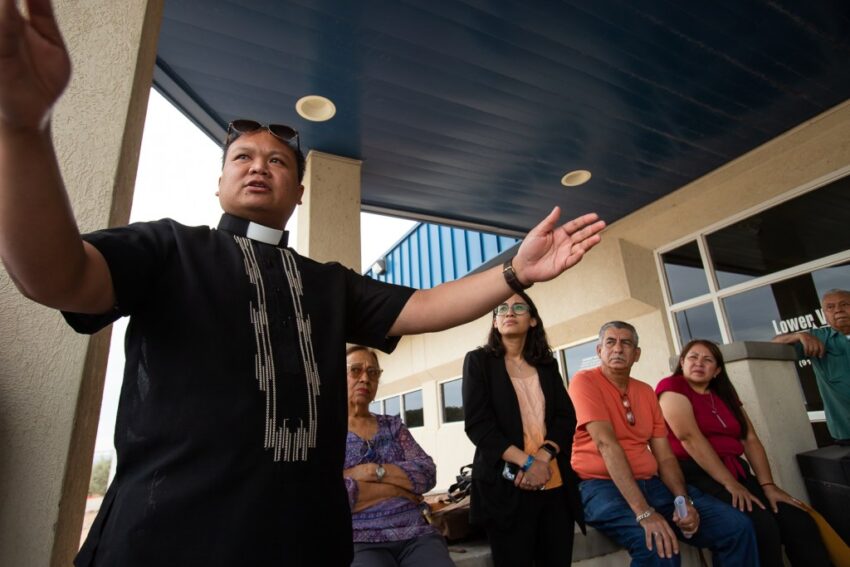
Socorro opposition to the detention center began to grow in April, when the El Paso Interreligious Sponsoring Organization began meetings with parish leaders in the town’s three Catholic churches to discuss what the planned detention center might mean.
EPISO is part of the Industrial Areas Foundation, a national network that works with local religious congregations around the country – primarily but not exclusively Catholic – to organize communities around issues that local residents identify as most important.
In El Paso and throughout Texas, the most consistent issue for IAF affiliates over the past 50 years has been water. In El Paso County alone in the 1980s, more than 80,000 residents lived in homes without water or sewerage services. Hundreds of thousands of other residents along the Texas-Mexico border lived in so-called colonias, illegal subdivisions built without basic infrastructure.
Organizing by IAF organizations led to hundreds of millions of dollars in state investments starting in the late 1980s that brought basic water and sewerage infrastructure to most – but not all – of the state’s colonias.

EPISO began focusing on the proposed Socorro immigrant detention center in April, based largely on Catholic social teaching on the treatment of immigrants. Organizers put together what they call “house meetings” at each of the town’s three Catholic churches.
“And when people learned what was happening, then the water issues started to surface,” said Surya Kalra, EPISO’s lead organizer. Officials with El Paso Water and the Lower Valley Water District said hundreds of thousands of gallons of water a day would be needed for a large detention facility.
House meeting participants started talking about water issues they were seeing at their own homes, especially with water pressure.
“People started to realize that they weren’t isolated in their own issues on water pressure and water backup and all that stuff,” Kalra said. “That’s what house meetings do when you have people get together and they start to share their stories, they realize that what they thought might be their own personal failing is actually a systemwide difficulty.”
On May 28, more than 40 people organized by EPISO went to a meeting of the Lower Valley Water District board. The agenda didn’t include any items about the detention center or water pressure issues, but several residents addressed the board in English and Spanish during the public comment portion of the meeting.
“I’m completely opposed to detention centers on so many levels, on a human level, ethical, moral, our faith, we just don’t believe in that. The way we’re treating them, it’s just abhorrent,” Padilla said at the meeting. “But on a practical level, we don’t have water, and we have several issues at our house. The most common one is the pressure.”

“We are many generations of families, and I would hate for us to be known as the city that is holding this many people that don’t deserve to be treated the way they’re going to be treated,” said Grace Herrera, who attended the meeting with her daughter and granddaughter.
Several residents focused on a disruption of service on May 18, when the area’s water pressure dropped dramatically. Lower Valley Water District officials didn’t respond to El Paso Matters’ questions on the water pressure issues raised by residents.
A Socorro dialysis center had to shut down for the day, said Alicia Mossman, whose nephew works at the facility.
“They were trying to disperse these people to other dialysis centers. Many of the people that show up for dialysis are dropped off and have no way to get them elsewhere, so they had to do without dialysis that day,” she told the water board.
Herrera’s granddaughter, Eleina Gibbs, started to tell the water board about what happened at her middle school the day the water pressure dropped, but she was too soft-spoken for the board and audience to hear. So her mother, Gracie Ortiz, read her letter for her.
“No one could go to the restroom or drink water. This continued from 8:30 in the morning to the end of the day,” Gibbs’ statement said.
Her letter said that by the end of the school day at 3:30 p.m., she rushed home to use the restroom, only to find it occupied by her grandmother. “I desperately waited for her to get out. When she was done, I rushed to get in.”

The girl’s statement said her parents weren’t told that students didn’t have access that day to the restroom or drinking water, a claim disputed by the Socorro Independent School District.
“Parent messages were sent by the campus, and water was made available for restrooms and consumption,” district spokesperson Daniel Escobar said. “The campus did consolidate to use specific restrooms on campus. Drinking water also was offered for students and staff.”
Rosalinda Vigil, the water district board chair, was clearly moved by Gibbs’ statement.
“I’m a resident, and I, too, have complained about pressure and certain issues, and I pray and promise that we hopefully won’t have to go through this again,” Vigil said. “We’re going to address these issues, and we’re going to talk about them, so that no one should ever have to go through this again.”
EPISO and the parishes continue efforts to inform residents about the detention center and ongoing water concerns, and meet regularly with local government officials. Democratic U.S. Rep. Veronica Escobar of El Paso met with EPISO representatives shortly after a June 12 meeting where Acting ICE Director David Venturella told her the administration had adjusted its plans for the Socorro warehouse facility.
“The Department of Homeland Security is going to proceed with using those warehouses, but there will not be 8,500 people held there,” Escobar said during a news conference after her meeting with Venturella. “They said that they’ve changed the plans a little bit. It will be a training facility. It will be a campus, essentially, for ICE, with offices and conference rooms, but yes, there will be privately run detention.”

Escobar and other El Paso area officials said even a scaled-down detention facility would stress water and public safety infrastructure in the Socorro area.
DHS officials didn’t respond to a request for comment from El Paso Matters about its plans for the Socorro warehouses.
Kalra said EPISO will remain vigilant in its efforts to stop the detention center, and to advocate for improved water services for Socorro’s residents.
She said the Catholic parishes will play a key role in those efforts because they serve as a place of trust for many residents.
“If you’re doing this outside of the structure of an institution or a church, it’s catch as catch can. But churches have deep networks of relationships of trust that help people understand and interpret what’s going on and start to get organized quickly,” Kalra said.
Padilla, who was part of the fight to bring water to the colonias in the 1980s, said she believes that it’s possible to organize the community again around the detention center and water issues.
“I believe we can, but it does take involvement by organizations that are already organized, like churches, and that’s why I am so happy to see that our church is behind this effort, and that San Felipe (another Socorro Catholic church) is behind it, and others. But that’s what it takes, and I do believe we can do it,” she said.
This article was produced as a collaboration between El Paso Matters and Religion News Service as part of the Atlas of American Belonging project, supported by the Henry Luce Foundation.
The post Socorro Catholic churches unite residents over ICE detention center, water concerns appeared first on El Paso Matters.
Read: Read More