



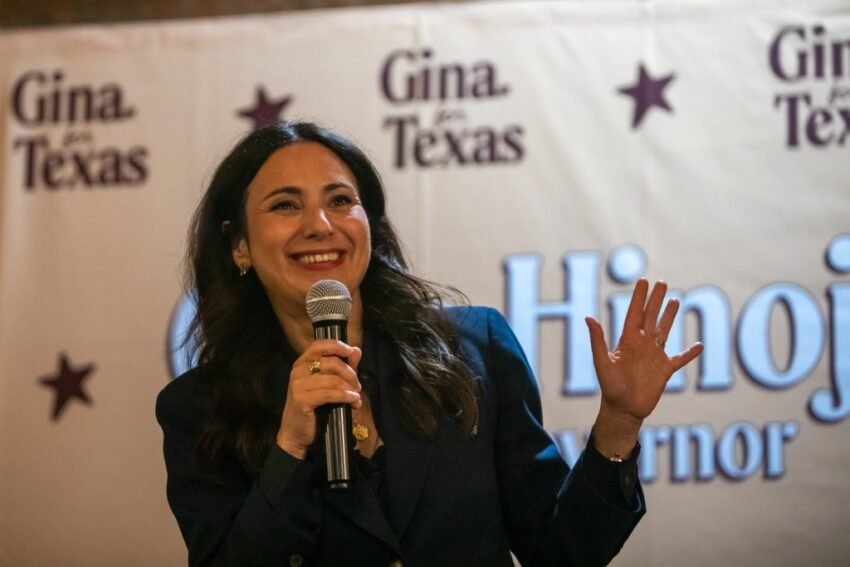

Texas Gov.-elect Gina Hinojosa is familiar with issues that face K-12 school districts as a former president of the Austin Independent School District Board of Trustees. She spent part of her campaign talking about her support for teachers and schools.
Less known are her plans as governor to address concerns that have changed the direction of higher education under the state’s Republican leadership during the past quarter century.
These concerns include general political interference, reduced state support for full-time students, reshaping institutional priorities, the ban on DEI (diversity, equity and inclusion), the threats against tenure and academic freedom, and the erosion of shared governance and curricular censorship.
Hinojosa’s office said the governor-elect is fielding numerous media requests and would follow up and accommodate El Paso Matters’ request at a later time. Leaders of the University of Texas and Texas Tech University systems as well as the Texas Higher Education Coordinating Board did not respond to requests for comment.
But those familiar with the higher education situation in Texas said that there are a few things that can be done quickly, but overall change will take time.
Mike Gavin, CEO and president of Michigan-based Alliance for Higher Education, said Hinojosa and the other new state leaders in the executive and legislative branches might “be able to put some toothpaste back in the tube.”

“It’s going to be messy,” he said during a telephone interview. “It’s going to take a long time, and we’re all going to be learning how to do it on the fly.”
Hinajosa will have about 20 openings to fill on seven boards of regents that govern state university systems early in her administration, including three on the University of Texas System and two on the Texas Tech University System.
The jobs of regents include the selection and evaluation of chancellors and institutional presidents and determining their compensation. Regents also award faculty tenure, approve operating and capital budgets, allocate resources, and set tuition rates and faculty salaries.
Gavin said her choices should be people who care about higher education and student success as opposed to being big political donors.
He said using values-based, academically-sound reasons to select future regents for Texas systems could be a signal to the nation of how to do things the right way. They should be focused on merit and mission, academic freedom and institutional autonomy. At each level – regent, chancellor, president – after a person is selected, the person should be allowed to do their job without interference.
“I think that will actually be able to correct a lot of what has been chaos and wrongdoing at the systems level in Texas,” said Gavin, a former college administrator who trains higher education leaders on how to focus on their tasks in politically disruptive times.
During a February 2026 interview with a student journalist at the University of Texas at Tyler, Hinojosa said that she would appoint people to the boards of regents who were respectful of academic freedom.
Those appointments will need the confirmation by two-thirds of the 31-member state Senate, which will still be controlled by Republicans, 19-12. If the Senate does not confirm the nominees during the Legislature’s 140-day session, the governor may make recess appointments who must be considered by the Senate when it reconvenes in two years.
While Gavin suggests a certain background for regent nominees, the truth is that any adult U.S. citizen who votes in Texas, who is mentally competent, and has not been convicted of a felony is eligible to hold those positions.
Among the regents whose term will expire is Cody Campbell, chairman of the Texas Tech University System Board of Regents. Texas Gov. Greg Abbott appointed him in 2021. During an October campaign stop in Lubbock that featured President Donald Trump, Campbell warned the audience what an Hinojosa win could mean for future TTU Systems regents’ appointments of which there will be three openings in 2027.
“If (Abbott) doesn’t succeed in this election, we will have three blue-haired weirdos on the board at Texas Tech,” he said, lamenting that it could mean an end to all the “good work” it had done.

State Rep. Vince Perez, D-El Paso, said he hoped that Hinojosa’s arrival might bring about a change among the boards of regents to hire chancellors with academic credentials instead of former politicians.
The University of Texas System hired Dr. John Zerwas, who served in the Texas House of Representatives from 2007 to 2019. The Texas A&M University System appointed Glenn Hegar, the state’s comptroller from 2014 to 2025 and he served in the Legislature prior to that since 2003. The Texas Tech University System selected Brandon Creighton, who served in the Texas House from 2007 to 2014 and as a state senator from 2014 to 2025. All of these hires were made last year.
Perez, whose district stretches from the Westside to the Lower Valley and includes UTEP and Texas Tech Health El Paso, is a member of the House Committee on Higher Education. He echoed some of the same concerns Gavin shared including an increased government involvement in colleges and universities.
“You’re definitely going to see a shift away from that, ensuring that our institutions of higher learning have the academic freedoms that I think any institution should have,” he said.
Perez hoped that changes could affect the number of faculty and administrators who want to leave or bypass the state because of Texas’ higher education policies. He said faculty members want to do their jobs and not be sidetracked by political pressure and legislative scrutiny.
The Texas chapter of the American Association of University Professors released in September the results of a faculty survey that showed deep dissatisfaction with higher education in the state. Among the findings was that 70.2% would not recommend Texas for a faculty position to their out-of-state colleagues.
The chapter believes the results were due to the negative effect of political interference, censorship policies, weakened shared governance and tenure protections.
Teresa Klein, president of the Texas AAUP-AFT (American Federation of Teachers), sent an election-related statement that Texas had spent more than a decade making its public universities a premiere destination for the best and brightest students, top researchers and for billions of dollars in research investments. She said Gov. Abbott spent most of his last term crashing that ship.
“Now everyone who loves our Texas universities and is committed to their mission can breathe a sigh of relief and turn the page,” Klein wrote. “Gina Hinojosa made public education a cornerstone of her campaign, and professors look forward to working with her to restore competent, student-centered leadership at Texas universities.”

Albert Burnham, a professor of history at El Paso Community College and president of the college’s Faculty Association, said he hoped the change in state leadership would equate to reviews and possible changes to policies on DEI and shared governance.
He said the current situation is a combination of restrictions and micromanagement where the state tells the systems and college districts to tell instructors what they can and cannot say and teach.
“I’m hoping that (the state) will just let us do our job,” he said.
Gavin from the Alliance for Higher Education said that past leadership had really attacked higher education in terms of curriculum, but also from access for minorities to research interests. He said one of the messages he got from the midterm elections was that people want students to think, learn and research without censorship.
He said the laws passed by recent Texas Legislatures such as Senate Bills 17 and 37 have negatively affected students and have led faculty to retire or move to institutions outside of Texas. Hinojosa, who was elected to the state house in 2016, voted against both bills.
SB 17, passed in 2023, banned DEI offices and programs at Texas’ public universities. The Legislature passed SB 37 two years later. It enhanced the authority of regents over university operations including academic decisions and established a new state office to investigate compliance with state higher education laws.
Since 2017, Hinojosa has filed several bills that could affect higher education. They involve campus safety, mental health support, campus voting access and student affordability. In 2025, she co-authored HB 4361 that made public institutions of higher education create strict plans to alert students and staff about emergencies. It was signed into law that year.

When she first ran for office in 2016, she supported having the state pay a larger amount for higher education to lower tuition costs, and in-state tuition for Dreamers, who are undocumented immigrants who were brought to the United States as children.
Gavin advised Texans to be patient as policy changes to rebalance higher education will take time – perhaps a decade. He said it might be better for Hinojosa to focus on cultural and social changes. He believes that some regents have gone beyond what legislation has required so Hinojosa could suggest that everyone from state officials to regents to institutional leaders to faculty re-examine their approach.
As an example, he said boards of regents and college presidents should not be involved in curriculum and the public needs to understand that. However, those choices are institutional.
“People belong in their lanes,” Gavin said.
He said agencies such as the Commission on Colleges and Universities, which is the accrediting body that evaluates the UTEP and TTHEP, could ask an institution to take corrective measures if they think the curriculum is misdirected. The commission was formerly the Southern Association of Colleges and Schools Commission on Colleges
Perez, the state representative, believed that Hinojosa and the House will be supportive of policies that encourage academic freedoms, and in-state tuition for non-citizens who graduated from a Texas high school and are not eligible for state or federal benefits. That decision to end in-state tuition to non-citizens led to as many as 57,000 undocumented students not going to college and a loss of more than $81 million to those higher ed institutions.
“It’s those types of policies that just don’t make any sense for Texas academically or economically,” Perez said.
He hoped that the Texas Senate would be willing to compromise on policies that affect higher education institutions.
“We’ll just have to see,” he said.
The post Gina Hinojosa faces a long road to reshape Texas higher education appeared first on El Paso Matters.
Read: Read More