



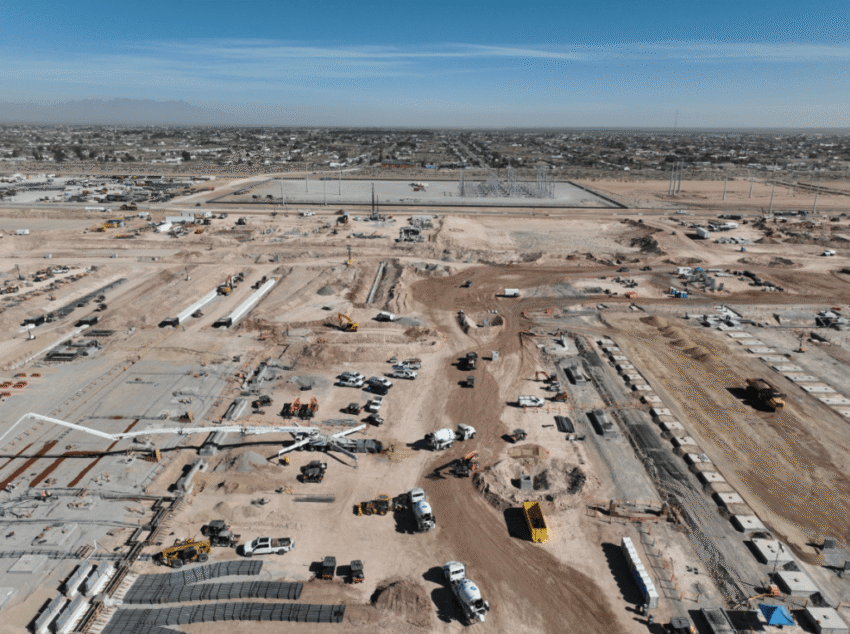

El Paso Electric is signaling that more large-scale artificial intelligence data centers are likely to come to the Borderland over the next three years – and wants them to operate under a set of rules meant to prevent El Pasoans from paying higher electric bills as a result.
Companies including Meta Platforms, Oracle and Open AI are developing hyperscale data center campuses in and around El Paso as the city government is setting up operating policy guides for any future developments. Some see data centers as the future of the region’s economy, while others view them as unsustainable resource hogs.
El Paso Electric earlier this month asked its regulator, the Public Utility Commission of Texas, for permission to set up a special rate specifically for big data centers – a sign the utility anticipates it will provide service to more of the facilities soon.
El Paso Electric “expects to begin serving between 1 and 2 (gigawatts) of new load” under the data center rate in the next three years, the utility said in PUC filings.
The data center rate is structured differently than the rates households and small businesses pay. It also charges data centers exponentially more for electricity consumed during “peak hours” – from 2 p.m. to 7 p.m. during summer months – while electricity use during other hours is far cheaper.
The overarching idea behind the data center rate is to lower the risk El Pasoans face higher bills because of data center development.
The data center rate is “cost-based and not discounted,” El Paso Electric said in a statement. “Cost-based” refers to setting rates to recover whatever it costs to serve a certain customer.
“The impact of service to large, high load factor customers is to shift system costs away for existing customers, including residential and small commercial customers,” the utility said.
Meta’s facility will total 1 gigawatt of electricity demand when fully built out in a couple of years. That means El Paso Electric is indicating it expects to see as much as an additional gigawatt of data center demand by 2029.
The utility said it hasn’t made any formal agreements with new developers or to serve the data center the military plans to build at Fort Bliss. The projection of an additional gigawatt of data center demand is for planning purposes, the utility said in a statement.
In its application to establish a special rate, El Paso Electric said it has been hearing from companies over the last year that want to set up data centers in El Paso.
“The referenced load expectations, in addition to Meta, reflect inquiries from other large customers who would qualify on the proposed tariff,” El Paso Electric said in a statement. “It does not include any expected load for the potential data center at Fort Bliss. It does not reflect the load that EPE has confirmed it must and will serve.”
For reference, El Paso Electric maintains about 2.9 gigawatts of generation capacity across its entire system that serves about 460,000 homes and businesses in West Texas and Southern New Mexico. The highest customer demand the utility has ever seen was about 2.3 gigawatts during the record hot summer of 2023.

Project Jupiter, which will become one of the largest data center campuses in the nation, is under construction in Santa Teresa, New Mexico, and will serve Oracle and OpenAI. That data center will operate on a microgrid that’s isolated from El Paso Electric’s regional power grid. Project Jupiter will require 2.45 gigawatts of electricity to be supplied by fuel cell technology.
However, any data center developer such as Meta that does want to connect to the regional power grid would have to take service under El Paso Electric’s pending “High Load Factor Large Power” tariff.
The PUC still has to officially approve the rate, with a final decision likely sometime late this summer or fall.
Safeguarding utility customers
The utility’s pursuit to develop a special data center rate comes after months of public backlash over data center developments in El Paso, fueled by concerns that data centers will increase household utility bills, guzzle groundwater and produce air pollution.
Utilities should be “making provisions that safeguard utility customers from the impacts of the energy system expansion on their electricity bills,” said Lauren Keeler, an associate professor at Arizona State University who researches sustainability and innovation.
The data center rate contains several binding provisions, such as a 20-year initial contract term – meaning a data center developer has to commit to a multi-decade deal and can’t walk away and stop paying its electric bills without consequence, even if the AI economy shifts in the years ahead.
Other provisions would require data centers to post huge amounts of cash or get a letter of credit from a bank so that if the developer goes out of business or walks away from the data center, El Paso Electric can tap the cash or credit to pay off any stranded infrastructure the utility built to serve the data center.
Without the data center rate, customers would have to pick up that cost – for a substation or even onsite power plant – if the data center stops paying its electric bills.
“There are some fears that maybe all of this demand for data centers could be wrapped up in an AI bubble that doesn’t completely manifest,” Keeler said. “What you really don’t want is an overbuilt energy system with your average household having to foot the bill for too much energy infrastructure over the next 25 years.”

The rate El Paso Electric is seeking to implement mirrors some of the rules the Public Utility Commission wants to impose on data centers throughout Texas that would require developers to pay $50,000 per megawatt of the data center’s demand.
A one-gigawatt facility such as Meta’s would have to put up $50 million in security to advance the project.
“When the data center growth started … there was a learning period for a lot of utilities around the country,” said Javad Mohammadi, an assistant professor of engineering at the University of Texas at Austin. “And now they’re learning what would be the best kind of deal to have with the data centers to support the grid? How could we make sure the ratepayers are not impacted?”
Another provision in the rate El Paso Electric wants to set up would force data centers to pay a minimum amount every month, regardless of electricity usage, and also directly pay for infrastructure the utility has to build to support the data center. For example, Meta paid $192 million for multiple substations built by El Paso Electric for its data center, according to El Paso Electric.
In certain areas of the United States, ratepayers saw higher electric bills shortly after the arrival of AI data centers – particularly for people within the PJM Interconnection, the regional transmission organization that serves 13 states mostly along the East Coast.
In El Paso, however, an El Paso Electric rate increase of about $13 per month that goes into effect this month is backward-looking: It’s meant to collect costs the utility incurred years ago for projects such as the Newman 6 gas-fired power plant.
Data center tradeoffs
Even if El Paso homes and businesses don’t see electric bills increase as a result of data centers, the projects are far from harmless.
The so-called McCloud power plant El Paso Electric is building to serve Meta’s data center is allowed to emit each year 98 tons of carbon monoxide, about 68 tons of nitrogen oxides which cause to ozone pollution and about 47 tons of particulate matter – the small dust particles that can penetrate deep into the lungs and bloodstream.
In El Paso, unpaved roads are the largest source of particulate matter in the air and produced over 9,000 tons of particulate pollution in 2020, according to a review of El Paso’s air basin by the Texas Commission on Environmental Quality published in 2021. Commercial construction produced over 4,500 tons of particulate pollution that year.
SEE ALSO: El Paso leaders approve city’s first climate action plan. What happens now?
However, the McCloud plant would add significantly to point source emissions of particulate matter in El Paso – meaning emissions coming from a stationary source such as a power plant or industrial facility. In 2021, El Paso saw point source particulate matter emission of 471 tons; so 47 tons of annual particulate pollution from McCloud would increase point source particulate emissions in the city by 10%.

Water usage is another question. The water supply agreement between Meta and El Paso Water permits usage of up to 1.5 million gallons of water per day, although El Paso Water’s internal estimates suggest the data center will actually use around 400,000 gallons per day. The McCloud plant will require minimal water, according to El Paso Electric.
In its last fiscal year, El Paso Water supplied 108 million gallons of water to customers per day. The utility has said 400,000 gallons of daily demand is manageable.
But this year, El Paso is expected to see a near-record low amount of water flow through the Rio Grande into the city after a warm winter led to minimal snowpack in the mountains of southern Colorado. That means the city has to pump more of its finite groundwater to meet the gap.
Longer-term, pumping more groundwater to supply data centers could force El Paso Water to accelerate its expensive plan to pipe in groundwater from Dell City at an estimated cost of roughly $1,300 per acre-foot. By contrast, drawing and treating that same amount of water from the river or underground aquifer costs El Paso Water between $250 and $350, according to the utility’s estimates.
Despite the risks of air pollution and excessive water consumption, electricity grid experts increasingly contend data center developments can benefit their host communities. When a massive data center needs a lot of electricity, it forces the local utility to invest in upgrading the power grid that serves everyone.
And utilities recover their fixed costs to maintain the grid by selling electricity. So, if a utility sells more electricity, the cost per unit declines.
“If you have some unused, underused parts of the grid, you add more users, then the cost per user goes down,” said David Spence, a professor of energy law at the University of Texas at Austin. “If there are transmission lines that are underused that will get more fully-used because of the data center being there, then the fixed cost of those lines are spread over more kilowatt hours. And everybody who pays per kilowatt hour pays less.”
Meta’s data center will also become the largest taxpayer in El Paso once fully operational. And El Paso Electric said Meta soon will be absorbing tens of millions of dollars of costs currently paid for by existing ratepayers.
That’s because El Paso Electric has expenses to upkeep the power grid and maintain the system of electricity generation and distribution that it spreads out among all of its customers. When a huge customer such as Meta arrives, it has to pay a share of the utility’s fixed maintenance costs.
“The effect of that is to shift cost of all of our existing customers onto Meta,” said James Schichtl, a vice president for El Paso Electric.
“All of our customers are currently paying for 100% of the cost of our facilities in Texas. When we add this 250 megawatts (to supply Meta), a portion of those costs are then reallocated to Meta,” Schichtl said. “You’re essentially shifting about $40 million from all of our customers to Meta. So, there’s an immediate benefit for existing customers from (Meta) coming to our service territory.”
And if more data centers want to locate in the Borderland, El Paso Electric can force them to agree to conditions, such as dialing back electricity usage if there’s a grid emergency, Mohammadi said.
“If you want to get connected to the grid faster, maybe you are willing to provide some grid support during specific events for a specific period of time,” he said.
“The power system is struggling with underinvestment. And there are a lot of healthy discussions around the country, whether how fast (data centers) should be connected and how we can also leverage the investments from the hyperscalers to improve the resiliency of the grid,” Mohammadi added. “I think if you do this right, there is an opportunity to gain from this.”
The post More data centers could be coming to El Paso. What will that mean for your electric bills? appeared first on El Paso Matters.
Read: Read More