




Never miss an episode. Subscribe to the El Paso Matters Podcast on YouTube, Apple Podcasts or Spotify.
This episode was recorded Oct. 2, 2026.
Read the transcript
Diego Mendoza-Moyers: Today: We ask what’s going on with the El Paso County Sheriff’s office?
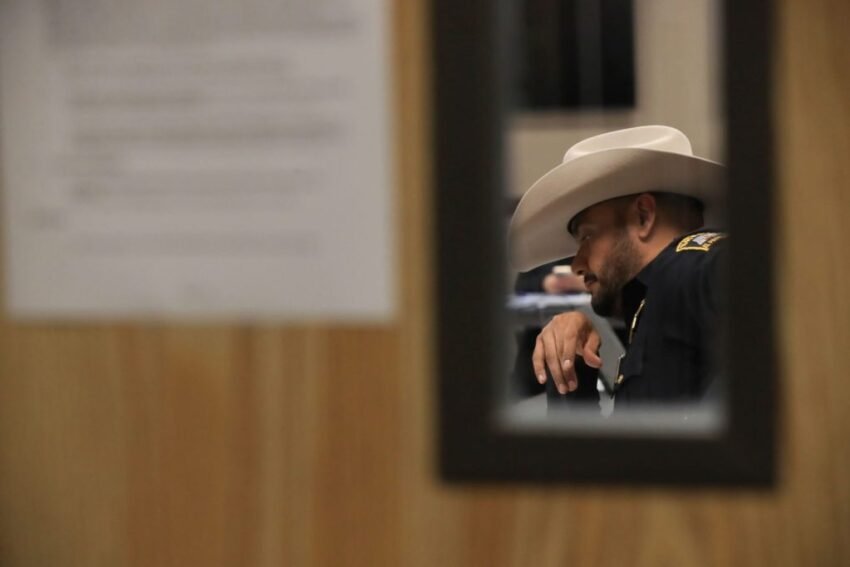
El Paso Sheriff Oscar Ugarte, who was elected in 2024, has faced some heat from county commissioners in recent weeks as the office faces a $6 million budget deficit tied largely to higher-than-expected spending on overtime hours.
How did we get here, though? And how has the Sheriff’s Office responded?
In a moment, El Paso Matters senior reporter Elida Perez will walk us through the financial situation within the El Paso County Sheriff’s Office and how Ugarte is responding.
Before I speak with Elida, this El Paso Matters podcast episode is brought to you by our podcast title sponsor, Tawney, Acosta and Chaparro, truck crash and injury attorneys. Their team of local, seasoned trial attorneys are ready to help if you’ve been injured in a crash.
Also, you can subscribe to the El Paso Matters podcast on YouTube or read our free reporting at elpasomatters.org. And many thanks to El Paso Community College Valle Verde Campus for the use of their podcast studio space.
Now, on to our conversation.
Elida, always good to be with you to chat city and county issues here.
Elida Perez: Yeah, thank you for having me.
Diego: So, I’ll just give you the million-dollar question here, I suppose. Why is the El Paso County Sheriff’s Office experiencing a multi-million-dollar budget deficit this year?
Elida: So, the simple answer is that they have been using overtime to pay for positions that they felt were needed at the county jails.
So, since Ugarte took office, he asked his command staff what they felt they needed at the two jails, the Downtown jail and the annex. And, so, he, basically, started staffing some of those positions that weren’t being funded prior – or, I don’t know that they weren’t being funded, but there were only so many officers per position in the jails doing various duties, right?
So, based on what his command staff said, he added positions to fill those gaps where they felt they needed coverage for safety purposes, for safety of the inmates, safety of the detention officers and everything. But since the county hasn’t authorized new staff positions for any departments over the last couple of fiscal years, the sheriff started to, in essence, fund those with overtime pay. So that, in the first fiscal year, started to grow.
So, he got in in 2025, January 2025. But in January, in 2026, the county commissioners and the budget staff started to raise a little more attention to it because they were just seeing this inordinate increase. And they were, like, “Wait a minute. Like, we’re almost halfway through the budget and it’s February.”
So, they started to have presentations and, like, say “We need to meet with the sheriff and figure out what’s going on.” But the very short answer is that Ugarte felt they needed more staffing for certain positions in the jails and they covered it with overtime costs.
Diego: OK. So, I appreciate that explanation. But I guess my next question is how did we get here, right? To the point where our sheriff felt the need to provide all these additional positions and spend all this money on staffing at the jail?
And part of the question is the county jails have been the same for years, right? And the same – ostensibly – the same requirements for staff and everything that goes into operating a jail. In my mind, I don’t know why that would have changed, right, from prior sheriff administrations. And, so, what’s driving this need for additional overtime spending at the jails?
Elida: Well, the ongoing question, right, is, “What is the need?” Because the jail population has actually declined over the last several years, about 10%.
So, as the jail population is decreasing, this increase in overtime spending is occurring to, seemingly, make up for this gap in staffing that the sheriff’s office says exists. So, ultimately, it’s – the thing that changed the most is the new administration, right?
Because, under the prior administration, they were staying within their overtime budget. They weren’t violating any state standards for staffing or anything of that nature. The one difference is that when Ugarte took office, he asked his command staff what they want, what they needed as far as jail staffing. And, so, he made it happen. But he made it happen with overtime.
Diego: So, do you think that the jail was just massively understaffed prior to Ugarte coming into office?
Elida: I think that’s part of the lingering issue, right? Because Sheriff Ugarte says that they are understaffed. If you look at their staffing tables, if you look at just the numbers, then they don’t appear to be understaffed.
So, there’s this pending staffing study that both the sheriff asked for and the county is willing to provide or hire a firm to do so that they can get down to the bottom of whether or not there is, in fact, a staffing shortage.
But from the Sheriff’s Office perspective, there is a staffing shortage. From the county’s perspective, there is no staffing shortage. And, so, until that study is done, that’s kind of the rock and the hard place, where they are.
Diego: Interesting. And we should mention – I mean, I said at the top that Ugarte entered office in 2024 fairly recently as a Democrat, was pretty heavily backed by our Congresswoman, Veronica Escobar. And, so, I guess there were questions about his experience prior to coming into office. But just interesting that sort of that disagreement and the perspective – I wouldn’t think that’s, like, subjective of, “Is the county staffed or the jail staffed properly or not?”
But can you share a little bit more about how – what Ugarte is saying in response to this? I know there was a little bit of drama maybe between the county commissioners, like, summoning Ugarte and he didn’t show up at first, right? Just kind of walk us through this, the last few weeks of their sort of correspondences.
Elida: Yeah. So, back in April, they called for a special meeting to sit down with the sheriff and talk about this overtime issue.
At that time, they sent a letter – a very detailed letter. We’ve shared it, and one of my stories has the actual letter that they sent with what they want him to do, in essence.
The trick is that the County Commissioners Court can’t control how the sheriff manages his department because he’s an elected official. What they can control is the money. So, that’s kind of where that is. So, they sent a letter asking him to immediately stop any unplanned overtime, bring us information, like, detailed information. “We want to know who’s getting the overtime, what they’re doing during these overtime shifts.” That kind of stuff. And several other things that they wanted him to address. Also, to come to commissioners court meetings to talk about these expenditures and this and that.
So, that happened in April, and he hadn’t been to any commissioners court meetings at all since then. A couple of weeks ago, as we were getting closer to the budget adoption in mid-September, his command staff would start to come and talk about the jail overtime. But Ugarte himself had not appeared.
So, when they adopted the budget, they also reiterated, “Hey, where are these action items that we requested from the Sheriff’s Office? So, we need to resend that letter. We need to not approve any further overtime in this budget.” They’re going to set aside a contingency fund. And if (Ugarte) needs overtime, he needs to come and ask for that budget transfer. Like, you can’t just go and just spend and “We’ll talk about it later,” right?
Diego: Says, “Oops, I went over budget.”
Elida: Yeah. So, those were some of the things that were put in place.
Now, the following week from that kind of, like, “OK, this is where we’re at, we want you to come back,” all this stuff, Ugarte apparently had already had planned to travel to a law enforcement training conference. So, he didn’t physically show up to commissioners court. He Zoomed in, if you will, or whatever they use.
And, so, there was a lot of public backlash on that because they were like, “He doesn’t respect the court, he should have been there.” Apparently, the commissioners court knew he was going to be out of town. And, so, they were aware that he was going to be on video.
So, I think it was just the optics that didn’t sit well with the community, because there were a lot of people that were commenting publicly and blog posts and all this about, like, “He’s not respecting them” and whatnot.
He did – he has shown up the last couple of meetings though, and they have been trying to work through some of this stuff. Publicly, the commissioners court and the sheriff during these meetings aren’t having outright clashes and “Why are you doing this?” They’re being very diplomatic about the whole situation. My guess is that there’s probably some underlying stress and frustration because this is a big financial problem. But they’re doing a very good job at being diplomatic, and they are saying that they’re trying to work together and all that. And, so, that’s kind of where things are.

Diego: Yeah. And I know that there’s – you mentioned this staffing study that will take place, which I want to ask about. But has Ugarte argued, like, is he protecting members of the Sheriff’s Office from burnout or something like that? You know what I mean? Is that the source of this overtime, all these hours, from his perspective?
Elida: Yeah. So, from our prior interviews and stuff like that, that’s part of it, right? Because to work in a detention facility is extremely stressful. So, they’re long shifts. It’s very stressful work. For him, it’s not only trying to alleviate that burnout, but also making sure that everybody’s covered, right?
So, some of the things that he had done was to, for example, have two detention officers, like, in the kitchen area, for example, when, I guess, they’re prepping meals or what have you. Prior to that, it was just one officer keeping an eye on all of the trustees in that kitchen area. So, you can imagine, if you’re a detention officer and you’re in a kitchen with I’m not sure how many trustees are in there at a time cooking meals, but you could see where there could be a potential danger when they’re handling utensils, possibly knives, boiling water, this kind of thing, where it would be less stressful if there’s somebody else watching your back while you observe what’s going on.
So, things like this and also, like, delivering medication to the inmates. There has to be somebody walking through with that person, these kinds of things. So, he was adding people to make sure that everybody – that nobody was getting burnt out and that there was an extra layer of safety there, from what I understand.
Diego: Yeah, that’s kind of an interesting example, I guess, of the kitchen. What is the impact to the county’s financial situation if the Sheriff’s Office is millions of dollars over budget, right? I mean, is that – is it “Hey, we’ve got to have increased taxes” or something? Or is it less of a dramatic impact, I guess?
Elida: Well, I think it’s going to eventually, if it continues, right, then there probably will be an impact to taxpayers. Because, I mean, the county itself is already in a financial situation over the last few years where they’ve barely been able to work back in pay raises for county employees. They had made some prior cuts to reduce the budget, to adopt a lower tax rate, to kind of minimize the impact on taxpayers.
But those kinds of things are never sustainable for a government. We see it with the city. The county budget staff was saying, “We can’t continue to do things like tap into reserves.” They’ve done that over the past couple fiscal years as well. So, I mean, you’re looking at either having to dip into reserves or take money from somewhere else to cover this additional cost. Like the money just doesn’t appear out of nowhere.
Diego: Yeah. And back to the study you mentioned, which again, refers to, like, a staffing assessment of the jails to see is it understaffed? Is it adequately staffed? What’s the situation?
What’s the timeline for that? I mean, are we talking a year, three months? Any idea?
Elida: It’s still a bit of an unknown because they did agree to it. So, the county did set aside some funding for it. I think, total, it’s about $1 million, about $300,000 for the study itself. And then the extra money would help go towards implementing whatever recommendations may come of it.
But I have yet to see – and maybe I missed it. I’m not perfect, right? I’ve yet to see when it’s going to actually occur and how long it’s going to take to complete the study. And I really can’t even say that I know that they’ve said publicly who’s going to conduct this study. So, it’s still a question mark there.
Diego: Yeah, very preliminary. It’s not like we’re going to get an answer on whether the staffing levels are –
Elida: It will not be overnight.
Diego: Yeah. And then, so looking forward, right, has the Sheriff’s Office laid out, like, “Hey, here’s what we’ll do next fiscal year to try to avoid this budget deficit.” How is the Sheriff’s Office explained how they’re going to mitigate the excessive spending by the office?
Elida: Well, it’s still a work in progress. They’ve said they’re going to really try to remain within the budget, but haven’t outright promised “We are not going to over spend on overtime when it comes to the jails.”
Now, that being said, Ugarte did have one of his command staff come in to see if he could find some ways for him to come – a different set of eyes on it, right? So, let me take a quick look here because I don’t want to get his name incorrect.
Diego: That’s good journalism right there.
Elida: Yeah. So, Commander Ruben Soraya, he’s from the patrol division. So, Ugarte had him come into the jails, get a good look at the staffing and how they were staffing the positions and everything and the schedules, if you will, and see if they could make some cuts within a reasonable, safe approach, if you will.
And he, in fact, did make some changes. What I think is interesting is that what he presented to the commissioners court on Monday kind of looks like the way staffing was prior to Sheriff Ugarte taking office. So – and I’ll pull it up as well because I don’t want to, it’s a lot of details here.
So, for example, these are some of the personnel reallocations that they made. So, with the jail annex in the kitchen that I was talking to you about before, so, they reduced the positions from two officers back to one. In the clinic, they reduced from two officers back to one. Information area, I guess, from two officers to one. So, there were a lot of – to me, it looks like a lot of places where it looked like Ugarte wanted that additional staff for that extra security are now back to the way it was before.
So, Commander Soraya said that cut overtime by about 40 (percent), in the 40 to 45 (percent) range for both the detention center downtown and the annex. What he did not say is how much money that actually saved. So, they’re going to have to bring that figure back because it’s great to say, “Oh, yeah, we cut it by almost half.” Well, what does that mean financially?
So, we’ll still see what that impact is, but I thought it was really interesting that some of these changes that I heard kind of looked like they just went right back to the way it was before.
Diego: It sounds like maybe Ugarte’s ambitions or desires for staffing were met with the reality of the county’s financial situation?
Elida: Perhaps, yeah. And I think he was open to having somebody else come in and say, “Well, let’s get a fresh set of eyes on it.” It’s not like he’s opposed to it. So, it’s a very interesting dynamic and a very interesting situation that’s unfolding.
Diego: Yeah. Especially, again, like, fairly early in Ugarte’s tenure – not early, it’s two years in already, but it’s not like the previous sheriff that served for many years and it seemed like probably had a rapport with the county commissioners. But, to your point, I thought it was interesting you said that there’s not some sort of at least public rift between the sheriff and county commissioners court.
Elida: Right, yeah.
Diego: And just one more thing before I let you go, Elida. I just want to touch on how, at the same time that this is happening and the county’s trying to figure the situation out with the Sheriff’s Office, the County Commissioners Court – which is again, I’ll remind listeners like the city council of the county, essentially – the composition of the commissioners court is going to change a good deal.
There’s usually four commissioners and one county judge. I’m curious if you could just talk briefly about the county judge race, which you just covered. We also have two outgoing county commissioners, David Stout, as well as Sergio Coronado, who will both be replaced. Those elections are coming up next month. And so, I guess it’ll be curious to see how a new commissioners court next year sort of handles the situation with the sheriff and if there’s a different approach, I guess.
But just talk a little bit about that, the changing court and, in particular, the county judge race.
Elida: Yeah. So, elections are hard to predict. I mean, sometimes when you’ve covered elections for so many years, you can kind of see the writing on the wall. But you just never know. There’s a lot of factors going on right now. When we look at the commissioners court precincts that were, in essence, two incumbents ousted in the primaries. That’s not usual.
Diego: Especially Stout, who served for, like, 10 years or something like that.
Elida: Yeah. I mean, it’s really not usual. So that plays into the county judge race, right? Because, while El Paso is traditionally a Democratic-voting county, is there an anti-incumbent vibe going to be at the polls with voters? You just never know.
So, County Judge Samaniego, he’ll be facing Republican opponent Minerva Torres Shelton. She’s got the law enforcement background, was former FBI, former El Paso police officer. So, we just don’t know how it’ll play out.
If El Pasoans hold true to form, the Democratic seat stays as is. If there’s that shift where there’s kind of an anti-incumbent sentiment lingering in the air or at the polls with voters, then who knows? Like, there may be a Republican county judge, who knows?
But there definitely will be a change in the dynamics because anytime – I mean, we already know there’s going to be two new county commissioners. Anytime there’s a shift like that, in essence, almost half, right? You’ll just have to see how things play out. Like, maybe they’re going to come in with a hard stance on “We want more results. We’re not going to be approving any extra overtime. We’re not going to do A, B or C.” Then that could impact how things are going financially with the sheriff’s office budget.
So, it’s going to be interesting to see how it plays out because let’s say Minerva Torres Shelton does win the seat. So, then you’re going to have more than half of the commissioners court, like, brand new individuals. So, in that instance, anything can happen. Torres Shelton has already talked about how she’s not necessarily happy, if you will, with the sheriff’s office spending. So, we’ll see how all that goes.
Now, I cannot say that I’m 100% sure on where the candidates stand with the sheriff’s office for the other precinct chairs. I’ve been kind of tied up with my own races, so I need to educate myself. Precinct, well, the commissioner of Coronado’s seat is my precinct, so I need to know who to vote for as well, right? But, yeah, it’ll be interesting to see.
Diego: Yeah. I guess that’s a good example of, like, voting matters, right? Which is a cliche, right? But just that this is where voters, I feel like you can really make an impact where you see these headlines of, “Oh, this certain management choice by this department head” or, in this case, obviously the sheriff overtime spending. I think it’s kind of an interesting example of people can see that during an off-election year and they complain or whatever, have some concern. But this is an opportunity, I feel like, in a month where you really could change the course of county commissioners and sort of their priorities and how they handle this kind of situation with the sheriff’s office spending going forward.
So, yeah, it’ll just be interesting to see if we see a shakeup, anti-incumbency. Like you said, I think David Stout and Sergio Coronado were victims of that. And, so, we’ll see how some of the other city council races and the county judge and so forth, if they face a similar backlash from people complaining about affordability and so forth, if that hurts the incumbents. But, anyways.
Elida: It’s just a very active election cycle. So, it will be interesting to see how it plays out, especially because it can have those long-lasting impacts on taxpayers. And it’s like you said, people complain. The only way to at least be able to complain solidly is by casting that vote.
Diego: Exactly, yeah. So, anyway, we’ll have to see how the County Commissioners Court goes and maybe we’ll have you back on to see what’s going on with the Sheriff’s Office, if they get the spending in line or what.
But, anyways, we’ll leave it there, Elida. I always appreciate your insights into the city and county government. I like, whenever there’s a story that piques my interest about some goings on, I’m just like “Elida, come join me.” So, I always appreciate it.
Elida: I’m happy to be here.
Diego: Thanks.
The post Podcast: Why is El Paso County’s sheriff facing a budget deficit? appeared first on El Paso Matters.
Read: Read More