



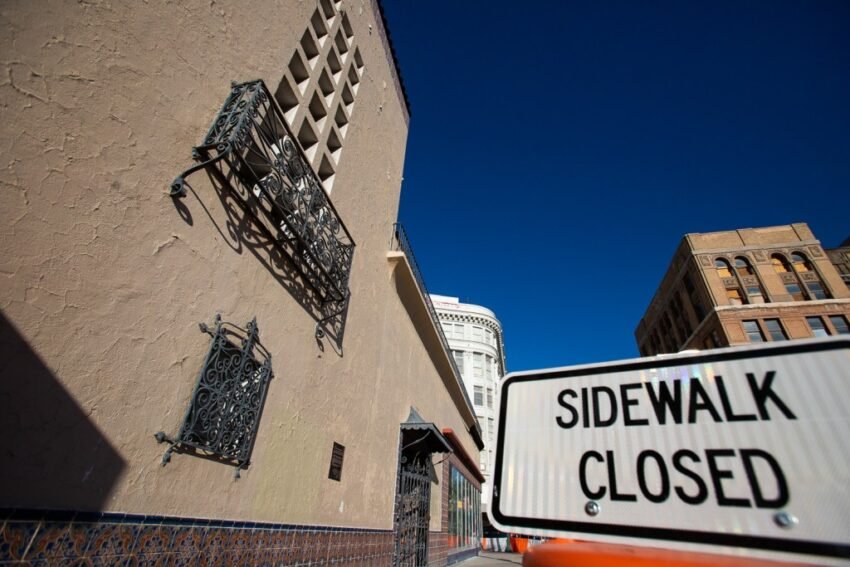

The El Paso City Council wants Downtown buildings that are at least two stories high to be inspected by the city’s Code Enforcement Department after pieces of eaves fell last month from a vacant building at the site of the historic Acme Saloon at Mesa Street and San Antonio Avenue.
The incident, where the debris hit a pedestrian who had to be hospitalized, was the third this year where pieces of Downtown building facades have fallen, raising concerns among city leaders, community members and some business owners about the safety and conditions of buildings in the area.
The City Council in late October voted unanimously to create a plan for Code Enforcement to inspect multi-story buildings within the Downtown Management District and planning area – and to start by inspecting eight properties this fall while the longer-term proposal is developed.

The city doesn’t set a routine inspection schedule for the interior or exterior of older buildings, but Code Enforcement conducts periodic exterior inspections, Steve Alvarado, who heads the department, told El Paso Matters. The department also does not inspect the interior of properties unless a safety violation has been reported, he added.
Without violation reports, interior inspections would be difficult to conduct because city policy states that staff need permission to enter private properties. Even with more rigorous inspections, the bigger question may be who’ll bear the cost – taxpayers or property owners.

“This is a very unique ask of my department – the unique challenge, I think, is going into a building that nobody’s reported any specific violation on,” Alvarado said.
Alvarado said staff will have to work with other city departments and create a task force for the undertaking. Staff can conduct preliminary visual assessments, but entry requires permission or a judge-approved writ supported by probable cause.
There are about eight inspectors on Alvarado’s team and about 700 buildings within the Downtown Management District – about 300 are at least two stories high.
In 2022, part of the roof of the De Soto Hotel at 309 E. Mills Ave. collapsed during a four-alarm fire. No injuries were reported, but safety concerns remain as the building is more than 100 years old. But El Paso has not experienced a collapse on the scale of the Nov. 11 disaster in Brooklyn, which killed eight people, including two children, and injured 18, or the June 2021 collapse of Champlain Towers South in Surfside, Florida, which killed 98 people.
The city for now has identified eight Downtown properties to be inspected by the end of the month. Five of the eight buildings were previously owned by William “Billy” Abraham, who lost ownership of many historic Downtown El Paso buildings in bankruptcy auctions, including the historic Caples building at 300 E. San Antonio Ave. built in 1911, and the Krupp building at 117 W. Overland Ave. built in 1916.

Some Downtown property owners welcome the inspections, but have raised concerns about what buildings are being targeted and unknown costs that may arise.
“It’s hard to know what the costs would be involved in that, but because it would vary greatly by building, and I would think that city manager and staff are going to have to develop some sort of matrix of requirements and standards that they’re going to apply to this evaluation,” Bill Helm, founder of the Insitu Architecture firm based in Downtown, told El Paso Matters.
The building at 112 Texas Ave., which is about 100 years old, is adjacent to the former Acme Saloon building at 227 E. San Antonio Ave., which itself was rebuilt in 1910 and at one time housed the popular Lerner Department Store. The original building is most known as the site where notorious gunfighter John Wesley Hardin was shot and killed in 1895.

Helm said debris has sometimes fallen off Downtown buildings due to neglect.
“From my perspective as an architect, it’s work that really needs to be done because you need to preserve the life, safety and welfare of the public around buildings. That’s our charge when we’re designing a building or renovation is to protect the life, safety, and welfare of the public who use a building, so then, therefore, it’s incumbent upon a building owner to do the same,” Helm said.
Stan Okies, owner of the 116-year-old, single-story building at 502 N. Oregon St., said it is not a bad idea for property owners to have their buildings inspected for safety issues, but warned that it could be costly.
“It depends on how the city approaches that (enforcement) if they’re going to be stringent and close everything down on the building because of some minor code violation, that in their opinion, doesn’t pass muster … that could be a problem,” Okies said.
Alvarado said city inspectors need permission from property owners to enter the buildings unless they are able to get a writ of entry, or inspection warrant, approved by a magistrate or municipal judge.
City staff has until Dec. 11 to develop a feasibility plan outlining recommendations to address identified hazards, including a way to require property owners to pay for inspections by qualified professionals depending on the results of a city safety inspection.

Owners of properties that require corrective measures would then have 30 days to make the repairs, unless they get an extension approved by the city.
Tanny Berg, president and co-founder of the El Paso Central Business Association, acknowledges some empty Downtown buildings have proven to have safety issues. But, he said, inspections should be conducted on buildings citywide.
“It should not be in one particular area, and two, it should be with the idea of working with a private-public partnership to get things done in a way that makes sense and that is in the best interest of the community at large,” Berg said.
“There are individual structures throughout the city that we, as a community, should be mindful of, and that we should do whatever we can to make them not a risk for the community at large,” he added.

Joe Gudenrath, executive director of the Downtown Management District, said the entity’s board welcomes building inspections.
“(We) have long been advocates for consistent and constant code enforcement across the Downtown,” Gudenrath said.
Gudenrath said the DMD regularly sees potential code violations such as unsecured properties, broken windows, unpermitted signage and signage and awnings that may potentially collapse and fall.
“I do believe that there are obvious code violations within sight of the street that could be addressed and should be addressed,” Gudenrath said.
The post The city wants broader Downtown building inspections. Here’s what could get in the way appeared first on El Paso Matters.
Read: Read More